

%201.svg)


A completed risk assessment doesn't have to use any particular form, but it does have to capture certain information. The hazards. Who could be harmed. The controls in place. Any further action needed, with owners and deadlines. The review date. The format is up to the employer; the content is set by regulation 3 of the Management of Health and Safety at Work Regulations 1999.
This page sets out three worked risk assessment examples — for an office, a small warehouse and a construction site — showing what each section of a completed assessment looks like in practice. The examples are illustrative rather than universal: every workplace is different, and a template completed without site-specific judgement is not a defensible assessment.
For the underlying method and the legal framework, see our introduction to risk assessment. The five-step process and the risk matrix provide the methodology behind everything that follows.
What a completed assessment looks like
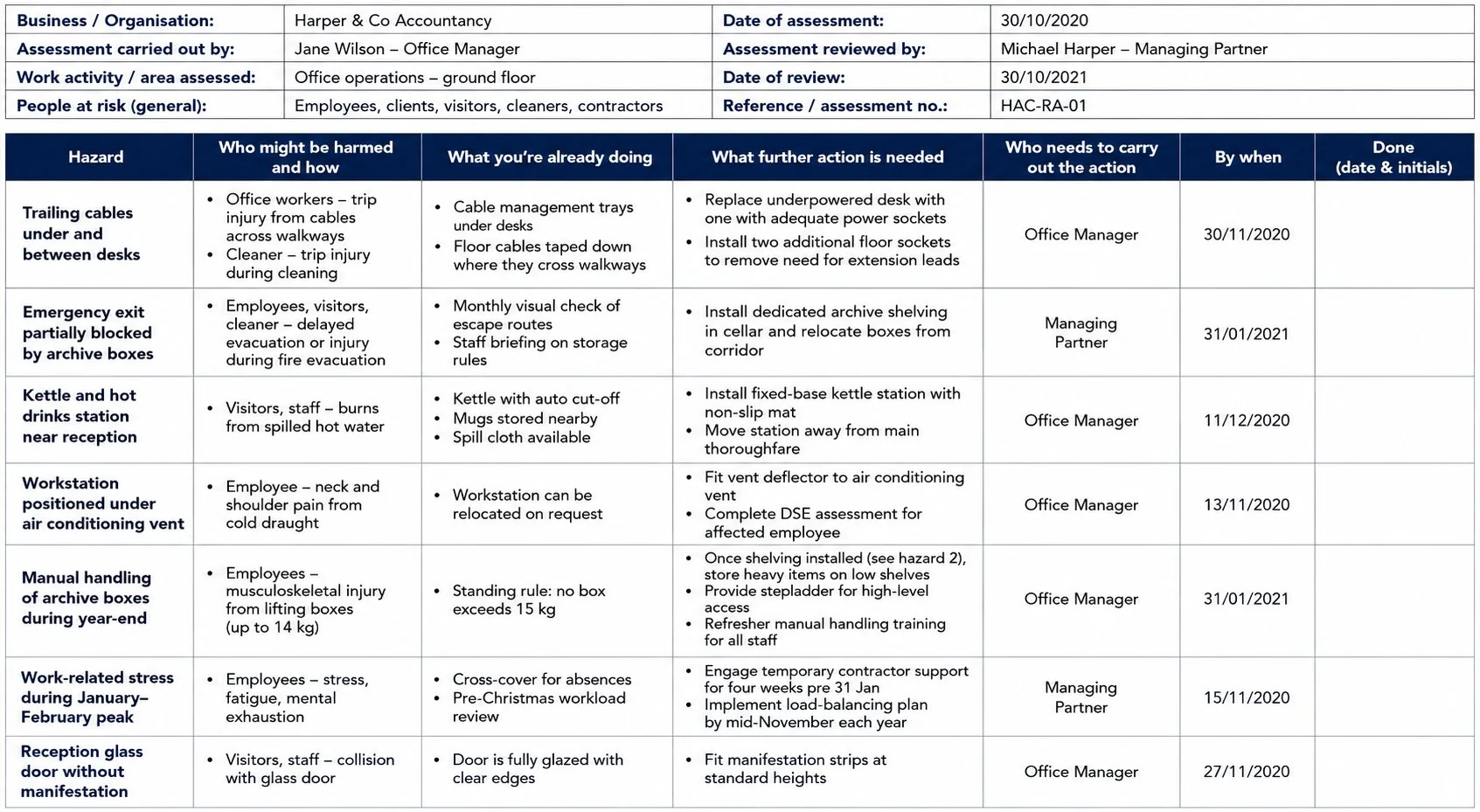
The standard structure used in UK workplaces follows the Health and Safety Executive's published template, which has seven columns:
Hazard
A specific description of what could cause harm. Not a category ("electrical safety") but a specific hazard ("damaged cables under desks").
Who might be harmed and how
Named groups, not just "staff" — and a specific harm mechanism. "Office workers — trip injury from cable across walkway" rather than "people might trip".
What you're already doing
The controls currently in place. Cable management, training, signage, equipment standards.
What further action is needed
What still needs to change. This is the action list that turns an assessment into improvements.
Who needs to carry out the action
A specific person, by role or by name. Not "management".
By when
A specific date. Not "ASAP" or "soon".
Done
A space for sign-off when the action has been completed.
The HSE template is freely available, but any structure that captures the same information satisfies the recording duty under regulation 3. Many organisations use spreadsheets or dedicated H&S software; some still use paper. The format matters less than the underlying discipline of identifying hazards, recording controls, assigning actions and following up.
Worked example one: small accountancy practice
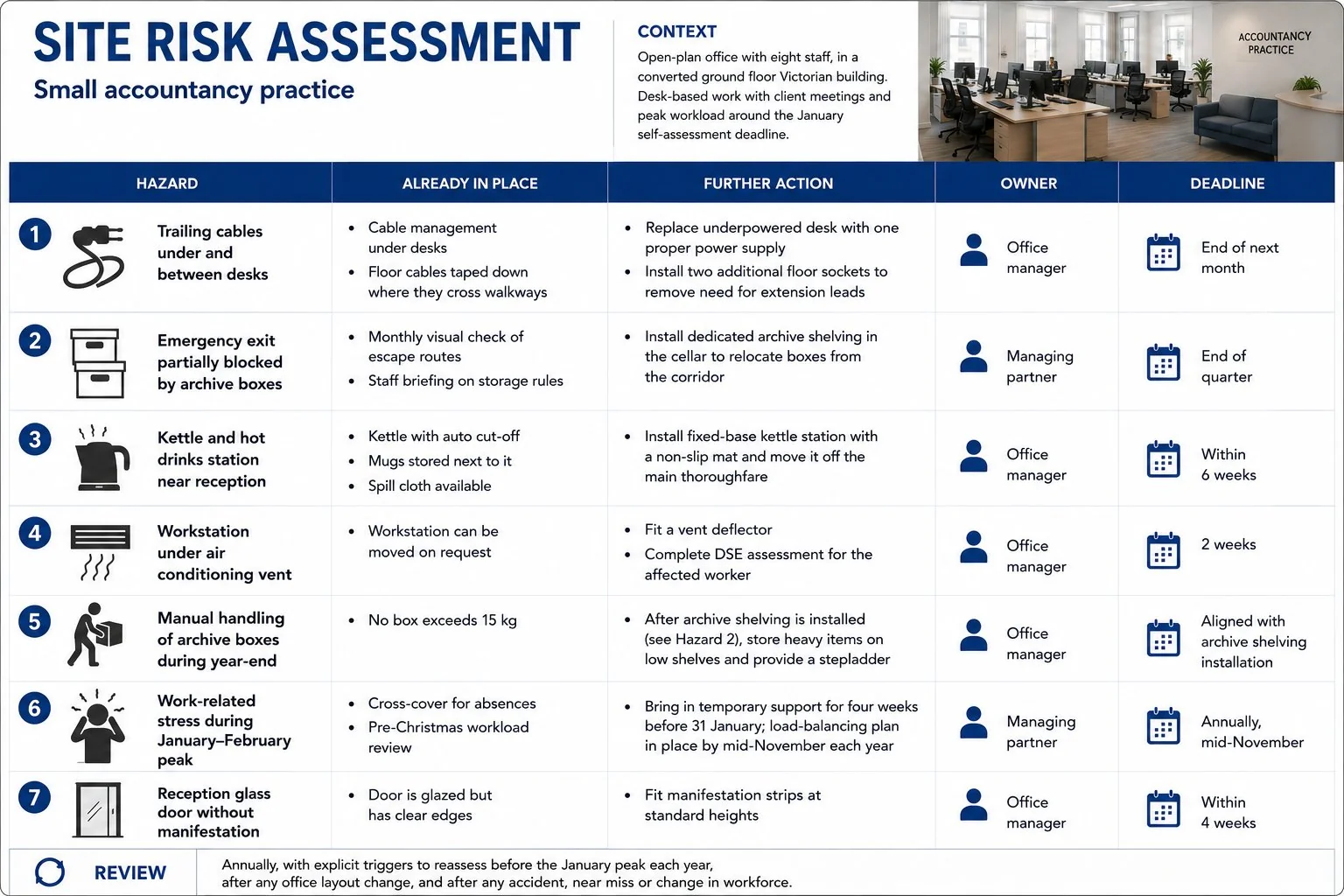
The context is an open-plan office with eight staff, occupying a converted ground floor in a Victorian high-street building. The work is desk-based with occasional client meetings on the premises and substantial peak workload around the January self-assessment deadline.
Hazard 1: Trailing cables under and between desks
Office workers and the cleaner could trip on cables in walkways, causing sprains, bruises or worse if they fall against furniture. Already in place: cable management under desks, a standing rule that floor cables are taped down where they cross walkways. Further action: replace one underpowered desk that has been the source of repeated power-strip workarounds, and install two additional floor sockets to eliminate the need for extension leads from the wall. Owner: office manager. Deadline: end of next month.
Hazard 2: Emergency exit partially blocked by archive boxes
Office workers, visitors and the cleaner could be delayed or injured in an evacuation if the secondary exit is obstructed. Already in place: monthly visual check of escape routes; staff briefing on storage rules. Further action: install dedicated archive shelving in the cellar to permanently relocate boxes from the corridor. Owner: managing partner. Deadline: end of quarter.
Hazard 3: Kettle and hot drinks station near reception
Visitors and staff could suffer burns from spilled hot water; the kettle's variable position has caused near-misses. Already in place: kettle with auto cut-off; mugs stored next to it; spill cloth available. Further action: install fixed-base kettle station with a non-slip mat and move the station off the main thoroughfare. Owner: office manager. Deadline: within 6 weeks.
Hazard 4: Workstation positioned directly under air conditioning vent
One member of staff experiencing repeated neck and shoulder pain; cold draught suspected as a contributing factor. Already in place: workstation can be moved on request. Further action: fit a vent deflector and complete a DSE assessment for the affected worker. Owner: office manager. Deadline: 2 weeks.
Hazard 5: Manual handling of archive boxes during year-end
Staff lifting boxes onto and off high shelves, with awkward postures and weights up to about 14 kg per box. Already in place: standing rule that no box exceeds 15 kg. Further action: when the dedicated archive shelving is installed (see Hazard 2), heavy items will be stored on low shelves and a stepladder will be available for accessing higher items. See our manual handling page for the underlying assessment framework. Owner: office manager. Deadline: aligned with archive shelving installation.
Hazard 6: Work-related stress during January–February peak
Sustained excessive hours and tight client deadlines associated with self-assessment season. Already in place: cross-cover for absences; pre-Christmas workload review. Further action: bring in temporary support from a contractor for the four weeks before the 31 January deadline, with a documented load-balancing plan in place by mid-November each year. The stress risk assessment page covers the broader framework. Owner: managing partner. Deadline: annually, mid-November.
Hazard 7: Reception glass door without manifestation
Visitors and staff could walk into the door, particularly if approaching from the back-lit side. Already in place: door is glazed but the doorway has clear edges. Further action: fit manifestation strips at standard heights. Owner: office manager. Deadline: within 4 weeks.
Review
Annually, with explicit triggers to reassess before the January peak each year, after any office layout change, and after any accident, near miss or change in workforce.
This assessment takes an experienced manager half a working day, produces a defensible two-page document, and identifies a useful set of practical actions.
Worked example two: small warehouse and distribution unit
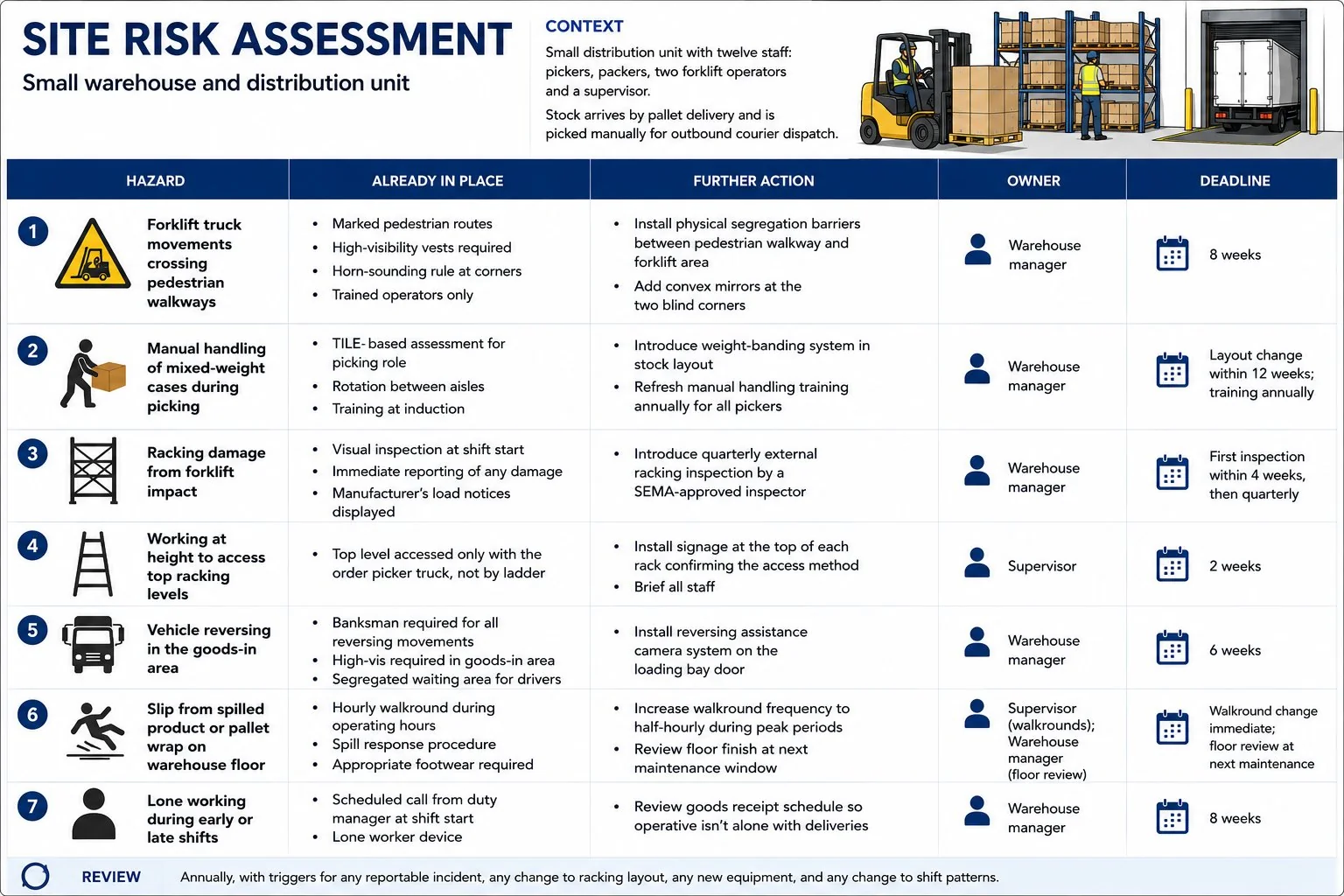
The context is a small distribution unit with twelve staff: pickers, packers, two forklift operators and a supervisor. Stock arrives by pallet delivery and is picked manually for outbound courier dispatch.
Hazard 1: Forklift truck movements crossing pedestrian walkways
All staff and visiting drivers could be struck by a forklift in the loading area. Already in place: marked pedestrian routes; high-visibility vests required; horn-sounding rule at corners; trained operators only. Further action: install physical segregation barriers between the main pedestrian walkway and the forklift operating area; add convex mirrors at the two blind corners. Owner: warehouse manager. Deadline: 8 weeks.
Hazard 2: Manual handling of mixed-weight cases during picking
Pickers lifting cases up to 18 kg, in repetitive movements, with twisting and reaching. Already in place: TILE-based assessment for the picking role; rotation between aisles; training at induction. Further action: introduce a weight-banding system in the stock layout so heavier items are stored at waist height and lighter items at high or low levels; refresh manual handling training annually for all pickers. See our manual handling page for the assessment framework. Owner: warehouse manager. Deadline: layout change within 12 weeks; training annually.
Hazard 3: Racking damage from forklift impact
Staff working near or under racking that could collapse if structural damage is undetected. Already in place: visual inspection at shift start; immediate reporting of any damage; manufacturer's load notices displayed. Further action: introduce a quarterly external racking inspection by a SEMA-approved inspector. Owner: warehouse manager. Deadline: first inspection within 4 weeks, then quarterly.
Hazard 4: Working at height to access top racking levels
Picker accessing top shelves using a manual stepladder. Already in place: standing instruction that the top level is accessed only with the order picker truck, not by ladder. Further action: install signage at the top of each rack confirming the access method; brief all staff. Owner: supervisor. Deadline: 2 weeks. See our working at height page for the underlying framework.
Hazard 5: Vehicle reversing in the goods-in area
Delivery drivers reversing into the bay, with risk of striking staff or other vehicles. Already in place: banksman required for all reversing movements; high-vis required for anyone in the goods-in area; segregated waiting area for drivers during unloading. Further action: install a reversing assistance camera system on the loading bay door. Owner: warehouse manager. Deadline: 6 weeks.
Hazard 6: Slip from spilled product or pallet wrap on warehouse floor
Staff could slip and fall, with risk of musculoskeletal injury. Already in place: hourly walkround during operating hours; spill response procedure; appropriate footwear required. Further action: increase walkround frequency to half-hourly during peak picking periods; review whether the current floor finish needs replacement during the next maintenance window. Owner: supervisor (walkrounds); warehouse manager (floor review). Deadline: walkround change immediate; floor review at next maintenance.
Hazard 7: Lone working during early or late shifts
Goods receipt operative working alone for the first 90 minutes of each shift before the rest of the team arrives. Already in place: scheduled call from the duty manager at shift start; lone worker device. Further action: review whether the goods receipt schedule can be adjusted so that the operative isn't alone with deliveries. See our lone working page for the framework. Owner: warehouse manager. Deadline: 8 weeks.
Review
Annually, with triggers for any reportable incident, any change to racking layout, any new equipment, and any change to shift patterns.
Worked example three: small construction site
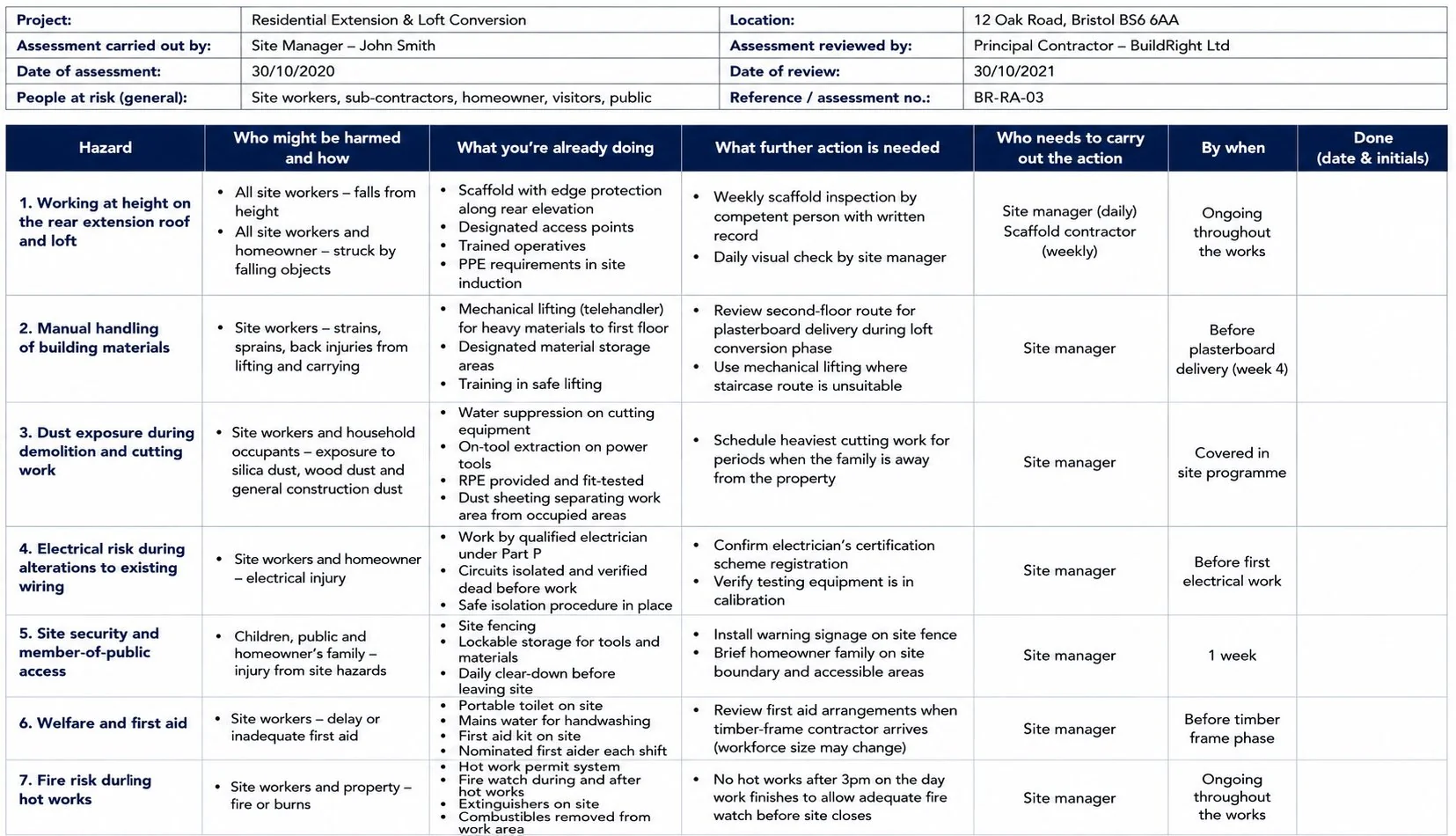
The context is a residential extension and loft conversion, with a principal contractor and three sub-contractors on site at varying times. The job is notifiable under the Construction (Design and Management) Regulations 2015 and has a Construction Phase Plan in place. The site risk assessment summarised below sits alongside specific RAMS documents for individual high-risk tasks.
Hazard 1: Working at height on the rear extension roof and loft
All site workers and the homeowner could be injured by falls from height or falls of objects. Already in place: scaffold with edge protection along the rear elevation; designated access points; trained operatives; PPE requirements documented in site induction. Further action: weekly scaffold inspection by competent person with written record; daily visual check by site manager. See our working at height page for the underlying framework. Owner: site manager (daily) and scaffold contractor (weekly). Deadline: ongoing throughout the works.
Hazard 2: Manual handling of building materials
Workers lifting and carrying timber, plasterboard, insulation and tools, often in restricted spaces. Already in place: mechanical lifting (telehandler) for heavy materials to first floor; designated material storage areas; training in safe lifting. Further action: review the second-floor route for plasterboard delivery during the loft conversion phase, with a view to mechanical lifting where the staircase route is unsuitable. Owner: site manager. Deadline: before plasterboard delivery for loft conversion (week 4).
Hazard 3: Dust exposure during demolition and cutting work
Workers and household occupants could be exposed to silica dust during masonry cutting, wood dust during carpentry, and general construction dust. Already in place: water suppression on cutting equipment; on-tool extraction on power tools; RPE provided and fit-tested; dust sheeting separating the work area from the occupied parts of the house. Further action: schedule the heaviest cutting work for periods when the family is away from the property. See our COSHH page for the framework. Owner: site manager. Deadline: covered in site programme.
Hazard 4: Electrical risk during alterations to existing wiring
Workers and the homeowner could suffer electrical injury during alterations to the consumer unit and existing circuits. Already in place: electrical work carried out only by qualified electrician working under Part P; circuits isolated and verified dead before work; safe isolation procedure in place. Further action: confirm certification scheme registration of the electrician and verify the testing equipment is in calibration. Owner: site manager. Deadline: before first electrical work.
Hazard 5: Site security and member-of-public access
Children, members of the public and the homeowner's family could enter the work area outside working hours, encountering open trenches, materials and tools. Already in place: site fencing; lockable storage for tools and materials; daily clear-down before leaving site. Further action: install warning signage on the site fence; brief the homeowner family on the site boundary and what's accessible to them. Owner: site manager. Deadline: 1 week.
Hazard 6: Welfare and first aid
Workers could lack basic welfare provision and first aid in the event of injury. Already in place: portable toilet on site; mains water connection for handwashing; first aid kit; nominated first aider on each shift. Further action: review the first aid arrangements when the timber-frame contractor arrives — their work could change the first aider requirement. Owner: site manager. Deadline: before timber frame phase.
Hazard 7: Fire risk during hot works
Workers and the property could be at risk during welding, brazing or torch-on roofing work. Already in place: hot work permit system; fire watch during and after hot works; extinguishers on site; combustibles removed from work area. See our fire risk assessment page for the framework. Further action: ensure no hot works after 3pm on the day work finishes to allow adequate fire watch period before site closes. Owner: site manager. Deadline: ongoing throughout the works.
Review
Weekly review by site manager; comprehensive review at each phase transition; immediate review after any incident, near miss or change to the programme.
Where to find HSE's official examples
The HSE publishes free risk assessment examples covering a range of common workplace types — offices, kitchens, food retail, vehicle repair, hairdressing, cleaning, manufacturing, leisure, healthcare and others. The examples illustrate the HSE's expected style and content and are the most authoritative starting point for any workplace working out what a "suitable and sufficient" assessment looks like in their sector.
The HSE template is also free to download in the same place, in a format that's straightforward to adapt for any workplace. We don't recommend buying a template — the HSE's are good enough and they have the advantage of reflecting what HSE inspectors expect to see.
Common errors in completed assessments
Five patterns appear in assessments that have been challenged in inspections or civil claims.
Generic hazards without site-specific detail
"Slips, trips and falls" as a hazard, without saying what specifically causes the risk in this workplace. The assessment looks compliant but doesn't help anyone fix the problem.
Vague actions and vague ownership
"Improve housekeeping" assigned to "management" by "ASAP". An action that can't be checked has effectively not been assigned.
No evidence of consultation with workers
The people doing the work usually know where the risks sit. An assessment written without speaking to them tends to miss the practical issues.
Controls that don't actually exist
The assessment claims controls are in place that aren't really there — the training that nobody attends, the inspection that never happens, the procedure that nobody reads. This is the most exposed position to be in: the document records the employer's knowledge of the hazard but doesn't reflect what's actually being done.
No review
An assessment that's three years old, written before the current layout, current equipment or current staff, isn't a current assessment.
Where this connects in the cluster
These examples illustrate the general method. The vertical pages — fire, legionella, COSHH, manual handling, DSE, stress, lone working, working at height, working from home, pregnancy, young persons — cover the specific assessment frameworks for particular categories of hazard.
For workplaces building in-house competence in carrying out and reviewing assessments, formal Risk Assessment Training provides the methodological foundation and the qualification framework that supports defensible practice.
Frequently asked questions
Where can I get a free risk assessment template?
The HSE publishes a free template alongside its example assessments on the HSE website. The template captures the seven standard columns and is in a format that's easy to adapt for any workplace.
Does HSE provide example assessments?
Yes. The HSE publishes example completed assessments for several common workplace types. These are illustrative rather than universal — a template completed without site-specific judgement isn't a defensible assessment — but they're a good reference for what HSE inspectors expect to see.
Does a risk assessment have to be on a specific form?
No. The format is up to the employer. The content is set by regulation 3 of the Management of Health and Safety at Work Regulations 1999: significant findings must be recorded, including the hazards, who's at risk, the controls and any further action needed. Any structure that captures this satisfies the recording duty.
Can I use the same template for every workplace?
The template can be the same; the content has to be specific. A template completed identically for two different workplaces is unlikely to be suitable and sufficient for either — the assessment has to reflect the actual hazards, the actual workforce and the actual controls in each place.