

%201.svg)


A working from home risk assessment is a structured examination of the hazards faced by workers carrying out their work from home, and a decision about the controls and equipment needed to keep them safe. The duty applies to anyone working from home, whether full-time, hybrid or occasionally, and it has been part of UK health and safety law for far longer than the post-pandemic shift in working patterns.
The legal framework is the same general framework that applies to any workplace — the Health and Safety at Work etc. Act 1974 and the Management of Health and Safety at Work Regulations 1999, supported by the Display Screen Equipment Regulations 1992 (extended to home workstations by the 2002 amendment). The duty to assess and control risk doesn't transfer to the worker just because the workplace is their home.
This page covers what employers need to assess for home and hybrid workers, the boundaries of the duty, and the practical approach most employers take.
Why home working still requires assessment
The Health and Safety at Work etc. Act 1974 doesn't have geographical limits. An employer's duty to ensure the health and safety of workers applies wherever those workers are carrying out work for the employer. The fact that the worker has chosen to work from home, or that the employer has agreed to home or hybrid working, doesn't extinguish the duty.
What does change is the practical execution. The employer can't walk through a home workstation in the same way they can walk through an office. They don't control the building, the furniture or the environment. They can't unilaterally redesign the worker's home. These are real constraints, but they don't remove the duty — they shape how it's met.
The HSE has been clear in its guidance that the duty applies to home workers and to hybrid workers, that the assessment can usually be carried out using a structured self-assessment supported by employer review, and that the employer remains responsible for the outcome.
The legal framework
Several pieces of legislation interact for home working.
The general workplace risk assessment under regulation 3 of the Management of Health and Safety at Work Regulations 1999 applies. The home workstation is a workplace for the duration of the work, and the foreseeable risks have to be assessed.
The Display Screen Equipment Regulations 1992 — as amended by the Health and Safety (Miscellaneous Amendments) Regulations 2002 — apply to home DSE users. The DSE assessment requirement covers home workstations as fully as office ones.
The Employment Rights Act 1996, as amended by the Employment Relations (Flexible Working) Act 2023, gives qualifying workers the right to request flexible working from day one of employment. The framework doesn't impose home working on employers, but it shapes the contractual basis on which much hybrid working is now structured. Where flexible working has been agreed, the H&S duty follows the agreed working pattern.
The Equality Act 2010 applies as it would in any workplace. Workers with disabilities may be entitled to reasonable adjustments to their home workstation under the same framework that would apply to an office workstation.
Self-assessment vs employer assessment
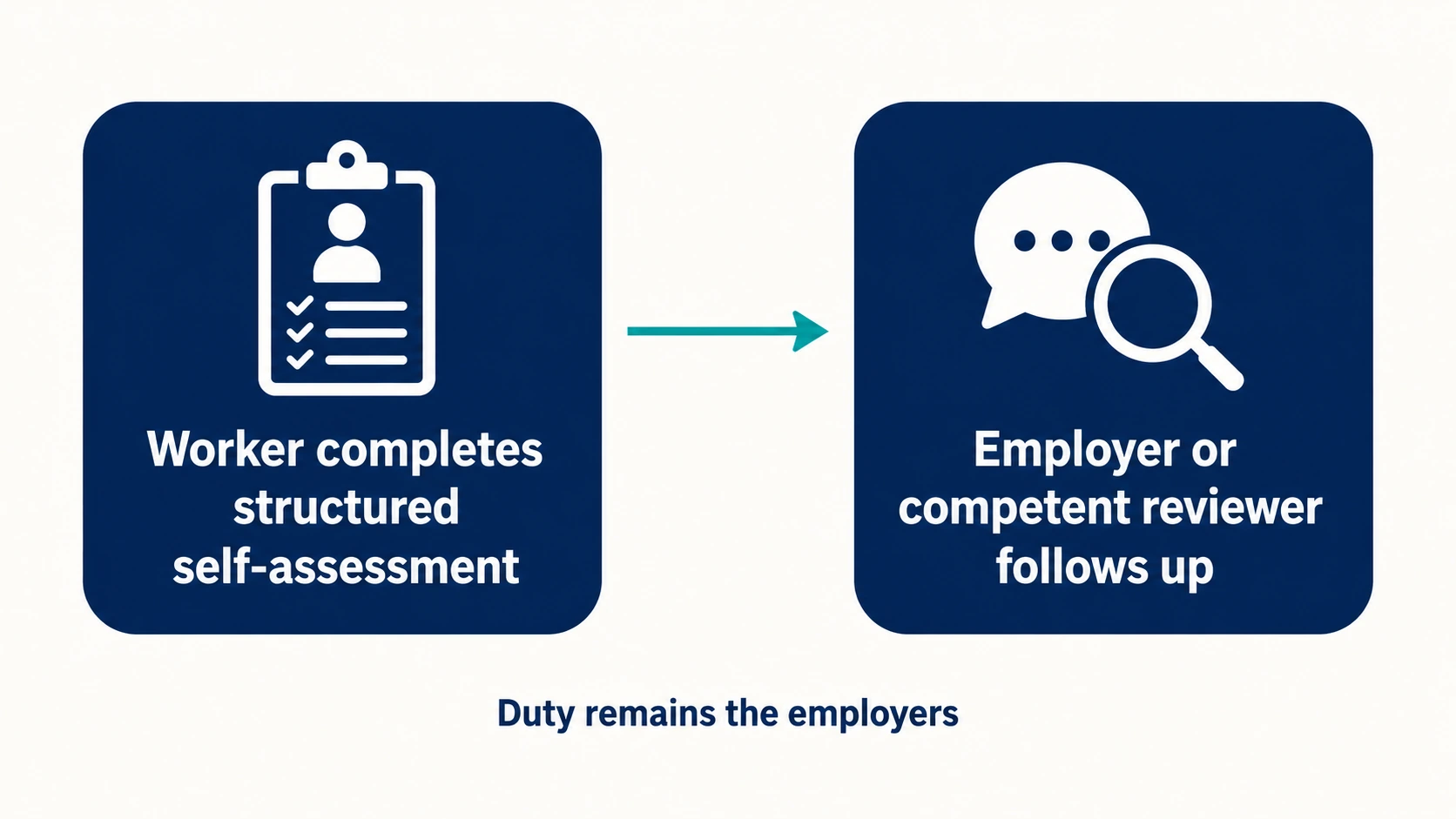
The pragmatic approach most UK employers take is a two-step process.
The worker completes a structured self-assessment of their home workstation. This typically uses a checklist covering the chair, desk, screen, keyboard, lighting, environment, electrical safety, fire safety, and any specific concerns the worker has. The HSE publishes a DSE self-assessment checklist that's widely used as the basis for tailored employer versions.
The employer (or a competent reviewer on the employer's behalf) reviews the self-assessment, identifies any concerns, and follows up where issues are identified. The follow-up might be a remote video call, a request for photographs, or in some cases an in-home visit by an ergonomics specialist.
This two-step approach satisfies the duty for the vast majority of home workers. It also produces a documentary trail — the completed self-assessment, the employer's response, any actions taken and the date — that demonstrates the duty has been met.
The self-assessment shouldn't be treated as the end of the process. The worker may not know what to flag; the employer's review is what turns a checklist into an assessment.
DSE for home workers
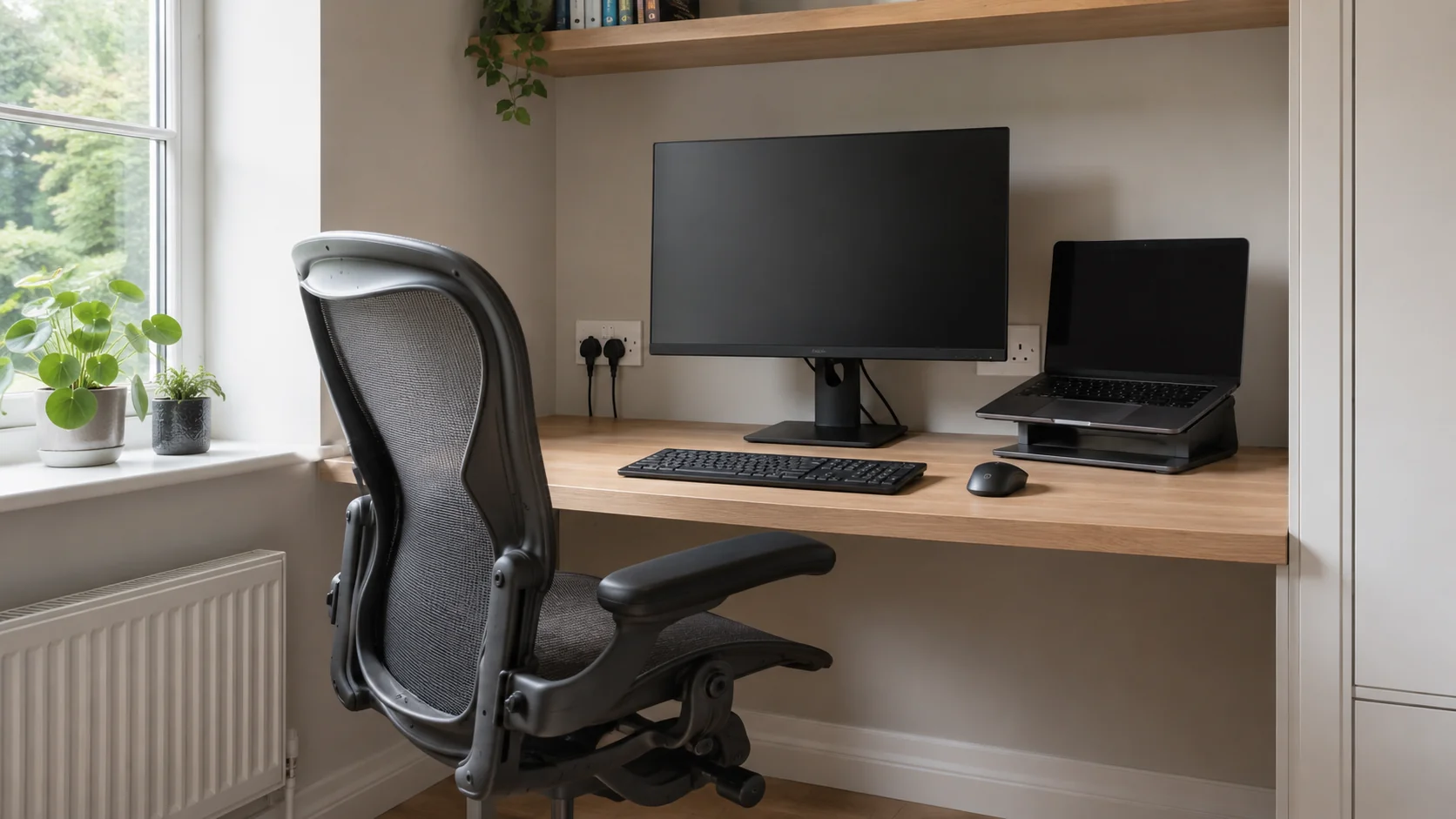
For office-based home workers, the DSE risk assessment is usually the largest single component of the home working duty. The standard issues — chair height and support, screen height and distance, keyboard position, lighting, breaks — apply as much at home as in the office.
Where home equipment doesn't meet the standards required by the DSE regulations, the employer is responsible for ensuring it does. In practice this typically means supplying or contributing to specific items: an adjustable chair, an external monitor, a separate keyboard and mouse (essential where the worker is using a laptop), a footrest if needed, and improved lighting where the home set-up is inadequate.
The regulations don't require the employer to fund the worker's home office in totality. The duty is to ensure the workstation meets the regulatory standards — which usually means contributing to specific items rather than redesigning the whole space.
Mental health and isolation
Home working introduces specific risks to mental health that office working doesn't. Isolation from colleagues, blurred boundaries between work and home, longer working hours through erosion of the commute as a natural endpoint, and reduced informal support are all recognised contributors to work-related stress in home workers.
These risks sit within the stress risk assessment duty and within the HSE's Working Minds framework. Specific measures for home workers include structured contact patterns, defined working hours, manager training in recognising and supporting remote staff, attention to workload calibration, and explicit permission for workers to maintain boundaries between work and personal time.
There's also a lone working dimension. A home worker is, by definition, working without colleagues physically present. For most office workers this isn't materially different from the working pattern they'd have in a busy office, but for workers who would have had significant peer support in person, the home setting can amount to lone working in everything but name.
Equipment, fire and electrical safety
The home workstation is a workplace under UK law, but the home itself remains the worker's domestic premises. The interaction between these is sometimes awkward.
Electrical safety
Equipment supplied by the employer to the home should be PAT-tested or otherwise verified as safe in line with the employer's general electrical safety policy. Equipment owned by the worker that's used for work — the worker's own desk lamp, extension lead, or laptop charger — is not directly controlled by the employer, but the assessment should consider whether the equipment in use is safe, and where electrical concerns are identified the employer may need to supply alternatives.
Fire safety
The employer's duty under the Regulatory Reform (Fire Safety) Order 2005 doesn't extend inside a single private dwelling. The fire safety of the home itself is the householder's responsibility. What the employer can do — and what most do — is provide basic fire safety information, encourage the worker to test smoke alarms and to keep escape routes clear, and consider whether any work activities (printing equipment, storage of paper records) introduce specific risks.
Equipment
Where the employer supplies equipment for home use, ongoing maintenance and replacement remain the employer's responsibility. Where the worker uses their own equipment, the assessment should consider whether that's safe and suitable for the work.
Children and pets
This is rarely covered in templates but matters in practice. Trailing cables to a workstation in a family home can be a hazard to a toddler or a pet that wouldn't exist in an office. The assessment should consider the realistic home environment, not a stylised office-at-home.
Hybrid workers and two workstations
For hybrid workers — those who split time between home and a workplace — the duty covers both workstations.
A worker who spends two days a week at home and three in the office has two workplaces, both of which need to satisfy the H&S duty. The office workstation is typically a controlled, standardised environment. The home workstation needs its own assessment using the self-assessment-and-review process.
Hybrid workers also face a specific risk pattern that doesn't apply to either pure home or pure office workers: the daily setup-and-pack-down of a temporary workstation. A worker who clears the kitchen table each morning to set up a laptop and then dismantles it before dinner is using a workstation that probably doesn't meet DSE standards on most measures. The assessment should address this realistically — either by providing equipment that supports a more permanent home setup, by accepting that the home days are reduced-intensity DSE work, or by adjusting the work pattern.
Review triggers
Review of the home working assessment is required when the working pattern changes (a shift from occasional home working to regular home working, or vice versa), when the worker reports discomfort, when significant equipment changes, or when the home circumstances change (a move, a substantial renovation, a change in household composition that affects the working environment).
A periodic refresh — typically annual — is good practice, particularly for full-time home workers whose conditions can drift over time. We cover the broader review framework on our how often a risk assessment should be reviewed page.
Where this connects in the cluster
Working from home risk assessment sits at the intersection of DSE, stress, lone working and the general workplace assessment under regulation 3. For most office-based home workers, the DSE element is the bulk of the assessment; the stress and lone working dimensions need explicit consideration alongside.
For employers with significant home or hybrid working populations, building competence in home working assessment is a sensible investment. Formal Risk Assessment Training covers the general method that underpins the home working duty.
Frequently asked questions
Does my employer have to assess my home workstation?
Yes. The duty to assess and ensure a suitable workstation applies wherever the work is carried out. For home workers this is typically met through a structured self-assessment that the worker completes and the employer reviews, with follow-up action where issues are identified.
Who pays for home working equipment?
The employer is responsible for ensuring the workstation meets the regulatory standards. In practice this usually means supplying or contributing to specific items — chair, monitor, separate keyboard and mouse, footrest — rather than funding the worker's home office in totality. The detail is often set out in the employer's home working policy.
Do hybrid workers need two assessments?
Yes — one for each workstation. A worker splitting time between home and office has two workplaces, both of which need to satisfy the H&S duty.
What about my home Wi-Fi, fire safety, and other home conditions?
The employer's duty doesn't extend to the home in general — fire safety inside a single private dwelling, for example, sits outside the Regulatory Reform (Fire Safety) Order 2005. What the employer is responsible for is the work activity and the workstation. Practical employers go further and provide general home safety information, encourage workers to test their smoke alarms, and supply equipment that doesn't introduce new hazards into the home.
Has the duty changed since the pandemic?
The legal framework hasn't changed materially. The Display Screen Equipment Regulations have applied to home workstations since the 2002 amendment, and the general workplace assessment duty has always applied wherever work is carried out. What has changed is the scale of home working — and the practical attention employers now give to a duty that was previously easier to overlook.