


%201.svg)


A stress risk assessment is a structured examination of the working conditions that could cause harm to mental health, and a decision about what to do about them. It's a legal duty for every UK employer under the same general framework that requires assessment of any other workplace hazard. Many employers treat stress as a wellbeing topic — the territory of EAPs, mindfulness apps and resilience training — but the legal framing matters: stress is a health and safety risk, and it's assessed under the same statutory duties as any physical hazard.
The HSE's approach to stress risk assessment is built around six "Management Standards" — areas of work design where mismanagement reliably produces ill health. This page covers the legal duty, the six standards, the distinction between organisational and individual stress risk assessment, and the Equality Act considerations that competitor guidance routinely misses.
Stress as a health and safety risk
The HSE defines work-related stress as the adverse reaction people have to excessive pressures or demands placed on them at work. The reaction is normal under short-term pressure. It becomes a workplace health risk when the pressure is sustained over time or when the individual lacks the resources to cope with it. Sustained work-related stress can produce anxiety and depression, contributes to musculoskeletal disorders through tension and posture changes, and is associated with cardiovascular and metabolic ill-health.
In its most recent annual statistics — for 2024/25 — the HSE reported that 964,000 workers in Great Britain experienced work-related stress, depression or anxiety, representing roughly half of all reported work-related ill health. The associated estimated 22.1 million working days lost made stress-related conditions the largest single cause of work-related ill-health time loss. These figures are accredited official statistics published by the HSE in November 2025.
The legal framing isn't a presentational choice. It changes what the employer is required to do. Wellbeing initiatives are voluntary; risk assessment under the Management of Health and Safety at Work Regulations 1999 is not. An organisation that runs a wellbeing programme but doesn't carry out a stress risk assessment isn't satisfying the legal duty.
The legal framework
The duty arises from the general framework. Section 2 of the Health and Safety at Work etc. Act 1974 requires every employer to ensure the health, safety and welfare at work of their employees so far as is reasonably practicable. Regulation 3 of the Management of Health and Safety at Work Regulations 1999 requires a suitable and sufficient assessment of all foreseeable risks — including risks to mental health.
The HSE has been clear, in its statements and in enforcement guidance, that work-related stress sits squarely within this duty. The HSE's Working Minds campaign — launched in 2021 and still its current active campaign — exists in part to communicate this position to UK employers who still treat stress as outside the H&S framework.
Where stress relates to a disability, pregnancy, or another protected characteristic, the Equality Act 2010 adds a parallel duty: reasonable adjustments. We come back to this below.
The six Management Standards
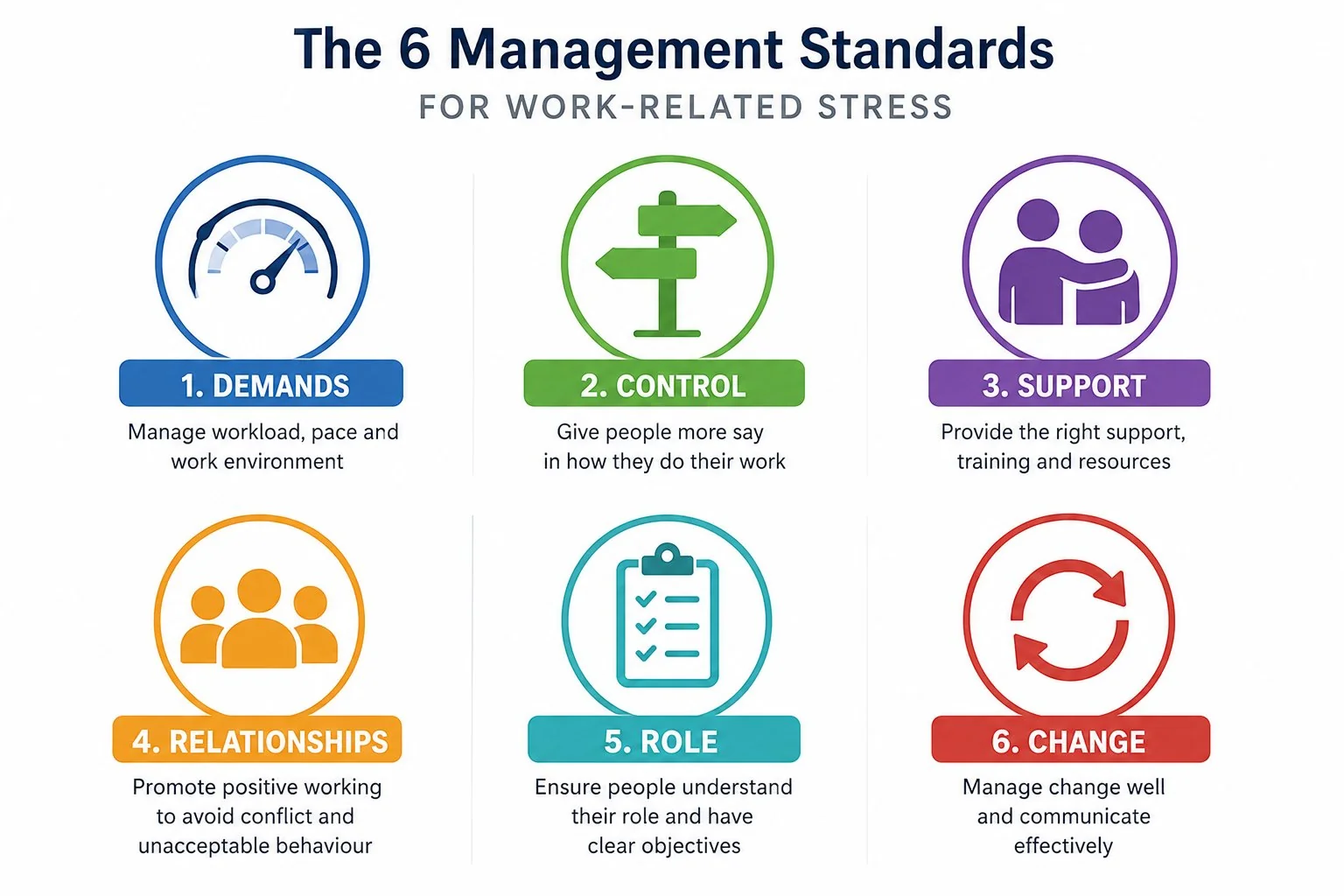
The HSE Management Standards were developed in the early 2000s as a structured framework for assessing organisational stress risk. They identify six areas of work design where evidence consistently shows poor management produces ill health. The standards are deliberately broad — they're factors of work design, not symptoms of stress — and they're meant to direct the assessment toward causes rather than effects.
Demands
The workload itself: the volume of work, the pace, the deadlines, the variety of tasks, the physical environment in which the work is done. The risk is that workers face demands they don't have the resources to meet, sustained over time. Indicators of poor management include unrealistic deadlines, frequent overtime that becomes routine, and work that requires capabilities the worker doesn't have.
Control
How much autonomy a worker has over how they do their job. The risk is that workers are required to follow procedures and timetables in detail without scope to adjust the work to their own pace, sequence or method. Evidence shows that work demands are much more tolerable when workers have meaningful control; the same demands without control are reliably stressful.
Support
The encouragement, sponsorship, training, equipment, supervision and colleague backing that workers need to do their jobs. The standard covers support from the organisation as a whole, from line management, and from peers. Inadequate support — by any of these — is a reliable producer of work-related ill health.
Relationships
Whether workplace relationships are constructive or destructive. The standard covers conflict, bullying, harassment, unacceptable behaviour, and the broader culture of how people treat each other at work. Where the organisation tolerates poor behaviour or fails to address grievances, sustained interpersonal pressure becomes a major stress risk.
Role
Whether workers understand what they're expected to do, whether their roles conflict with each other, and whether they're asked to do things they consider improper. Role ambiguity, role conflict and role overload are reliable contributors to stress-related ill-health and are areas where management action is straightforward when the problems are identified.
Change
How organisational change is managed and communicated. The risk isn't change itself — workplaces change constantly — it's change that's poorly communicated, abrupt, contradictory, or imposed without consultation. Restructures, redundancy programmes, technology transitions and changes in management style are all common triggers.
A useful test of any stress risk assessment is to look at it for evidence that all six standards have been considered. Assessments that focus heavily on Demands and ignore Relationships, or that cover Support thoroughly but skip Change, aren't suitable and sufficient.
Individual vs organisational stress risk assessment
The distinction is important and routinely blurred in competitor content. There are two separate but related assessments.
An organisational stress risk assessment is the assessment of the workplace as a whole. It identifies the working conditions across the six Management Standards, decides whether they're producing acceptable levels of risk, and sets out the actions needed to reduce that risk. The HSE's Management Standards Indicator Tool — a validated 35-item survey questionnaire — is the recognised method for doing this. The tool is distributed to staff (typically with assurance of anonymity), the results are analysed by management standard, and the assessment identifies the areas needing action.
An individual stress risk assessment is the assessment carried out for a specific worker whose mental health is at risk — usually triggered by signs of distress, a return from sick leave related to stress, or a worker raising concerns directly. The individual assessment covers the specific pressures that worker is facing, what's working and what isn't, and what reasonable adjustments to working conditions could reduce their personal risk.
The two assessments answer different questions. Organisational assessment asks what in our work design is producing stress across the workforce? Individual assessment asks what in this person's specific situation needs to change?
Most employers need both. The organisational assessment identifies the systemic issues — a department with persistent unrealistic demands, a team with unresolved conflict, a function in the middle of poorly managed change. The individual assessments address the human consequences for specific workers who are already affected.
Organisations that rely entirely on individual assessments end up firefighting cases without ever addressing the conditions that produce them. Organisations that rely entirely on the organisational assessment fail individual workers who need specific changes now.
The Working Minds campaign and the 5 Rs
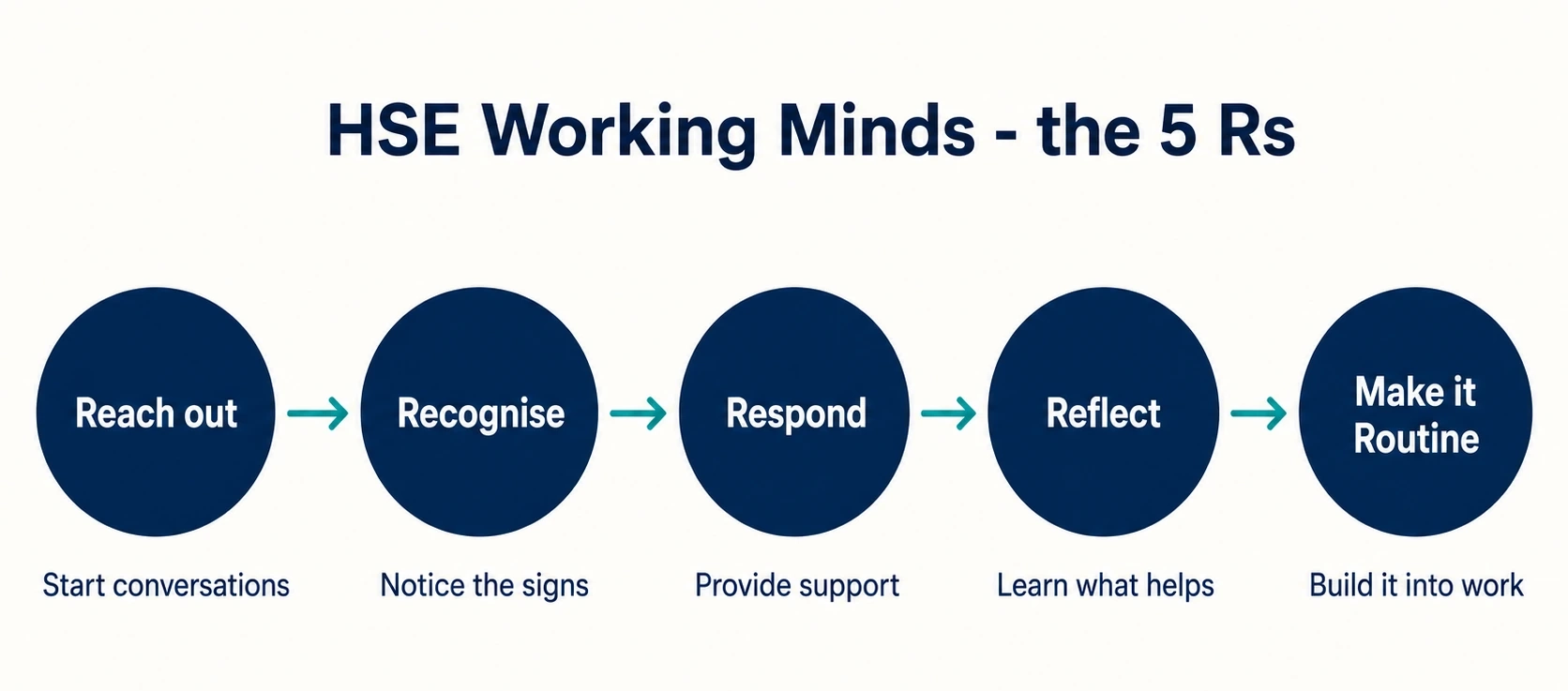
The HSE's Working Minds campaign supports employers in carrying out stress risk assessment in practice. Its core framework is the 5 Rs:
Reach out
Start conversations with workers about workplace pressures. This is the precondition for assessment — without dialogue, the assessor doesn't have the information needed to identify the actual stressors.
Recognise
Spot the signs of work-related stress in individuals and the indicators of poor work design at organisational level. Signs in individuals include changes in performance, withdrawal, irritability, increased absence, and changes in physical health. Indicators at organisational level include rising sickness rates, declining engagement scores, turnover patterns and recurring grievances.
Respond
Agree actions with the workers affected and with the wider team. Responses span the spectrum from individual adjustments (workload reduction, role clarification, additional support) to systemic changes (redesigning a process, recruiting additional capacity, restructuring management arrangements).
Reflect
Review what's working and what isn't. Stress interventions need to be evaluated; an action that looks good on paper but doesn't change conditions for the workers affected needs revisiting.
Make it Routine
Build stress prevention into how the organisation operates day-to-day, rather than reacting after problems emerge. This is what distinguishes mature stress risk management from event-driven case work.
The 5 Rs are a practical complement to the Management Standards. The Standards identify the dimensions to assess; the 5 Rs describe the process for translating assessment into action.
The Equality Act overlap
This is where competitor guidance routinely falls short. Where work-related stress relates to a disability — and persistent mental ill health can itself be a disability under the Equality Act 2010 — the employer's duty is no longer only about reasonable practicability under health and safety law. It's also about reasonable adjustments under the Equality Act.
The two duties interact in practical ways. A worker returning from a period of sick leave for stress-related depression may have a disability for Equality Act purposes. The employer's reasonable adjustments duty is then engaged: changes to working hours, workload, supervision arrangements, or physical workspace may be required, and failure to provide them can amount to disability discrimination, not just a breach of health and safety law.
Pregnancy is similarly covered: pregnancy and maternity are protected characteristics, and pregnancy-related stress is one of the areas where the pregnancy risk assessment duty intersects with the stress assessment duty.
The practical implication is that individual stress risk assessment in a case involving disability, pregnancy or another protected characteristic should be carried out with the Equality Act framework in mind, not just the H&S framework. The reasonable adjustments duty is generally more demanding than the reasonably-practicable duty — and the legal exposure if it's missed is materially greater.
Sector hot spots
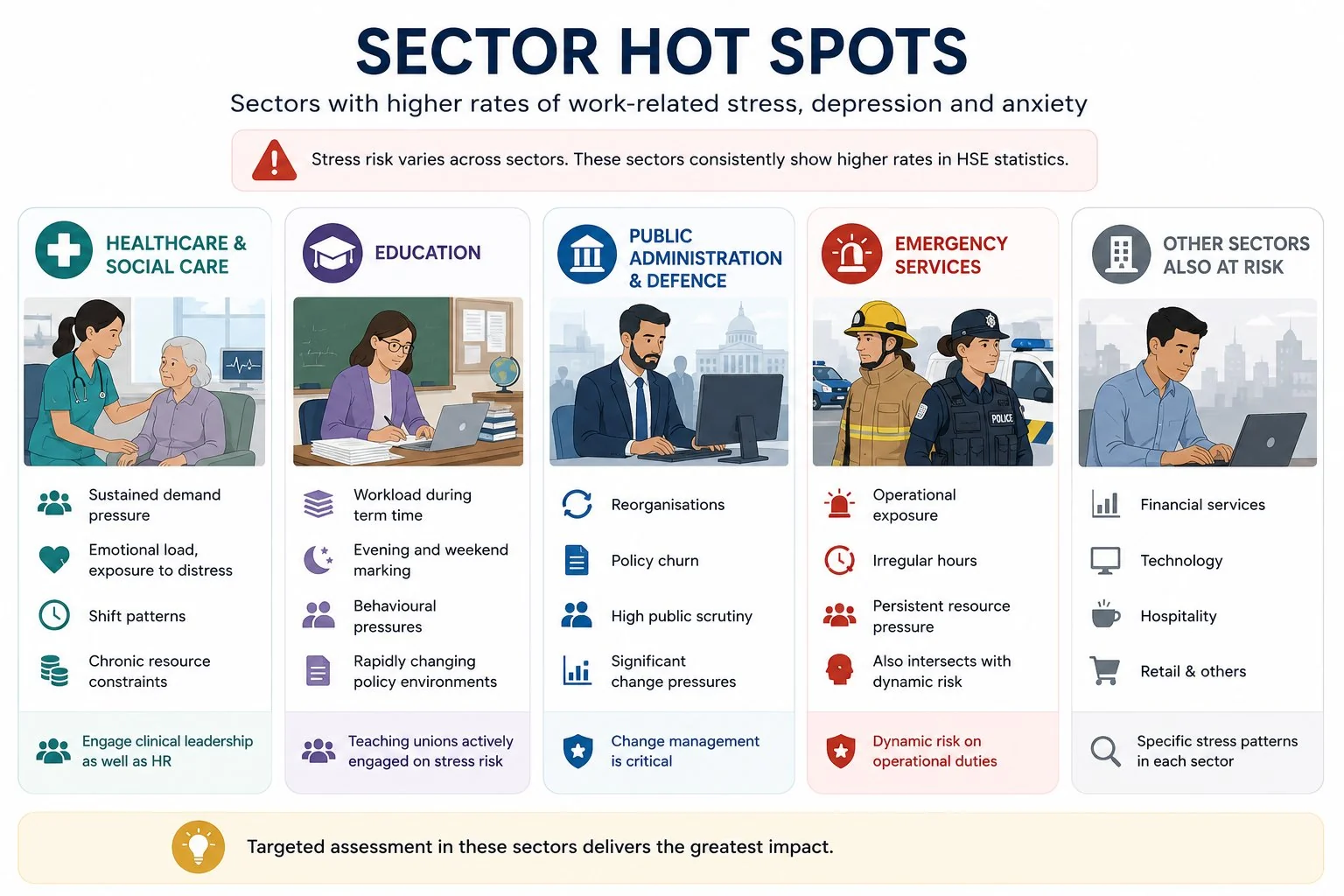
Some sectors carry particularly high stress risk. The HSE's accredited statistics consistently show higher rates of work-related stress, depression and anxiety in:
Healthcare and social care
Sustained demand pressure, emotional load, shift patterns, exposure to distress, and chronic resource constraints. Stress risk assessment in healthcare needs to engage clinical leadership as well as HR.
Education
Workload during term time, evening and weekend marking, behavioural pressures, and rapidly changing policy environments. Teaching unions have been actively engaged on stress risk assessment for years.
Public administration and defence
Reorganisations, policy churn, and high public scrutiny combine with significant Change pressures.
Emergency services
Operational exposure, irregular hours, and persistent resource pressure. Stress risk in these sectors also intersects with dynamic risk on operational duties.
These aren't the only sectors with elevated risk — financial services, technology, hospitality and others all show specific stress patterns — but they're where the data is clearest and where targeted assessment work has the most leverage.
Records and review
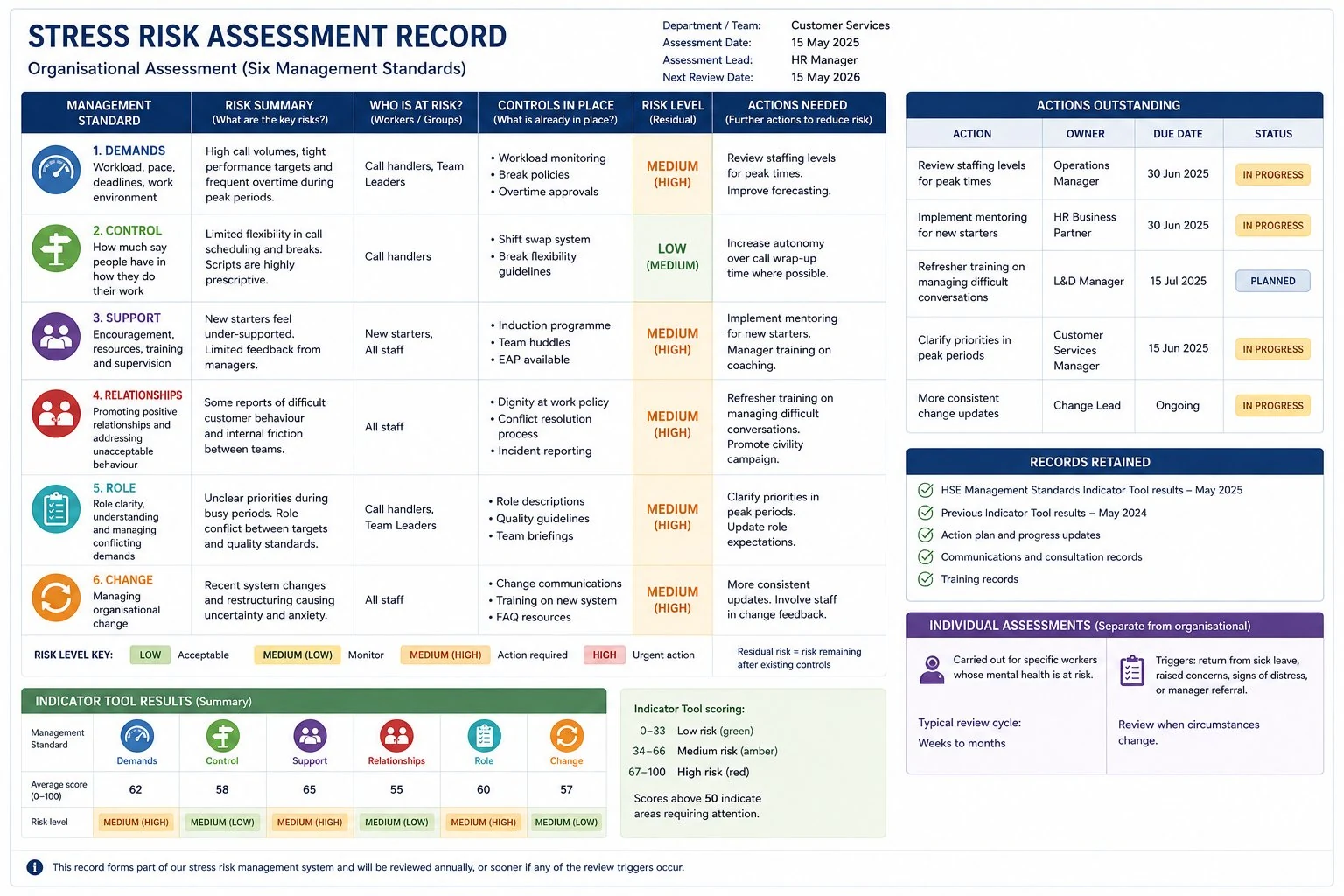
The assessment record should cover the six Management Standards, the workers and groups at risk, the controls and actions in place, the actions outstanding with owners and deadlines, and the review date. The Indicator Tool results, where used, should be retained for comparison with subsequent rounds.
Review is event-driven, with annual being widely adopted as good practice for organisational assessments. Triggers for review include major restructuring, significant absence patterns, changes to working hours or workload, the introduction of new technology, and any incident or grievance that suggests the assessment is no longer valid.
For individual assessments the review cycle is tighter — typically weeks or months rather than years — because the situation is specific to the worker and changes as conditions improve or deteriorate.
Where this connects in the cluster
Stress risk assessment connects most closely to working from home risk assessment (where isolation and blurred boundaries between work and home are common stress factors), pregnancy risk assessment (because of the Equality Act overlap and pregnancy-related stress specifically), and DSE risk assessment (because workstation-related musculoskeletal disorder and stress frequently co-occur in office workers).
For employers who want to build in-house competence to carry out stress risk assessment using the HSE Management Standards, formal Risk Assessment Training covers the methodological foundation. Stress-specific training is then a useful add-on, particularly for HR leads and line managers expected to carry out individual assessments.
Frequently asked questions
Is work-related stress a health and safety issue?
Yes. Work-related stress is a health and safety risk in UK law. The duty to assess it sits under the Health and Safety at Work etc. Act 1974 and the Management of Health and Safety at Work Regulations 1999, and the HSE has been clear in its enforcement guidance that this is a legal duty, not a wellbeing option.
Do I need an individual stress risk assessment as well as an organisational one?
Yes, where individual workers are at identifiable risk. The organisational assessment covers systemic conditions across the workforce. Individual assessments are needed for specific workers showing signs of stress, returning from stress-related sick leave, or raising concerns themselves. The two are complementary, not alternatives.
What is the HSE Indicator Tool?
A validated 35-item questionnaire developed by the HSE to support organisational stress risk assessment under the Management Standards. It's distributed to staff (typically anonymously), and the results are analysed by Standard to identify which areas of work design are producing risk.
What if work-related stress relates to a disability or pregnancy?
The Equality Act 2010 then engages alongside the health and safety duty. Reasonable adjustments to working conditions are required where the worker has a disability or is pregnant. The Equality Act duty is generally more demanding than the health and safety duty alone, and failure to provide reasonable adjustments can amount to discrimination.
What are the six Management Standards?
Demands, Control, Support, Relationships, Role and Change. They're the six areas of work design where evidence shows poor management reliably produces work-related ill health. A suitable and sufficient stress risk assessment should consider all six.