
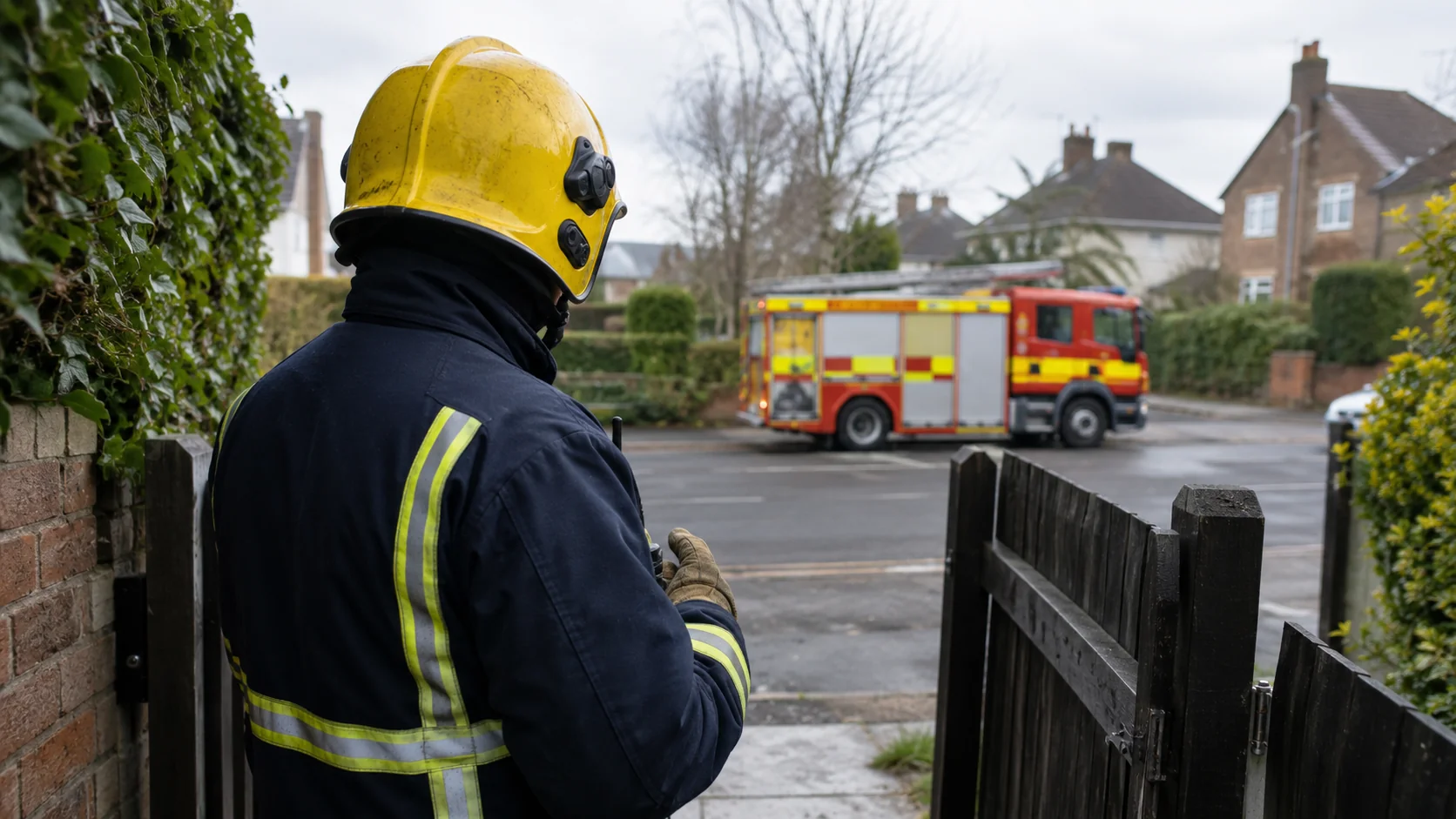
A dynamic risk assessment is the judgement someone makes on the spot, while a job is happening, when the situation in front of them doesn't match what was anticipated. It's the call a paramedic makes at the threshold of a house. The decision a roofer makes when a slate moves underfoot. The pause a lone district nurse takes before stepping into an unfamiliar flat.
It supplements a written risk assessment rather than replacing it. The written assessment anticipates the foreseeable hazards and sets out the controls. The dynamic assessment fills the gaps — the moments where the real world has produced a hazard the written document couldn't have predicted in detail.
How dynamic differs from a written assessment
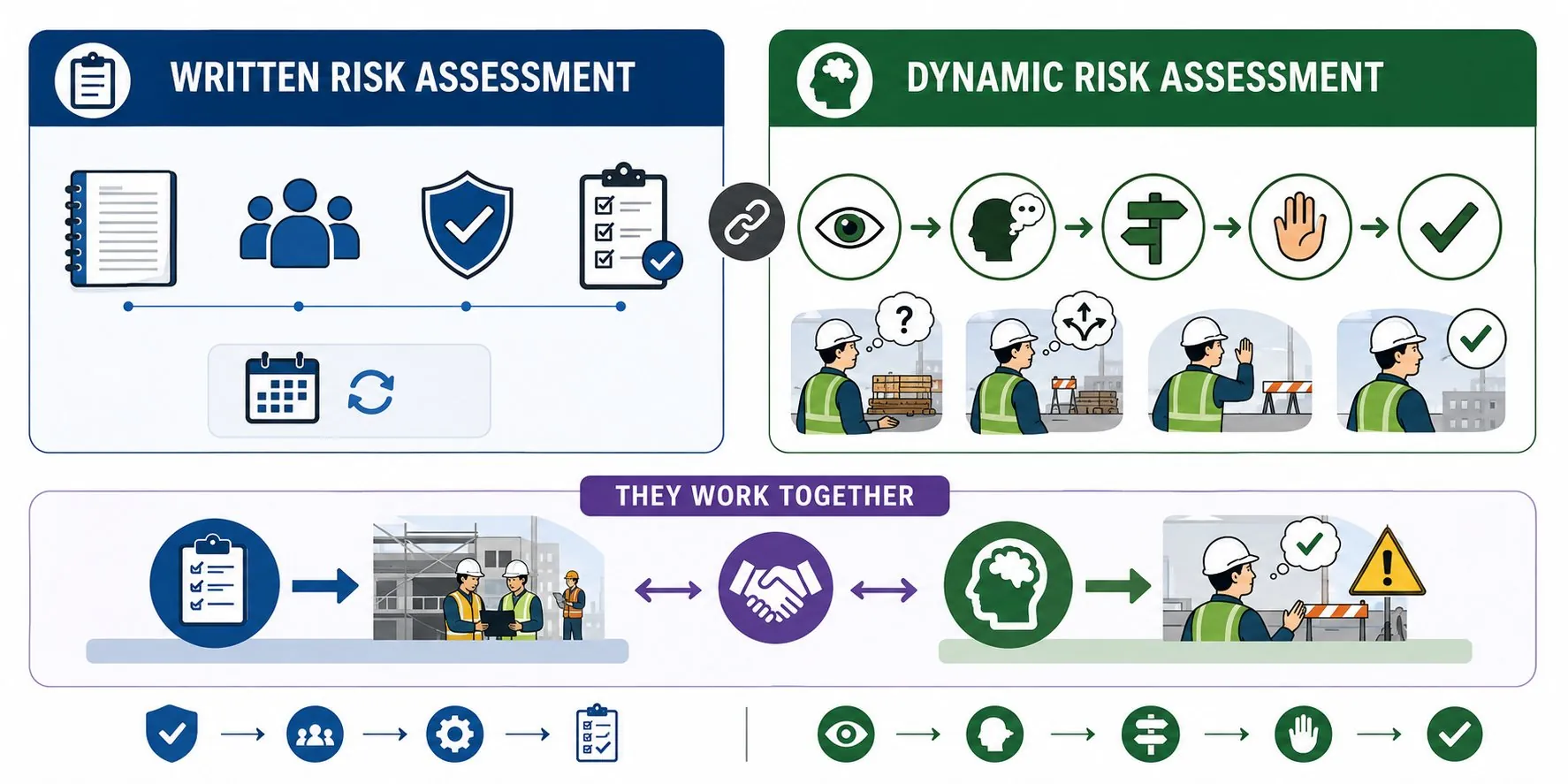
A written risk assessment is a planning document. It is prepared in advance, recorded on paper or in a system, and revised periodically. The five-step method we cover on our page on the steps of a risk assessment produces a static document that describes hazards, people at risk, controls, and required actions.
A dynamic risk assessment is a cognitive act. It's the worker thinking, in the moment: the situation in front of me isn't quite what we planned for — is it still safe to continue, do I need to adjust, or do I need to stop? There's no form to fill in at the time. The assessment is the thinking itself, and any record is created afterwards.
The two are complementary. The written assessment establishes the baseline — these are the hazards, these are the controls, these are the rules for how the job is normally done. The dynamic assessment is what kicks in when reality drifts away from the baseline. A team without a sound written assessment can't do dynamic assessment well, because they have no reference point for what "normal" looks like. A team that relies entirely on dynamic assessment is making decisions without preparation.
Where dynamic risk assessment came from
The phrase originated in the UK fire service in the early 1990s, as part of a deliberate effort to bring structure to the high-tempo decisions firefighters had always made by instinct. The old model — assume the worst, commit cautiously — wasn't enough when crews arrived at incidents where conditions changed every few seconds. The new approach formalised the cognitive process: stop, evaluate the new information, decide whether the original plan still holds.
It was picked up across the rest of the emergency services and adopted by the National Fire Chiefs Council as part of the broader Joint Emergency Services Interoperability Principles (JESIP) framework. Operational research by Tissington at Aston University and Flin at the University of Aberdeen documented how the UK fire service had used the model to reduce operational fatalities to roughly one per year across a workforce of around 50,000 firefighters.
From there it spread to healthcare, social care, security, construction and any other sector where workers routinely face conditions that change too fast for a paper assessment to keep up.
When dynamic risk assessment applies
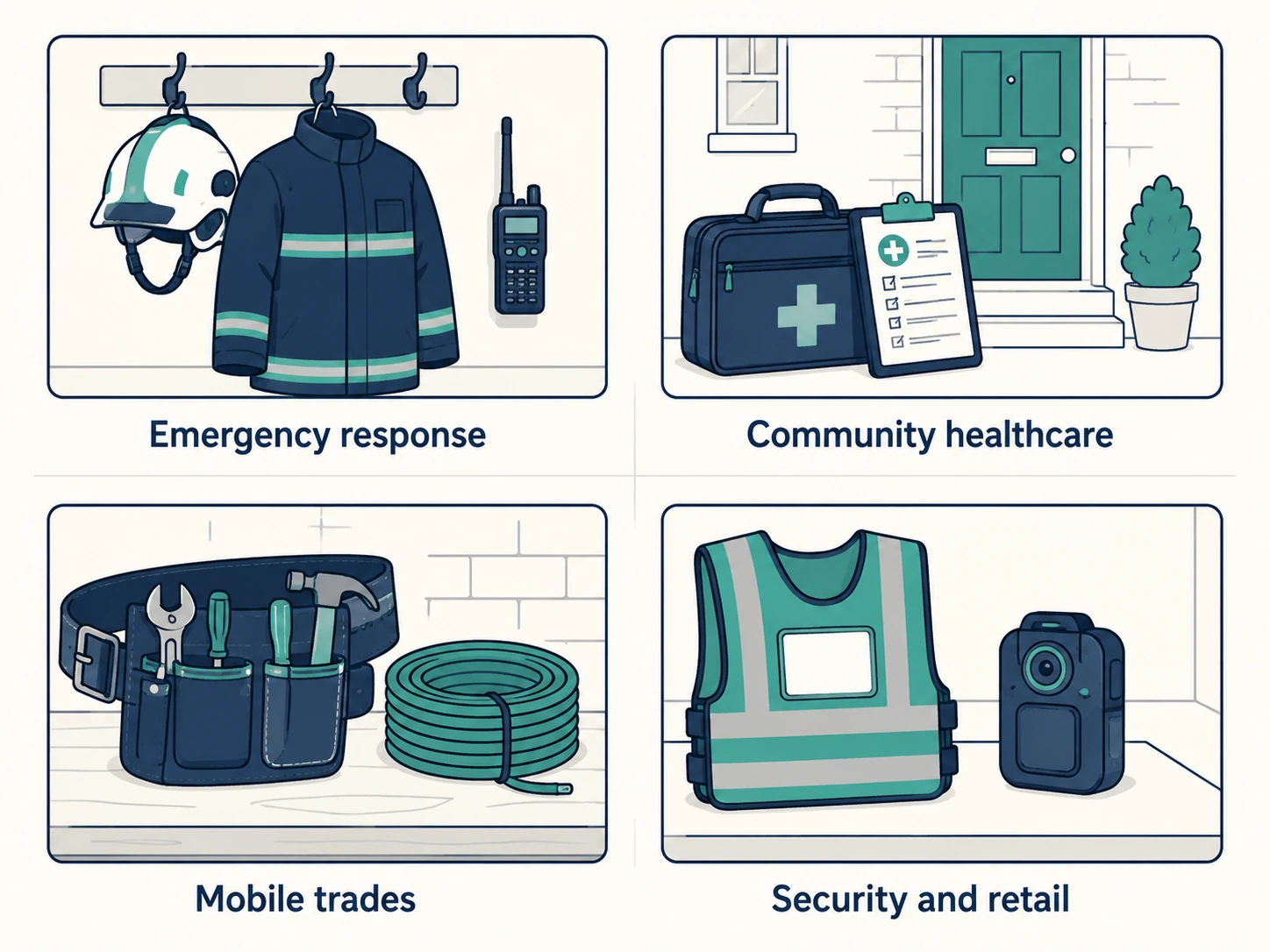
Two conditions need to be present for dynamic assessment to be relevant. First, the work has to involve genuine variability — situations where the worker, on arrival or partway through the task, encounters circumstances the written assessment didn't anticipate. Second, the worker has to have the competence and authority to act on what they find.
Routine office work doesn't generally need dynamic assessment. The written assessment is enough; conditions don't change minute to minute. By contrast, the following situations almost always do:
Emergency response
A fire crew arriving at a building doesn't know exactly what they're walking into until they get there. A paramedic crew called to a domestic incident has the dispatcher's information but no certainty about the scene.
Lone home visits
A district nurse, a social worker or a community-based mental health professional turning up at a service user's address is making a dynamic assessment from the moment they ring the doorbell — and continuing it the whole time they're inside.
Mobile and peripatetic work
A plumber, electrician or roofer turning up at a job they haven't been to before is operating to a generic written method but assessing the specific site dynamically.
Security and frontline retail
A shop worker dealing with an aggressive customer is making dynamic safety judgements that no written assessment could have specified in advance.
Construction at site arrival
Even with a comprehensive RAMS document, a contractor turning up at a site reads the actual conditions — weather, ground state, what other trades are doing — and decides whether the planned method still works.
The mental model
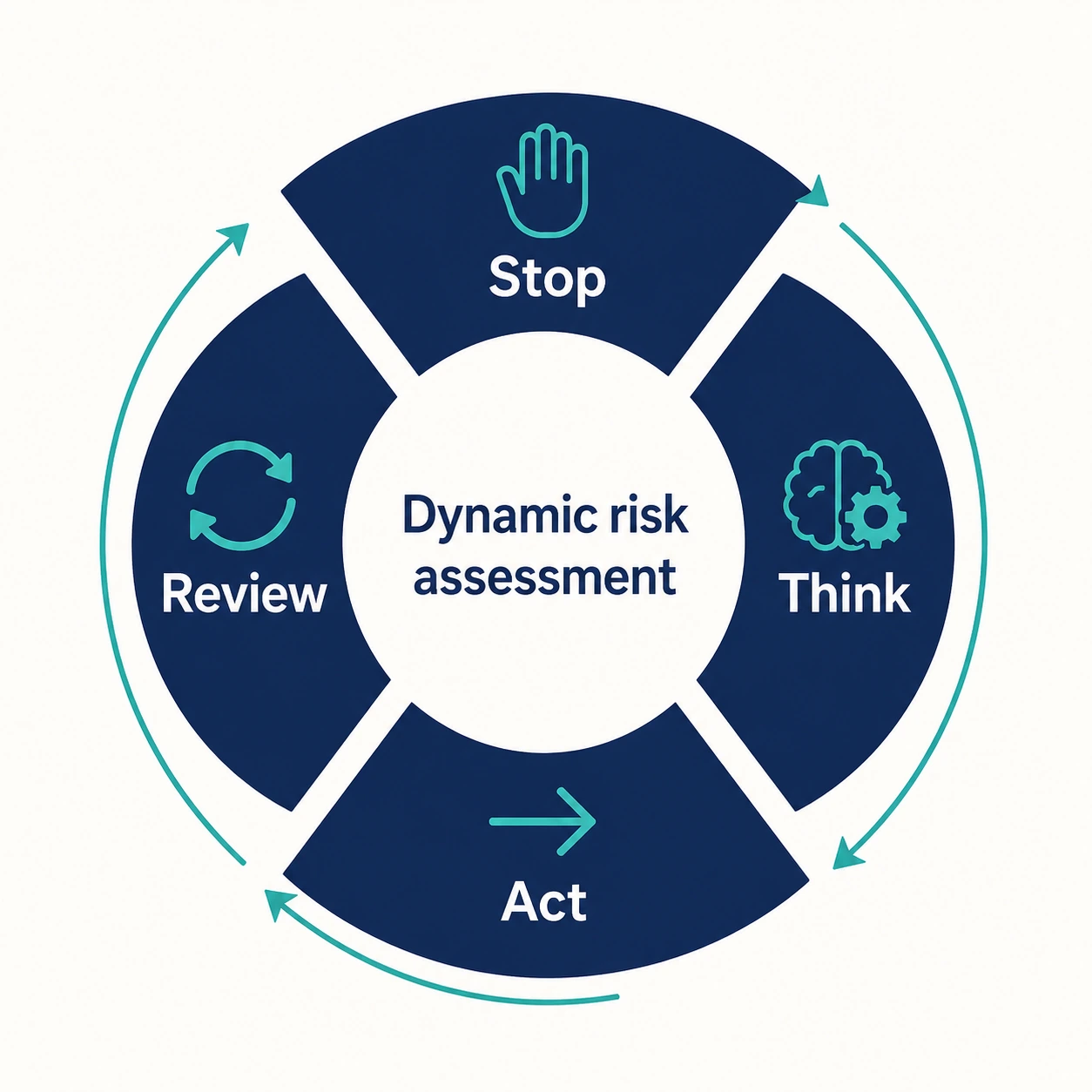
Most versions of the dynamic assessment model share the same shape. The names differ — Stop-Think-Act-Review is common, as is the simpler Pause-Plan-Proceed — but the steps are the same.
The worker pauses. They read the situation in front of them: what's different from what was expected, who is present, what's the immediate risk. They consider whether the planned method still works, whether it needs adjustment, or whether the safer choice is to withdraw and reassess. They act on that decision. And afterwards — sometimes hours later, sometimes weeks — they review what happened and feed it back into the written assessment for the next time.
The discipline of the model is in the first step. Pausing is unnatural under time pressure. Crews learn to pause anyway because the decisions made without pausing are the ones that turn into incidents.
Worked examples across sectors
Fire service
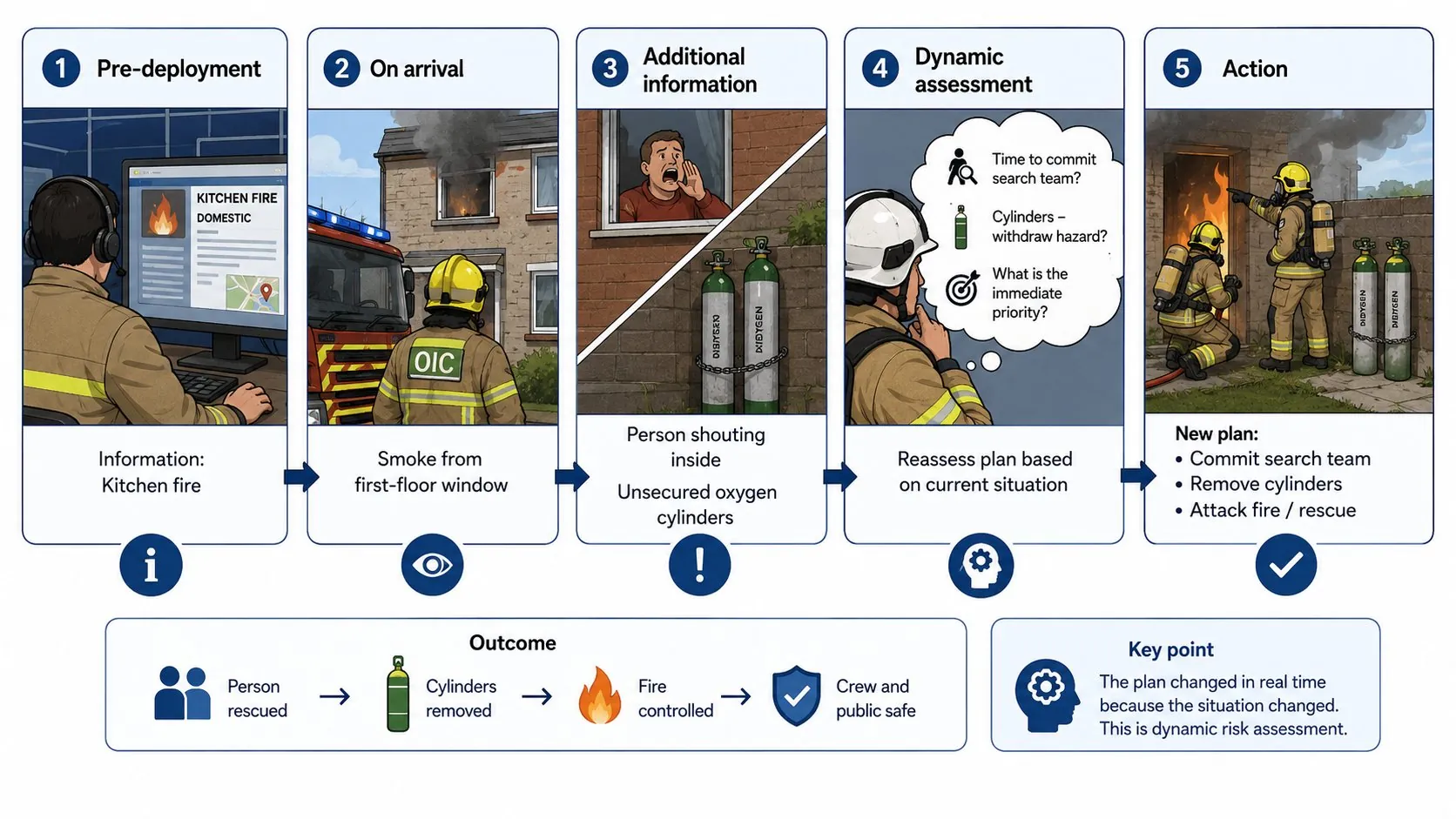
A crew is called to a domestic fire. The pre-deployment information says a kitchen blaze. On arrival, the officer in charge sees smoke from the first-floor window as well, hears someone shouting from inside, and notices unsecured oxygen cylinders against the garden wall. The original plan — defensive firefighting from outside — is no longer right. The dynamic assessment in those few seconds covers whether there's time to commit a search team, whether the cylinders are a withdraw-everyone hazard, and what the immediate priority is.
Community healthcare
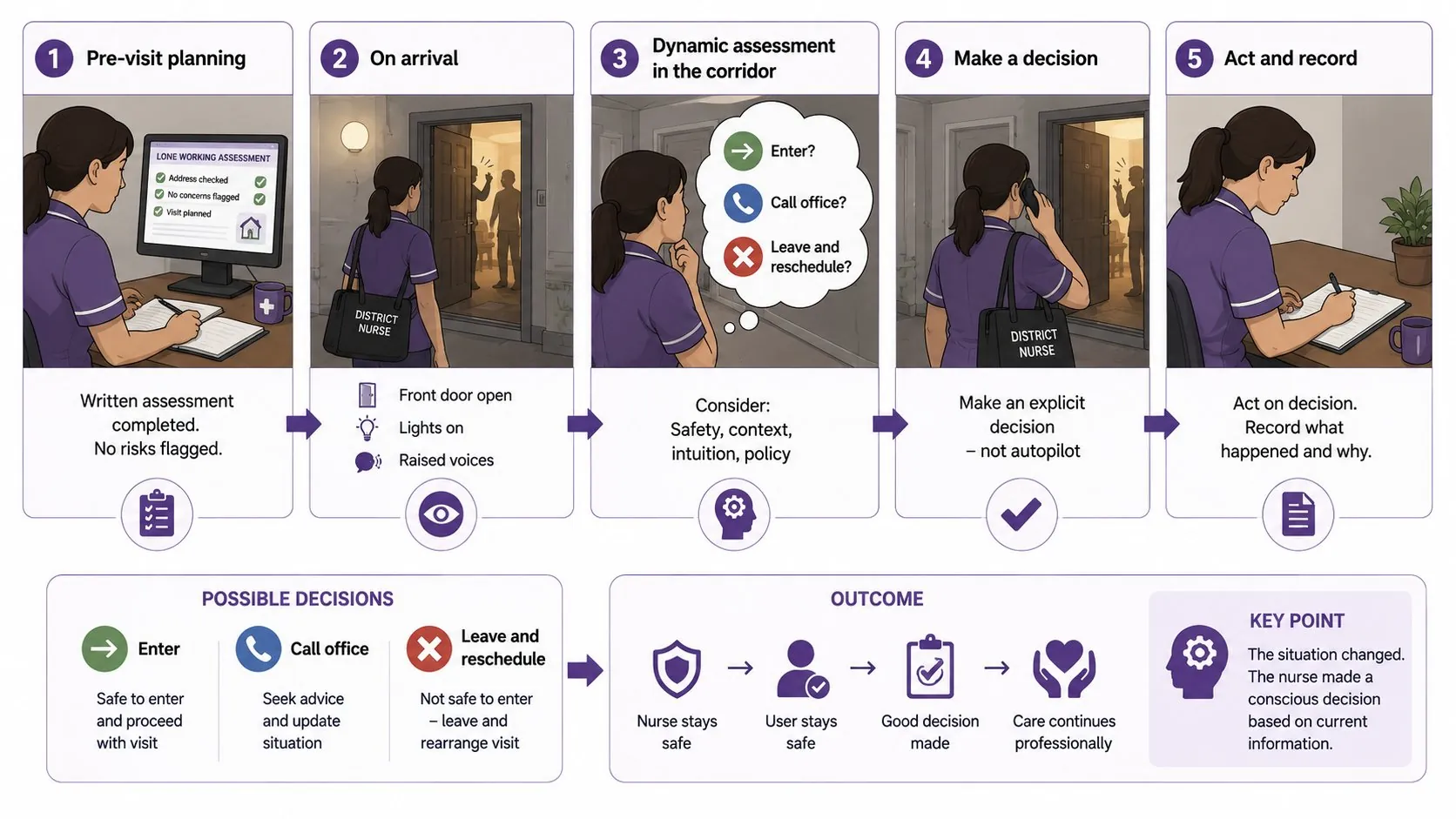
A district nurse arrives at a service user's flat to find the front door open, the lights on, and the sound of raised voices from inside. The written lone-working assessment covers expected risks at the address — none of which were flagged before this visit. The dynamic assessment in the corridor covers whether to enter, whether to call the office, and whether to leave and reschedule. The answer might be any of those things; what matters is that the nurse made an explicit decision rather than walking in on autopilot.
Roofing contractor
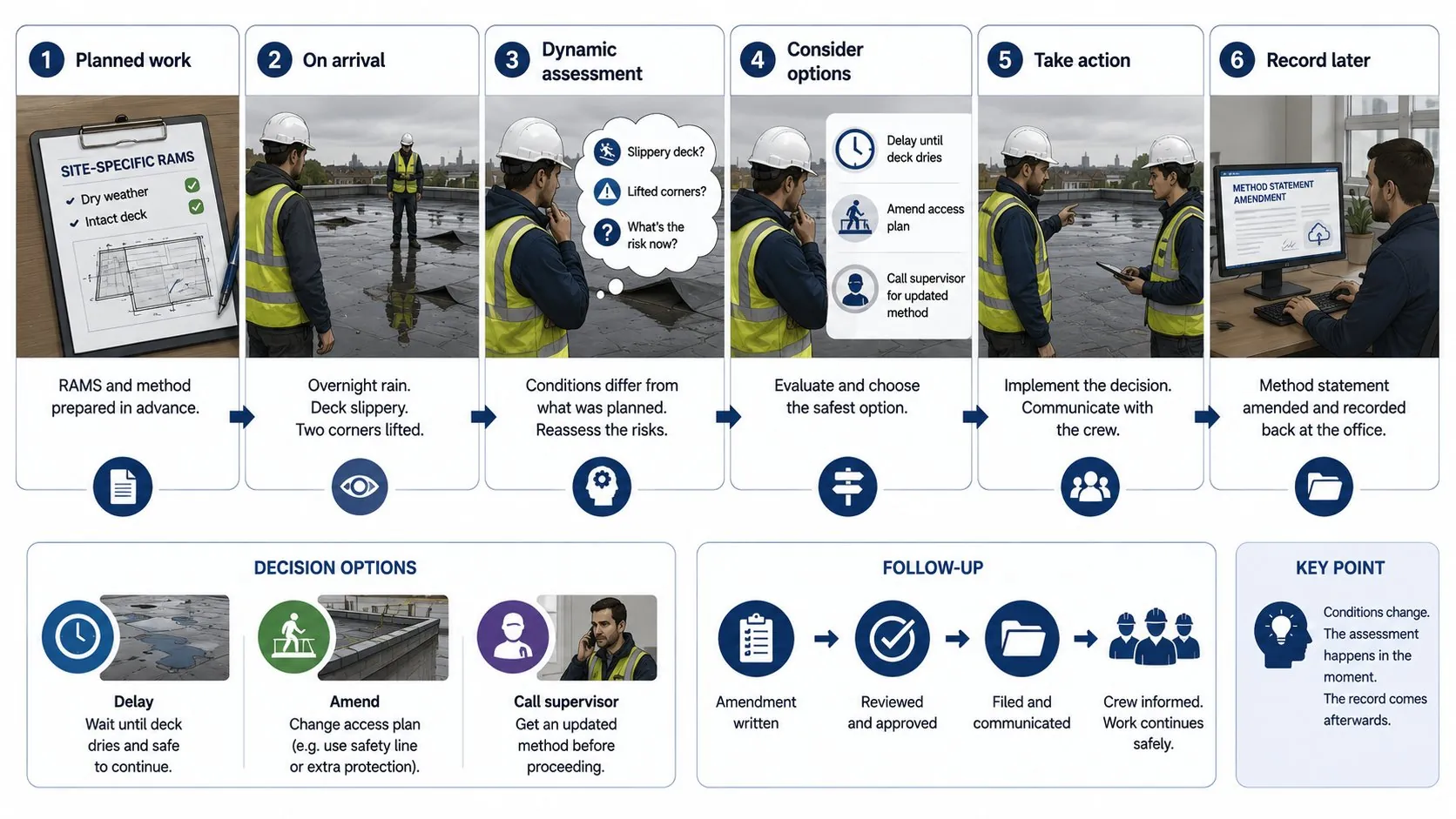
A site-specific RAMS for replacing a flat roof anticipated dry weather and an intact deck. The crew arrives to find overnight rain has left the deck slippery and lifted two corners. The written method is no longer appropriate to the conditions. The dynamic assessment covers whether to delay until the deck dries, whether to amend the access plan, or whether to call the supervisor for an updated method. There's no form to fill in on the roof — but there will be a method statement amendment recorded back at the office.
Lone retail worker
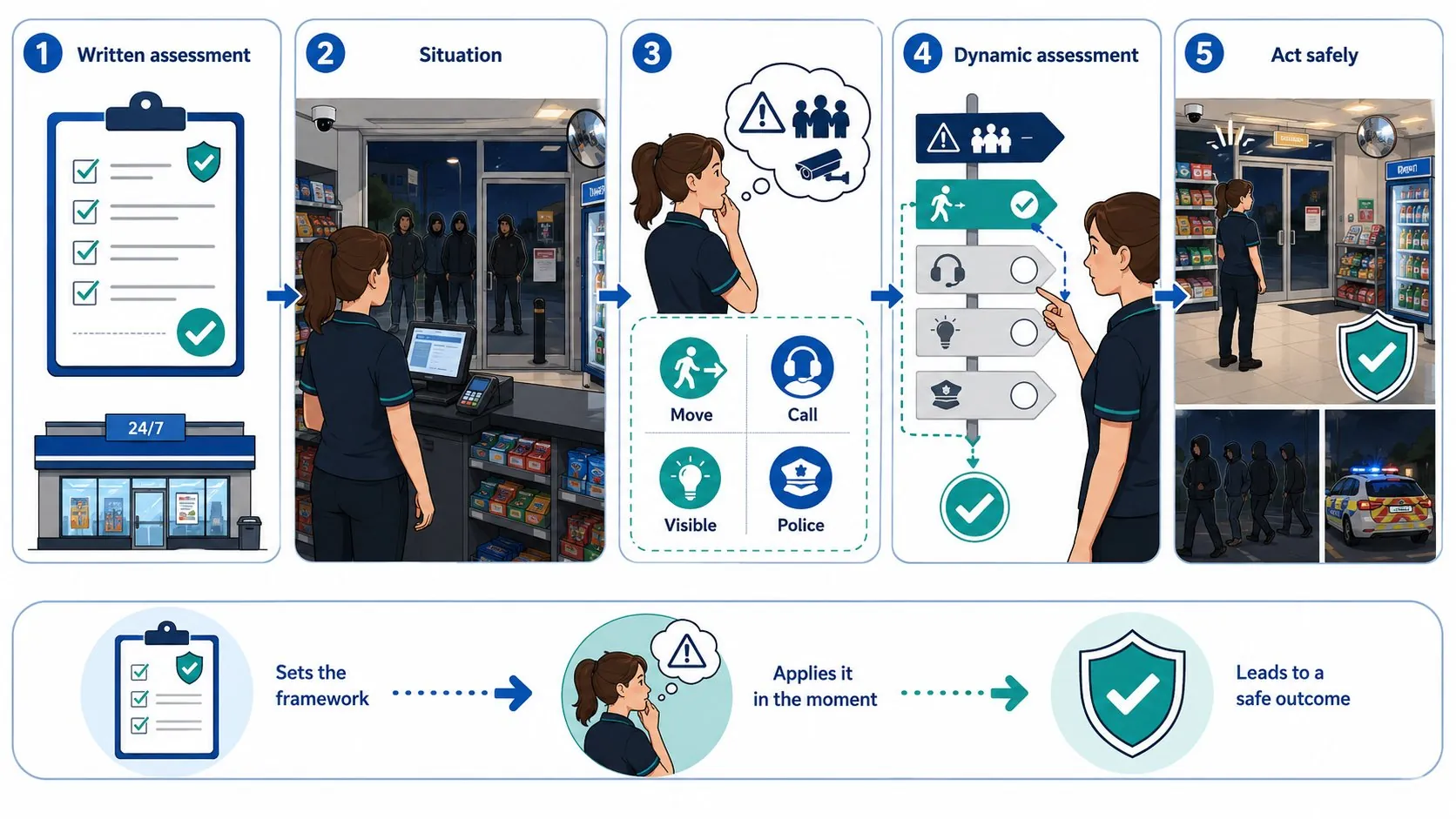
A late-shift worker in a small convenience store sees a group of three people loitering near the entrance who appear to be watching the till. Nothing has happened. The dynamic assessment covers whether to move position, call a colleague, increase visibility, or pre-emptively contact the police. The written lone-working assessment will have set out the framework for that decision; the dynamic assessment is the worker applying it to this specific moment.
Recording a dynamic assessment
The assessment itself is real-time. The record, when there is one, is created afterwards.
What gets recorded depends on the outcome. A dynamic assessment that confirmed the existing plan and ran without incident usually doesn't need formal documentation — that's why the written assessment exists. A dynamic assessment that resulted in the worker changing the method, withdrawing, or calling for support is worth recording, both to capture the learning and to feed back into the written assessment for next time.
For some sectors the recording is structured. Fire services use standard incident reporting that captures decisions made on the ground. Healthcare providers commonly use service-user-specific notes for lone-visit decisions. Construction principal contractors use site diaries and RAMS amendments. The pattern is the same regardless of the industry: the assessment happens in real time; the record reinforces it.
Training implications
Dynamic risk assessment can't really be learned from a template. The cognitive moves — pausing under time pressure, weighing the new information against the plan, deciding to commit, adjust or withdraw — only develop through practice and through being part of a team that takes those decisions seriously.
That's why most workplaces that depend on dynamic assessment invest in scenario-based training rather than classroom theory. Tabletop exercises, role-plays, on-site walkthroughs and post-incident debriefs are how the skill is built. Generic e-learning has its place for awareness but doesn't produce competence on its own. For roles where dynamic assessment matters, look for Risk Assessment Training that combines the written method with scenario practice and a credible certificate at the end.
A common misconception worth correcting
Dynamic risk assessment is not a substitute for a written assessment. We see this confusion regularly — workers telling us they "do dynamic risk assessments" instead of written ones, or supervisors using "we'll dynamically assess it" as a way of avoiding the documentation work.
The legal duty under the Management of Health and Safety at Work Regulations 1999 is to make a suitable and sufficient written assessment of foreseeable risks. That duty applies even where the work also involves dynamic conditions. Dynamic assessment fills the gaps the written assessment couldn't anticipate; it doesn't excuse not doing the written assessment in the first place.
Lone working is the area where this confusion is most common, often because the assessment of any individual visit feels unpredictable. The fix is the same as for any other vertical: a robust generic lone working risk assessment for the role and the typical conditions, plus dynamic assessment for the visit-by-visit reality.
Frequently asked questions
Is dynamic risk assessment legally required in the UK?
Not as a named requirement. The legal duty is to make a suitable and sufficient written assessment of foreseeable risks. Dynamic assessment is recognised by the HSE and by sector-specific bodies as good practice where conditions are unpredictable, but the underlying statutory duty is the written assessment.
Who carries out dynamic risk assessments?
The person doing the work, in real time. Supervisors and team leaders also carry them out for the activities they oversee. In high-tempo sectors — emergency services, healthcare, construction — every worker on the ground is making dynamic assessments throughout the shift.
Do you have to write a dynamic risk assessment down?
The assessment itself happens in real time and isn't written down as it occurs. A record is usually created afterwards if the assessment resulted in a change of method, a withdrawal, or any incident worth feeding back into the written assessment.
What's the difference between a dynamic risk assessment and a point-of-work risk assessment?
The terms are often used interchangeably. Some organisations use "point-of-work" specifically for the structured check a worker carries out at the start of a job — confirming the conditions match the written assessment — and reserve "dynamic" for the ongoing reassessment during the work. Both concepts cover the same underlying idea: the worker assessing real conditions in real time.
Can dynamic risk assessment replace a written one for lone workers?
No. Lone working is exactly where the combination matters most. The role needs a written lone working assessment covering the foreseeable risks and the controls; the individual visits need dynamic assessment to handle whatever actually turns up on the day.
Related guides
- How often should a risk assessment be reviewed?
- Who can carry out a risk assessment? The competence question explained
- Risk assessment examples: three worked examples for UK workplaces
Give your managers and supervisors the written method behind every confident on-the-spot decision.
Explore the Risk Assessment Training course →
Mark writes about workplace health & safety, risk assessment and accredited online training for Risk Assessment Training, part of Online CPD Academy.