

%201.svg)


A lone working risk assessment is a structured look at the additional hazards faced by workers who carry out their work without the close supervision or support of colleagues. The category covers more people than most employers realise: care workers visiting service users at home, drivers, security staff on isolated sites, retail workers on early or late shifts, agricultural workers, estate agents conducting viewings, and the small army of contractors who work alone in other people's premises.
There is no UK regulation specifically covering lone working. The duty is a derived one — it flows from the general framework in the Health and Safety at Work etc. Act 1974 and from regulation 3 of the Management of Health and Safety at Work Regulations 1999. That doesn't make the duty weaker. The HSE has been clear in its guidance and enforcement that lone working is a foreseeable risk and requires specific assessment.
Who counts as a lone worker
A lone worker is anyone who carries out activities without close or direct supervision. The category includes workers physically alone for parts of the shift, workers in workplaces where colleagues are present but out of sight or hearing, and workers operating remotely from their base with limited contact during the working day.
Common examples: community-based healthcare and social care staff, district nurses, home visiting professionals, sole-charge retail workers, late-shift cleaners, security guards on isolated premises, lone drivers, agricultural workers, lone manufacturing operators, contractors carrying out maintenance in other people's premises, estate agents on viewings, and homeworkers who never see a colleague during the working day.
Some workers fall in and out of lone working depending on the shift pattern. A care home worker may have colleagues nearby during the day and be effectively lone working on the night shift. A lab technician may have colleagues most of the time and be alone in the building when finishing late. The assessment should cover all the situations in which the worker is effectively lone, not just the obviously isolated ones.
The legal framework
The duty under section 2 of the Health and Safety at Work etc. Act 1974 is for employers to ensure the health, safety and welfare of their employees so far as is reasonably practicable. Section 3 extends the duty to anyone else affected by the work. Regulation 3 of the Management of Health and Safety at Work Regulations 1999 requires a suitable and sufficient assessment of all foreseeable risks. Lone working is a foreseeable risk and must be assessed wherever it occurs.
Several other regulations apply alongside the general framework. Where the lone work involves hazardous substances, COSHH applies. Where it involves work at height, the Work at Height Regulations 2005 apply. Where the lone worker is pregnant, regulation 16 of the 1999 regulations (covered on our pregnancy risk assessment page) engages. Where the lone worker is under 18, regulation 19 (covered on our young persons risk assessment page) engages.
What lone working doesn't have is a single statutory instrument. Online guides that imply a "Lone Working Act" or specific "Lone Worker Regulations" are wrong — and the misconception matters because workers and employers framing the duty around the wrong regulation often miss the actual one.
Common risks for lone workers
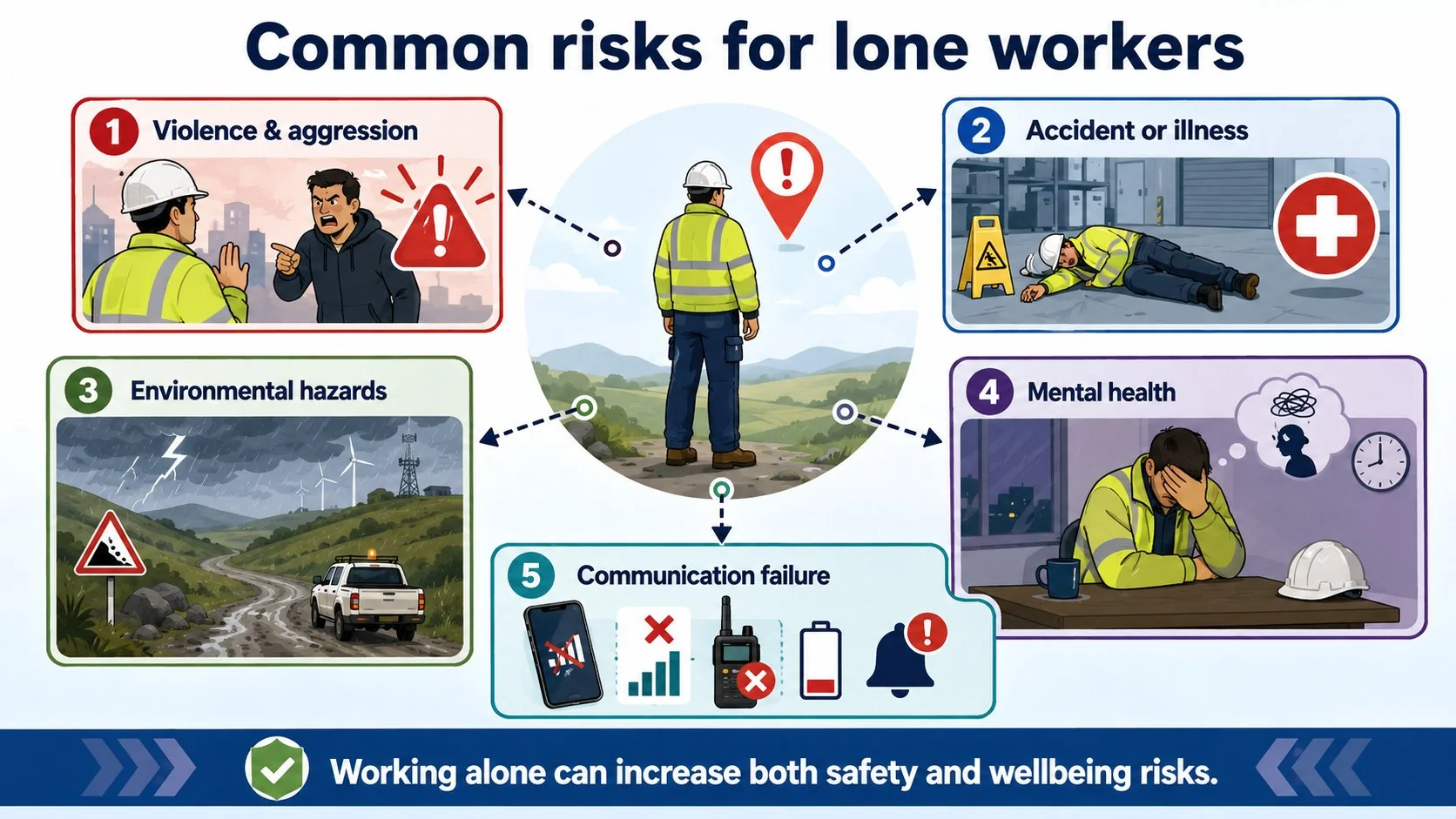
The hazards that distinguish lone working from supervised working fall into five broad categories.
Violence and aggression
Lone workers facing members of the public, service users, or others on premises they don't control face elevated risk of verbal abuse, threats and physical assault. The risk is highest for workers carrying cash, working evenings or nights, working in private homes, or working in roles where they have to deliver news or enforce conditions that may provoke an aggressive response. The Suzy Lamplugh Trust, established after the disappearance of an estate agent in 1986, has published practical guidance in this area for decades and remains a useful reference.
Accident or illness with no immediate help
A lone worker who slips, falls, suffers a sudden medical event or is involved in an accident has no colleague to call for help. The harm from the original event may be modest; the harm from the delay in getting assistance can be catastrophic.
Environmental hazards
Lone workers in remote or isolated environments — agricultural work, forestry, lone driving in poor weather, work on isolated sites — face exposure to conditions that wouldn't be tolerable for sustained periods without support.
Mental health
Sustained isolation, lack of social contact during the working day, and the absence of informal peer support are recognised contributors to stress-related ill health. This intersects with stress risk assessment — the two duties run in parallel for lone workers whose role is also stressful.
Communication failure
Where the worker's connection to base depends on a phone, a radio or an alarm device, the failure of that link is itself a hazard. Areas of poor mobile signal, devices with dead batteries, or systems where alerts are missed by the monitoring station create the very situation the lone worker most needs protection against.
The assessment in practice
The assessment follows the same general method we cover on our five steps page, translated into lone-working terms.
Identify what the worker actually does, where, and when. A care worker visiting unknown addresses faces a different risk profile from a lab technician working late in a controlled building. A taxi driver works alone differently from a maintenance contractor.
Identify who they could encounter and what could go wrong. Members of the public, service users, others on the premises, the worker's own health, the environment, the equipment, the route. The HSE recommends thinking through a typical shift step by step rather than working from a generic hazard list — the realistic risks emerge from the actual activity, not from theoretical lists.
Decide what controls are in place and whether they're enough. The next sections cover the practical control measures.
Record the assessment, brief the worker, and review.
Control measures
Lone working controls fall into three layers: procedural, equipment-based, and competence-based.
Procedural controls
Buddy or check-in systems where the worker signals safe arrival at and departure from each location. Defined working hours with notification protocols outside them. Risk-banded address registers identifying premises with known concerns. Two-person attendance for known higher-risk visits. Pre-visit information sharing. Defined escalation paths when a check-in is missed. Driving and parking guidance for visits to unfamiliar areas.
Equipment controls
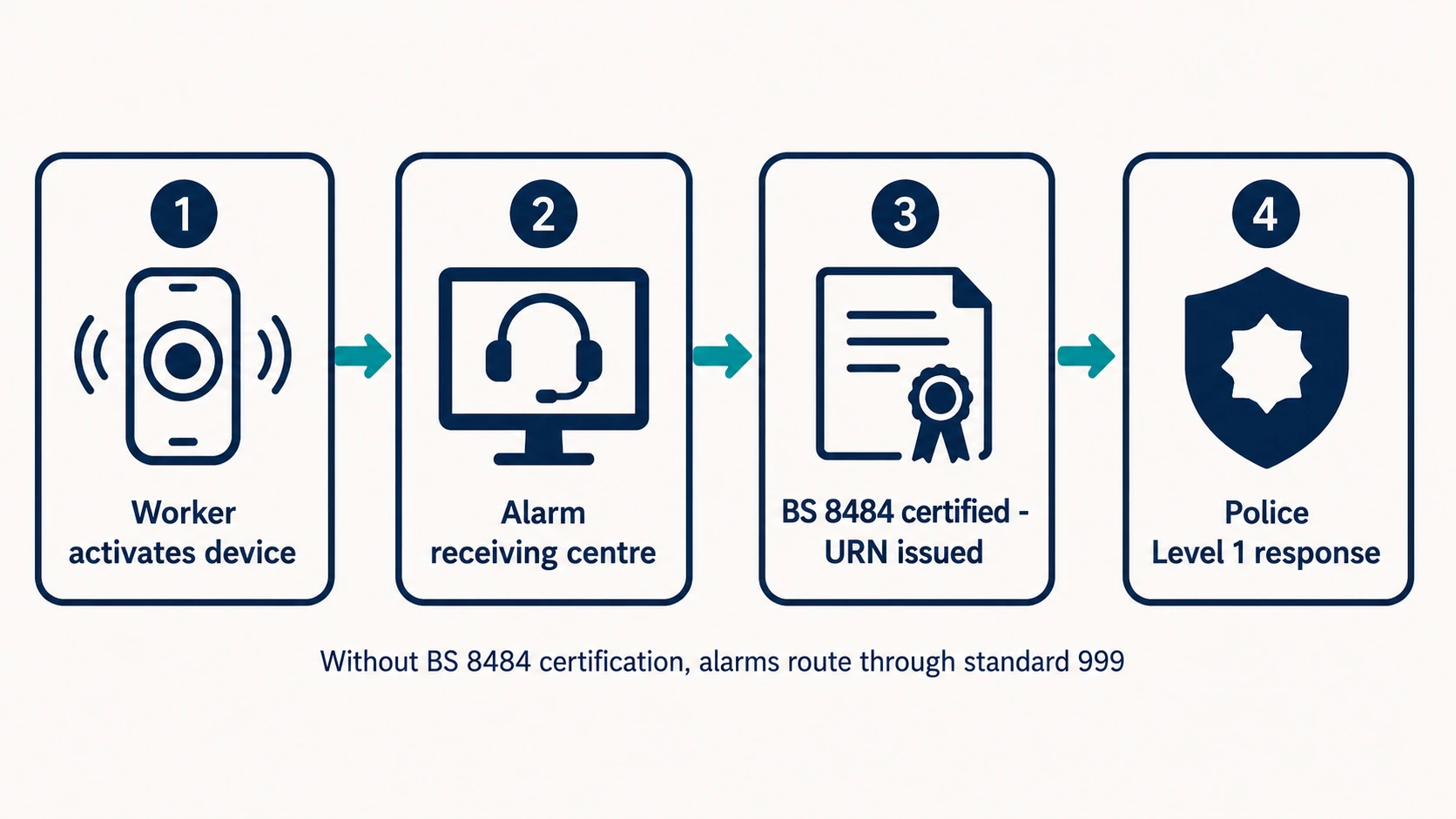
Lone worker devices — purpose-built alarms that allow the user to summon help with a single action, with location data and audio. These vary in sophistication from app-based solutions through to dedicated devices with mantrap detection, no-motion alerts and ATEX certification for hazardous environments. A device only works if it's reliable, the worker has it on them, the battery is charged, and the response system actually responds. The British Standard for lone worker services is BS 8484. Devices and monitoring services certified to BS 8484 meet a defined minimum standard, and certification is the precondition for a service to be granted a Unique Reference Number (URN) by the police — which allows alarm activations to be passed to the police as a Level 1 priority response. Without a URN, the alarm goes through the standard 999 route, which is slower.
Competence and training
Lone workers need specific training in dynamic risk assessment, in conflict de-escalation where relevant, in the use of any equipment provided, and in the procedures the employer has put in place. Generic safety induction isn't enough.
The right combination of controls depends on the actual risk. A district nurse visiting community patients needs all three layers. A lone office worker doing late-shift paperwork in a controlled building probably only needs basic check-in arrangements.
The dynamic risk assessment overlap
Lone working is the area where written and dynamic risk assessment interact most heavily. The written assessment can't predict the exact conditions of each visit or each shift; the dynamic assessment fills the gaps when the worker arrives at the doorstep, reads the room, and decides whether to proceed.
This combination is the right answer. We see employers who treat their lone working duty as "trust the worker to dynamically assess each situation" — that doesn't satisfy the regulations. We also see employers whose written assessment is detailed but who give workers no autonomy to back out of situations that don't match the plan. Both fail.
A robust lone working approach has a comprehensive written assessment that anticipates the foreseeable hazards and sets out the controls, and a workforce competent and authorised to apply dynamic judgement to the specific situations the written assessment couldn't predict.
A worked example
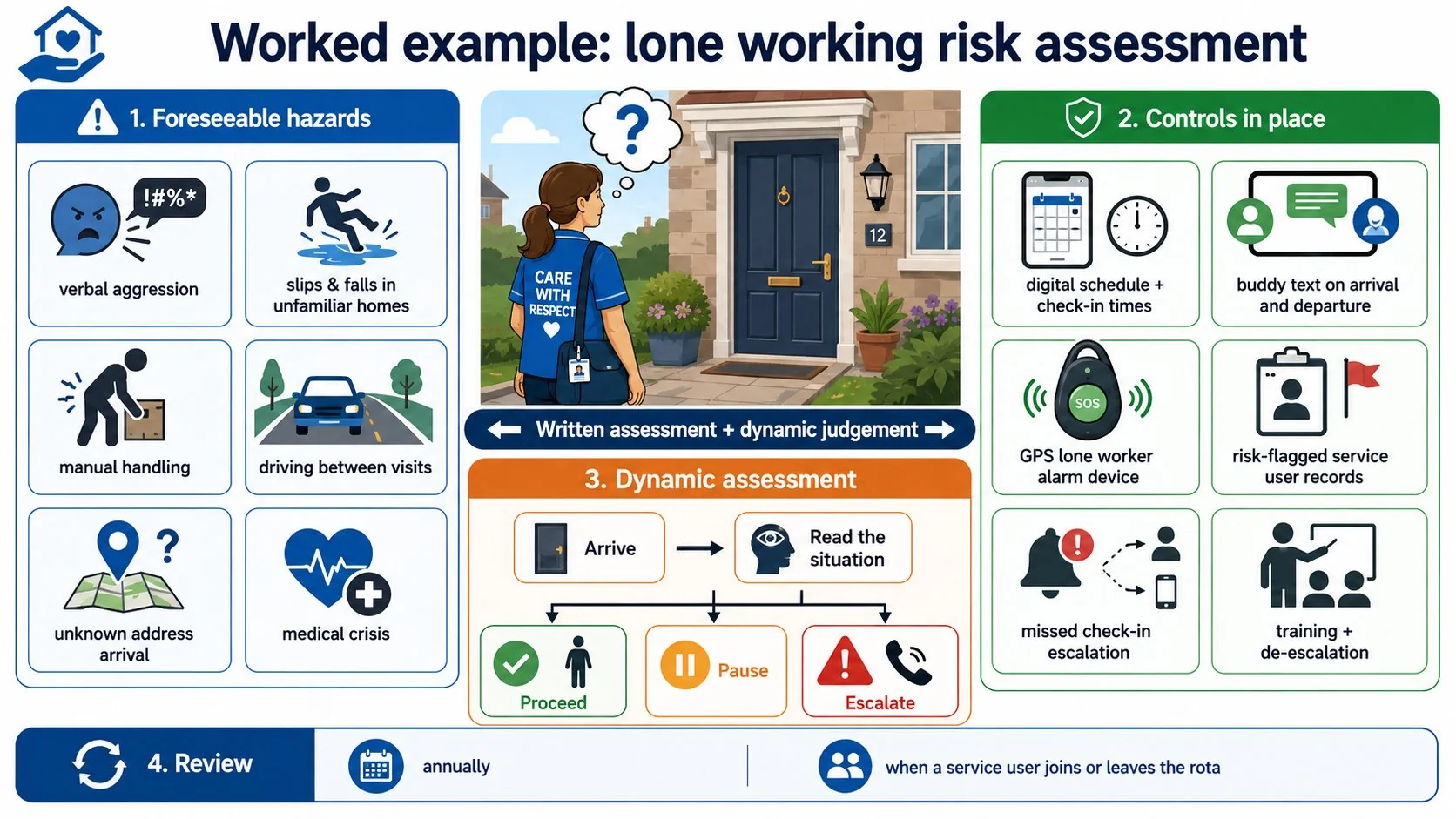
A small home-care provider sends carers to visit older service users in their own homes. The assessment identifies:
Foreseeable hazards include verbal aggression from confused service users or family members, slips and falls in unfamiliar homes (loose rugs, poor lighting), manual handling of service users (covered separately under the manual handling assessment), driving between visits, lone arrival at unknown addresses, and the small but real risk of finding a service user in medical crisis.
Controls in place: a shared digital schedule with check-in times for each visit, a buddy system where the carer texts arrival and departure to a designated contact, lone worker devices with GPS and a single-button alarm linked to a BS 8484-certified Alarm Receiving Centre, risk-flagged service user records identifying known concerns, a written escalation procedure for missed check-ins, and structured training covering all of the above plus de-escalation.
The written assessment is reviewed annually and when a service user enters or leaves the rota. Dynamic assessment by the carer at each visit handles the situation-specific judgements.
Records and review
The assessment should cover the role, the typical pattern of work, the foreseeable hazards, the controls in place, training requirements, equipment provision, and the review date. Where individual workers have specific circumstances — a pregnant lone worker, a young lone worker, a lone worker with a disability — those need to be considered alongside the role-level assessment.
Review is required when the role changes, the equipment changes, an incident or near-miss occurs, or there's reason to think the assessment is no longer valid. Lone working assessments often warrant more frequent review than office-based assessments because the conditions are more variable and the consequences of failure are higher.
Where this connects in the cluster
Lone working intersects with dynamic risk assessment more closely than any other vertical. It also connects with working from home risk assessment (home workers without colleagues are lone workers for parts of their day), stress risk assessment (sustained isolation contributes to stress), and dynamic risk assessment for the per-visit decisions.
For organisations with significant lone working populations — community healthcare, social work, housing, security, retail — competence in assessing and managing lone working risk is one of the higher-leverage areas of safety management. Formal Risk Assessment Training covers the general method that underpins lone working assessment, with role-specific lone working procedures layered on top.
Frequently asked questions
Is there a specific lone working law in the UK?
No. The duty to assess and control lone working risk is derived from the general framework — the Health and Safety at Work etc. Act 1974 and the Management of Health and Safety at Work Regulations 1999. There is no specific statutory instrument named for lone working.
Can people legally work alone in the UK?
Yes, in most circumstances. There are some specific activities where lone working is prohibited or restricted — for example, certain confined-space and electrical-isolation work — but lone working in general is lawful provided the risks are properly assessed and controlled.
What is BS 8484?
The British Standard for lone worker services. It sets out the requirements for lone worker devices, monitoring services and the supplier organisations behind them. Certification to BS 8484 is the precondition for an Alarm Receiving Centre to be granted a police Unique Reference Number (URN), which gives alarm activations Level 1 priority response.
What's the difference between a lone worker and an isolated worker?
The terms are often used interchangeably. Some employers use "isolated worker" specifically for workers in remote or hard-to-reach locations and "lone worker" for the broader category of anyone working without close supervision. The legal duty is the same regardless of the terminology.
Do I need a separate lone working risk assessment if my general risk assessment already covers the work?
The lone working dimension has to be specifically addressed somewhere. That can be within the general workplace assessment or as a separate document. What matters is that the additional hazards of lone working are identified and the controls are recorded — not the format the assessment takes.