

%201.svg)


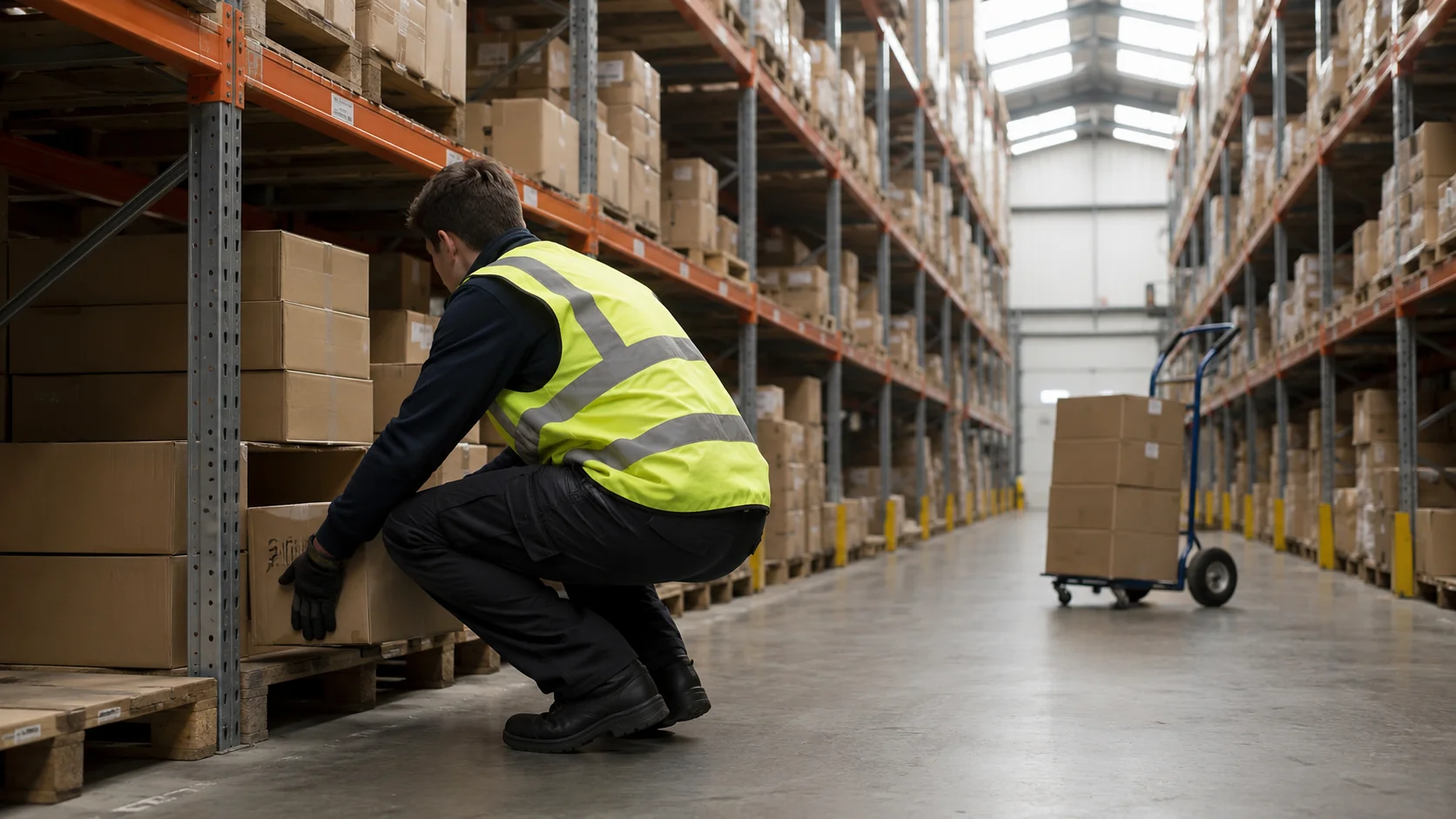
A manual handling risk assessment is the structured examination of any task at work that involves lifting, lowering, pushing, pulling, carrying or moving a load by hand. The duty sits under the Manual Handling Operations Regulations 1992, as amended by the Health and Safety (Miscellaneous Amendments) Regulations 2002. The regulations apply across every UK workplace where manual handling is part of the work, from healthcare to warehousing, from construction to retail.
This page covers what the regulations require, the TILE assessment framework, the HSE's guideline weights (and the persistent myth that they're a legal limit), and where most assessments fall short.
The three-step duty: avoid, assess, reduce
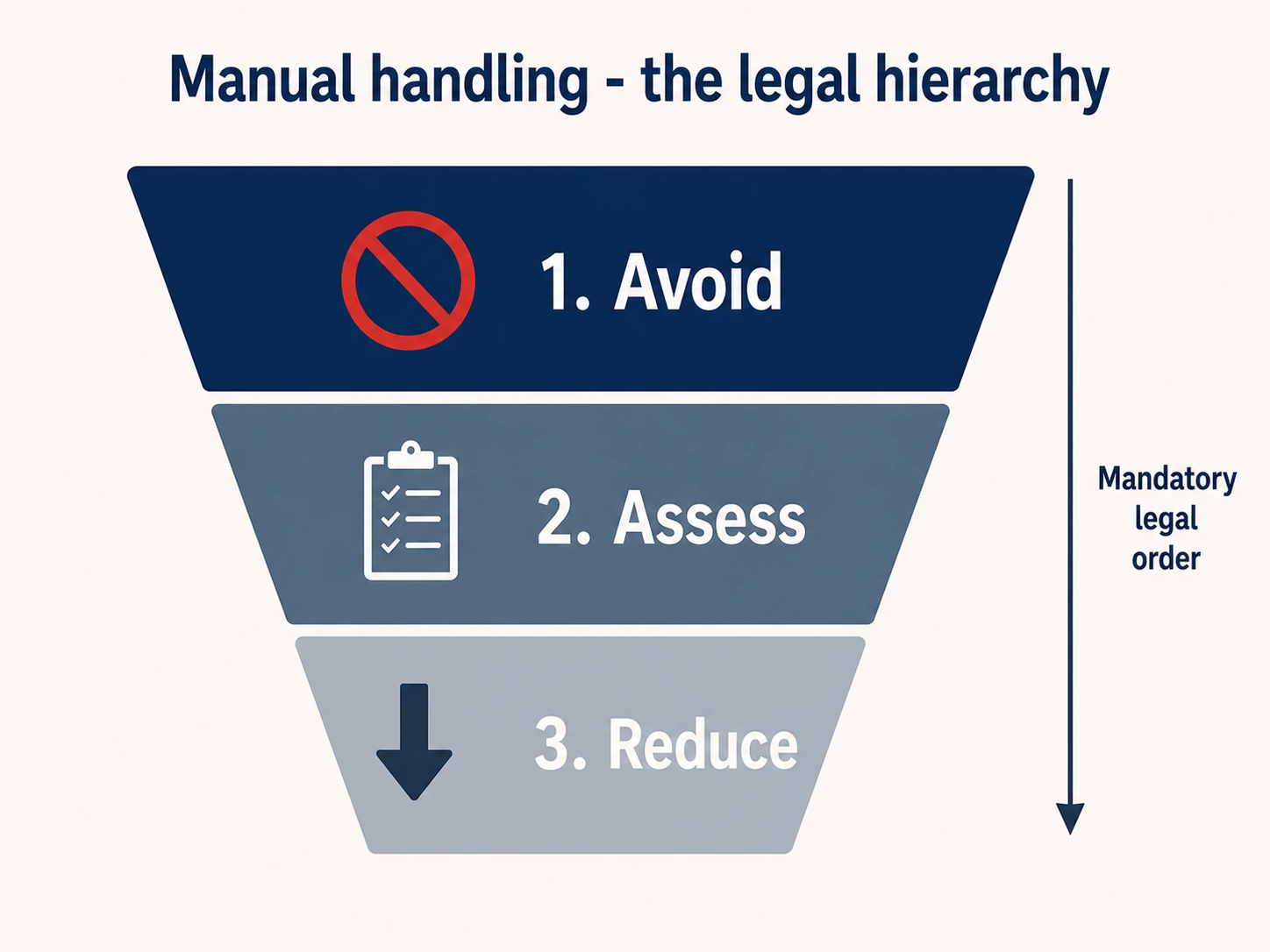
The single most important thing to get right about manual handling law is the order of duties. Regulation 4 of the 1992 regulations sets out a strict hierarchy that the employer must apply in order:
First, avoid hazardous manual handling
Where it's reasonably practicable to do so, eliminate the manual handling entirely. Mechanise the lift. Redesign the process so the load doesn't have to be moved by hand. Locate the work so the awkward movements aren't required. Avoidance comes before assessment because if the handling can be eliminated, the assessment work is unnecessary.
Second, assess any hazardous manual handling that can't be avoided
This is where the TILE framework comes in. The assessment has to be suitable and sufficient — meaning specific to the actual task, the actual people doing it, the actual loads, and the actual working environment.
Third, reduce the risk of injury to the lowest level reasonably practicable
Where the handling can't be avoided, the controls must bring the risk down as far as sensibly possible. Training alone is rarely enough; the controls usually involve a combination of task redesign, mechanical aids, environmental improvements and competence-building.
The order matters. Assessments that start with TILE — without first asking whether the handling can be avoided — invert the legal hierarchy and miss the most effective control of all. We see this routinely in workplaces where a heavy lift has been "TILE'd" carefully for years when a trolley, a lift table or a process change would have eliminated the handling entirely.
The TILE framework
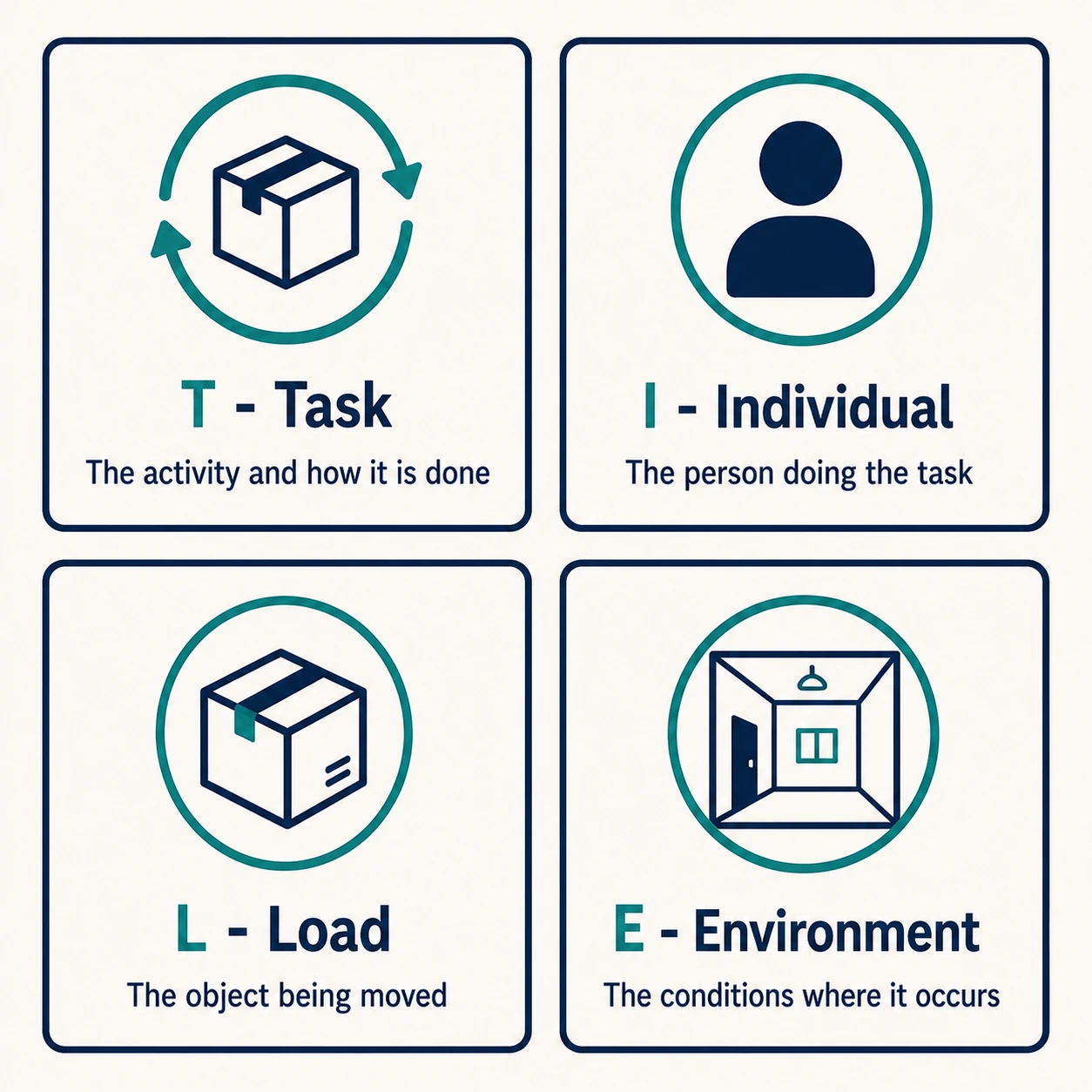
For handling that can't be avoided, the HSE's recommended assessment framework is TILE — Task, Individual, Load, Environment. Each letter prompts a different category of question.
Task
The handling activity itself. Does it involve twisting, stooping, reaching upwards or sideways, or holding loads away from the body? Over what distance is the load moved? How often is the task performed in a shift? Are there sudden movements, jerks or unpredictable elements? Is the task carried out in awkward postures or in confined spaces? Is rest or recovery time built in between repetitions? Does the work require precise positioning of the load? Is it carried out alone or as team handling?
Individual
The capability of the people actually doing the work. Does the task require unusual strength or height? Are there workers who might be at particular risk — pregnant workers, workers with existing musculoskeletal conditions, workers returning from injury, young workers whose physical development isn't complete? Has the worker been adequately trained for this specific task? Do they have the right clothing and footwear?
Load
The thing being moved. How heavy is it? Is its weight evenly distributed, or does the centre of gravity shift in handling? Is it bulky, awkwardly shaped, sharp, slippery, hot, cold or wet? Can it be grasped securely? Does it contain other things that could shift in transit?
Environment
The physical conditions in which the handling takes place. Are floors level and in good condition? Is there enough space to manoeuvre? Is the lighting adequate? Are there temperature extremes? Is the worker exposed to wind, vibration or other physical stressors? Are there steps, slopes, or surface changes along the route?
Some sectors use TILEO (adding "Other people"), reflecting the reality that handling another person — in healthcare, social care or emergency response — has dimensions that go beyond inanimate loads. Some use LITE, which covers the same factors in a different order. The acronym you pick matters less than ensuring every category is genuinely considered.
The 25 kg "limit" — a myth worth correcting
There is no legal maximum weight for manual handling at work in the UK. None.
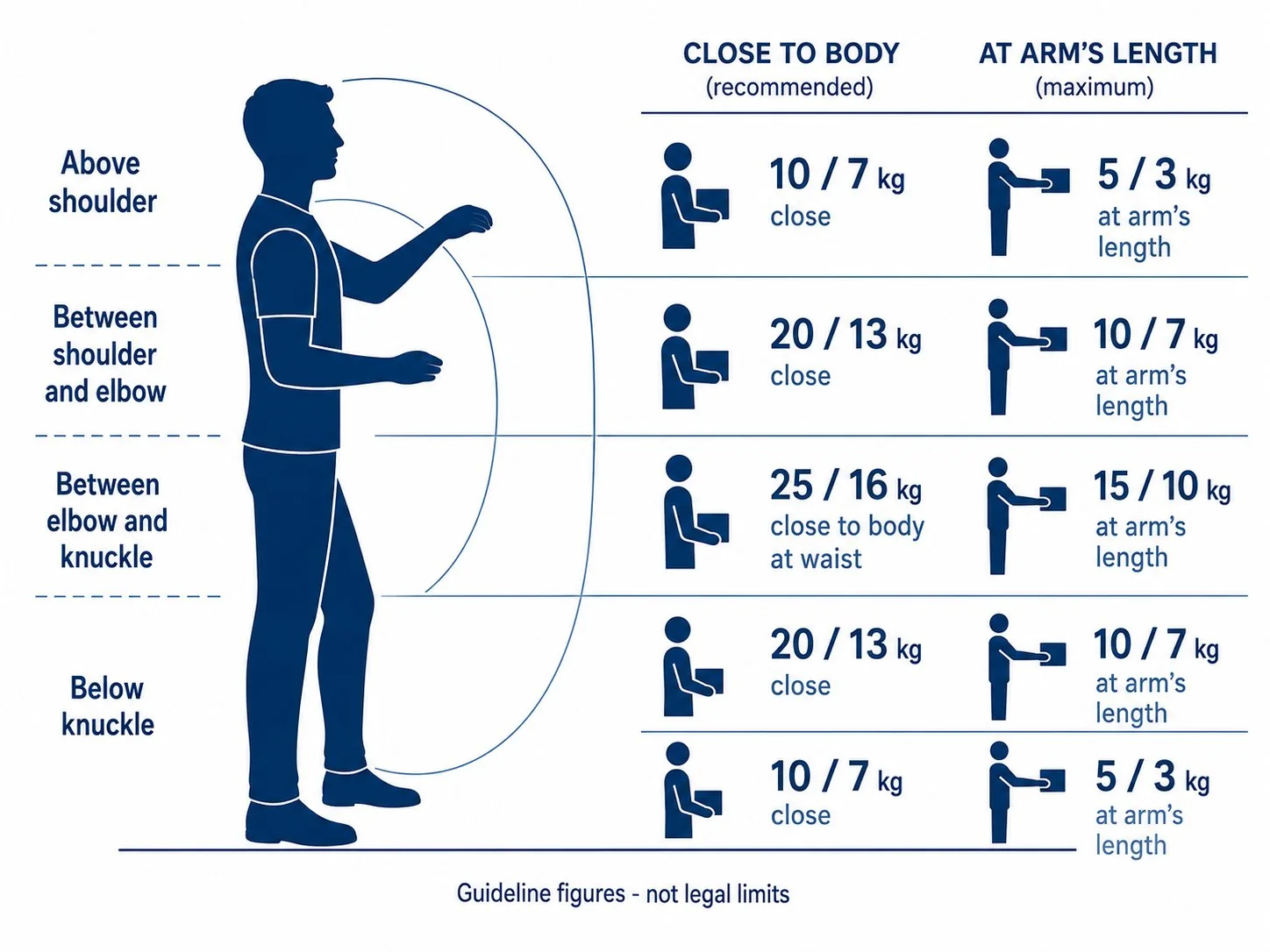
The HSE publishes guideline figures — not legal limits — as a screening tool to help with risk assessment. The guidelines describe weights that a reasonable male or female employee should be able to handle in defined postures without elevated risk of injury. The headline figures most often quoted are 25 kg for a man and 16 kg for a woman lifting close to the body at waist height.
But those figures only apply in specific conditions: load held close to the body, at waist height, with the worker stationary and facing the load. The figures fall sharply when the load is held further from the body, above shoulder height, below knee height, or with twisting. For a load held at arm's length above the shoulder, the guideline drops to a fraction of the waist-height figure — for some postures, well below 10 kg for a man.
The HSE has been explicit, repeatedly, that the guidelines are an assessment tool, not a permit. A lift below the guideline weight in an awkward posture can still pose significant risk of injury and may need controls. A lift above the guideline weight in ideal conditions, performed occasionally by a trained worker, may pose acceptable risk.
The persistence of the "25 kg legal limit" myth has practical consequences. Workers are told they can refuse anything heavier; employers are told they're compliant if they keep loads at 24.9 kg; insurance disputes get framed around the wrong question. The actual legal question is whether the handling can be avoided, and if not, whether it has been properly assessed and the risk properly controlled. Weight is one input to the assessment, not its conclusion.
The Manual Handling Assessment Charts
For tasks where the simple TILE walkthrough isn't enough — particularly repetitive lifting, carrying, team handling, or pushing and pulling — the HSE publishes more structured assessment tools.
The Manual Handling Assessment Charts (MAC) is a colour-coded tool for assessing lifting, carrying and team handling. It scores the task across several factors (load weight, hand distance from the body, vertical lift zones, twisting/sideways bending, posture/loading, floor surface, environmental factors) and produces a risk level that helps the assessor decide whether further detailed assessment is needed.
The Risk Assessment of Pushing and Pulling tool (RAPP) covers tasks involving wheeled equipment, trolleys, sack barrows and similar. Pushing and pulling injuries are a substantial category of MSDs that the TILE framework alone doesn't capture well.
The Assessment of Repetitive Tasks tool (ART) covers upper-limb tasks involving repetitive movement, force, awkward postures or psychosocial factors. ART is the right tool for assembly work, packing operations, checkout work and similar repetitive activities.
All three tools are HSE publications and are freely available. They're not legally required — TILE plus good judgement is enough for most assessments — but they're powerful when the simple framework runs out.
Training requirements
The 2002 amendment to the regulations added regulation 4(3), which requires the employer to consider — among other things — whether the worker has adequate knowledge and training for the manual handling tasks they're asked to perform. The duty to provide manual handling training arises from a combination of the 1992 regulations, the Management of Health and Safety at Work Regulations 1999 regulation 13 (general training duty), and the underlying duty in the Health and Safety at Work etc. Act 1974.
Training has to be appropriate to the actual tasks. A general "safe lifting techniques" course delivered once at induction isn't enough for a warehouse picker, a healthcare worker handling patients, or a delivery driver loading and unloading vehicles all day. Effective training is task-specific, practical, and refreshed.
The deeper point — often missed in training programmes that focus heavily on lifting technique — is that the regulations prioritise design over technique. The legal hierarchy is to avoid, assess, then reduce; reducing risk through training comes after engineering and task redesign, not instead of them. A workplace that relies on "lift properly" as its main control is working at the wrong end of the hierarchy.
Vulnerable workers
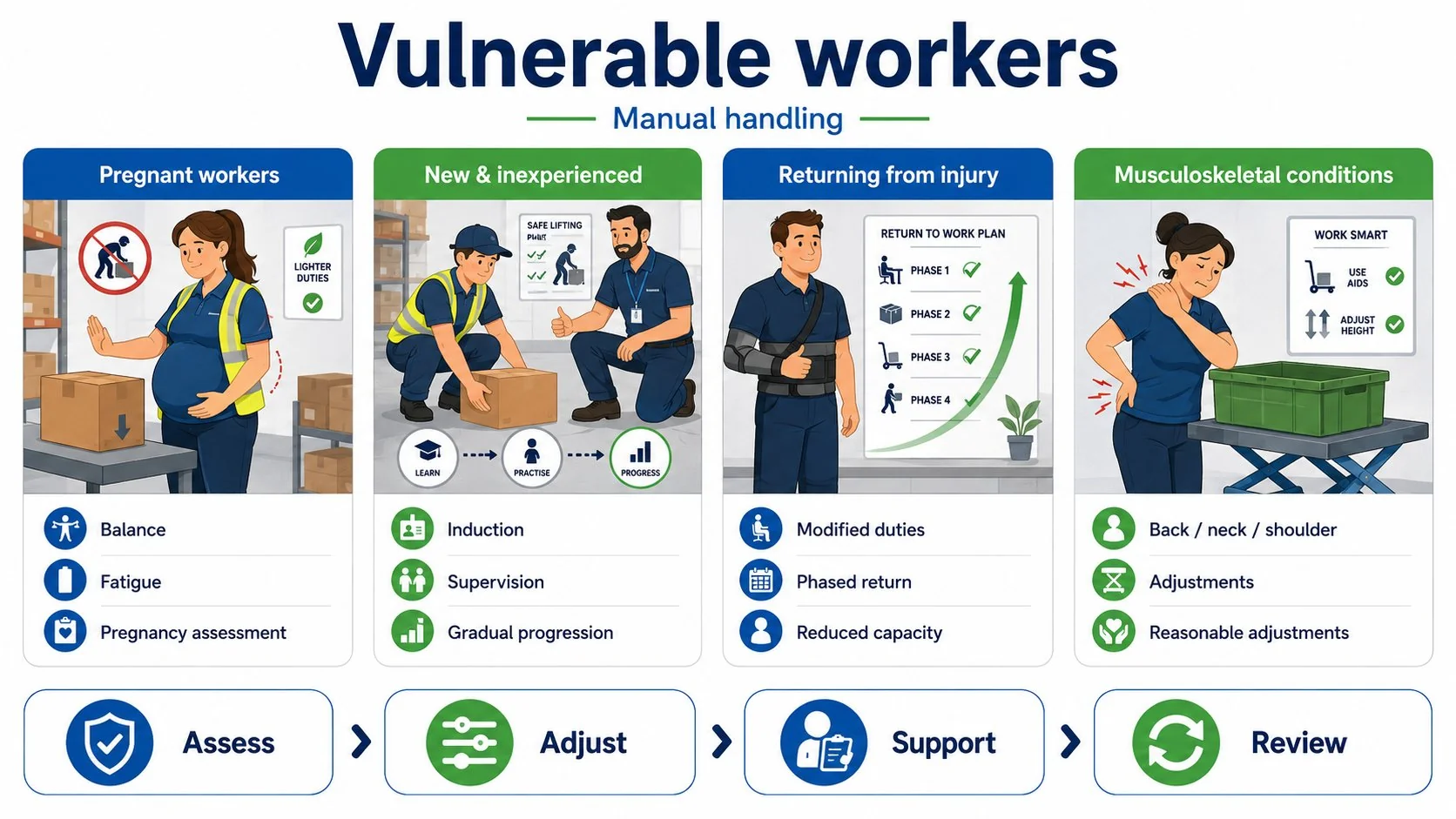
Some workers face particular manual handling risks that need specific consideration in the assessment.
Pregnant workers
Pregnancy changes the body's response to manual handling — ligament softening, changes to balance, fatigue. The pregnancy risk assessment duty under regulation 16 of the 1999 regulations sits alongside the manual handling assessment, and the two should be coordinated for any pregnant worker whose role involves handling.
New and inexperienced workers
Workers new to a task — including young workers — are at elevated risk because they haven't yet learned the specific handling patterns of the job. Induction, supervision and gradual progression are part of the controls.
Workers returning from injury
Returning workers may have reduced capacity, particularly where the original injury was musculoskeletal. The assessment should consider whether modified duties or phased return is needed.
Workers with existing musculoskeletal conditions
A worker with a known back, neck or shoulder condition may need adjustments to handling tasks. The Equality Act 2010 may engage if the condition amounts to a disability — see the stress risk assessment page for the broader framework on disability and reasonable adjustments.
Industry notes
Healthcare and social care
Patient handling — moving people, supporting them in transfers, repositioning in beds — is the manual handling category where TILEO (with the "other people" addition) is most relevant. Hoists, slide sheets, transfer boards and other patient handling equipment are the engineering controls; competence in their use is essential.
Warehousing and logistics
Repetitive picking and packing, heavy lifts onto vehicles, awkward postures in confined trailer space. The MAC and RAPP tools earn their keep here. Mechanisation — pick-to-light, automated storage, electric pallet trucks — is the high-impact control.
Construction
Heavy materials, awkward terrain, sustained physical demand over the working day. Mechanical aids and break planning are the primary controls. RAMS for construction tasks should include manual handling content where significant.
Retail
Frequent low-weight lifts, repetitive movements at the till, awkward stock locations. The risk profile is musculoskeletal-disorder-heavy rather than acute-injury-heavy, and ART is often the appropriate tool.
Records and review
The assessment record should cover the task, the individual or group at risk, the load, the environment, the control measures in place, and any further action needed. Where mechanical aids are part of the controls, their maintenance and inspection regime should be referenced. Where training is part of the controls, the training records should be linked.
Review is required when the task changes, when new equipment is introduced, when an injury is reported, when there's a change to the workforce profile, or when there's reason to suspect the assessment is no longer valid. Annual review is widely treated as good practice; for higher-risk operations more frequent review is appropriate. We cover the general framework in our page on how often a risk assessment should be reviewed.
Where this connects in the cluster
Manual handling intersects with several other vertical assessments. Pregnancy risk assessment for any handling task. Young persons risk assessment where under-18s are involved in handling. COSHH risk assessment where the load itself is a hazardous substance. Dynamic risk assessment for handling in unpredictable conditions — emergency response, social care home visits, mobile work.
For workplaces with significant manual handling — warehousing, healthcare, construction, manufacturing — investment in proper assessor competence pays back quickly. Formal Risk Assessment Training covers the general method that underpins manual handling assessment; manual-handling-specific competence is then layered on top with task-specific training for assessors.
Frequently asked questions
Is there a legal weight limit for lifting at work in the UK?
No. The HSE publishes guideline figures (around 25 kg for a man and 16 kg for a woman lifting close to the body at waist height, with much lower figures in awkward postures) but these are screening tools, not legal limits. The legal question is whether the handling can be avoided and, if not, whether the risk has been properly assessed and controlled.
What does TILE stand for in manual handling?
Task, Individual, Load, Environment. It's the four-category framework the HSE recommends for assessing manual handling tasks. Some sectors use TILEO (adding "Other people" for patient handling) or LITE (the same factors in a different order).
When does manual handling training become a legal requirement?
Whenever a worker carries out manual handling that could pose a risk of injury. The 1992 regulations require employers to provide information, instruction and training, and the level of training has to be appropriate to the task. There's no specific course or duration mandated, but generic awareness training rarely satisfies the duty for workers in handling-heavy roles.
Do I need a manual handling assessment for office workers?
For routine office work, usually no. But office workers do carry out manual handling — moving boxes during archiving, lifting equipment, helping with deliveries — and where the handling poses a real risk of injury the assessment is required. The general workplace risk assessment usually covers occasional handling; dedicated manual handling assessment is needed where handling is a regular part of the work.
Can I refuse a lift if it's heavier than 25 kg>
Not on the basis of the 25 kg figure alone — it isn't a legal limit. A worker can refuse to carry out work they reasonably believe poses a serious and imminent risk to themselves, but the framework for that refusal is the risk assessment and the controls in place, not a weight threshold.