


%201.svg)


RAMS stands for Risk Assessment and Method Statement. It's the standard format the UK construction industry uses to demonstrate that hazards on a job have been identified, controls have been planned, and the method of work has been thought through before anyone starts. Principal contractors expect it from sub-contractors; clients expect it from contractors; insurers and clients increasingly expect it before access is granted to a site.
One thing to clear up at the outset. "RAMS" is not a term that appears in UK legislation. The components are legally required — the risk assessment, under the Management of Health and Safety at Work Regulations 1999, and the plan-manage-monitor duty under the Construction (Design and Management) Regulations 2015 — but the combined document called a RAMS is industry convention, not statute. That convention is now so embedded that working without it on a construction site is practically impossible, but understanding what's a legal duty and what's a procurement requirement makes you better at meeting both.
Risk assessment vs method statement
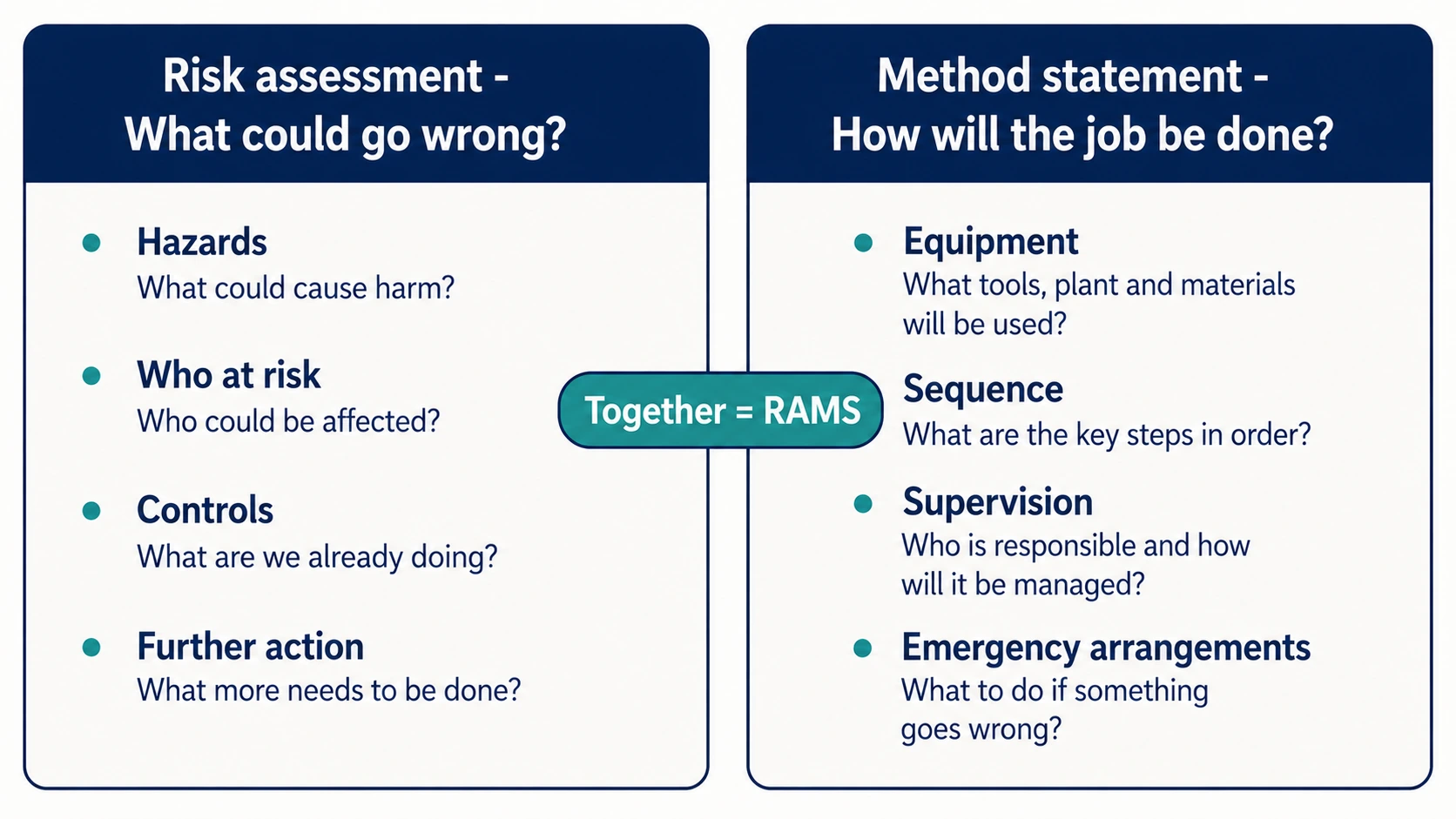
A risk assessment answers what could go wrong. It identifies the hazards on the job, who could be harmed, the controls that will be in place, and any further action needed before work can start. The structure follows the five-step method we cover on our risk assessment process page.
A method statement answers how the job will be done so it doesn't go wrong. It's a step-by-step description of the work — equipment, sequence, supervision, emergency arrangements — written in enough detail that a competent worker can follow it without having to invent the method from scratch.
The two documents reference each other. The risk assessment identifies that working at height on a fragile roof is a hazard. The method statement says how the access will be set up, what edge protection will be used, who will check it, what the team will do if the weather changes, and how a rescue would be organised if someone fell. The risk assessment establishes the what; the method statement establishes the how.
Some commercial RAMS templates blur the two together into a single narrative. That works for simple jobs but gets confusing on complex ones. The HSE's preference, set out in the L153 guidance on managing health and safety in construction, is for the two elements to be clearly identifiable even when they share a document.
When you need a RAMS
Not every construction task requires a formal RAMS pack. A general risk assessment for routine office work doesn't need a method statement. A site-induction toolbox talk for unloading materials may not.
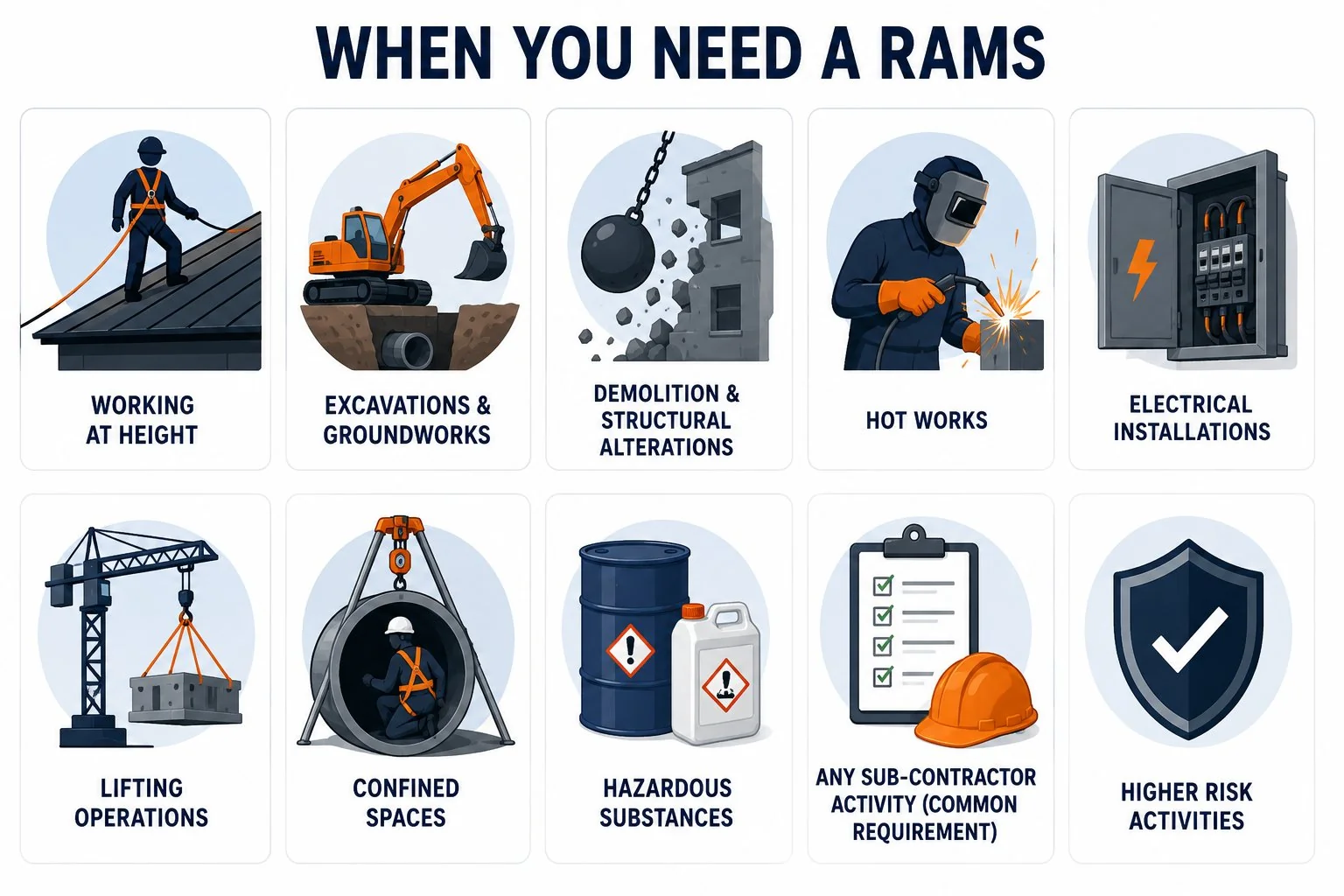
A RAMS is expected — by clients, principal contractors and insurers — for higher-risk activities. The most common categories are:
Working at height — roof work, scaffolding, mobile elevating work platforms, edge work, work near fragile surfaces.
Excavations and groundworks — anything involving ground stability, services strikes, confined spaces below ground level.
Demolition and structural alterations — load paths, dust suppression, asbestos surveys, debris management.
Hot works — welding, cutting, grinding, brazing, any task that produces sparks or heat where flammable materials are present.
Electrical installations — anything beyond routine domestic work, especially work on or near live equipment.
Lifting operations — crane work, telehandlers, complex rigging.
Confined spaces — vessels, ducts, sewers, voids.
Work involving hazardous substances — where the COSHH controls need to be set out in operational detail.
Principal contractors will often require RAMS for any sub-contractor activity regardless of category, because a consistent documentation requirement is easier to administer than case-by-case judgement. That's a procurement choice, not a legal one.
How CDM 2015 fits in
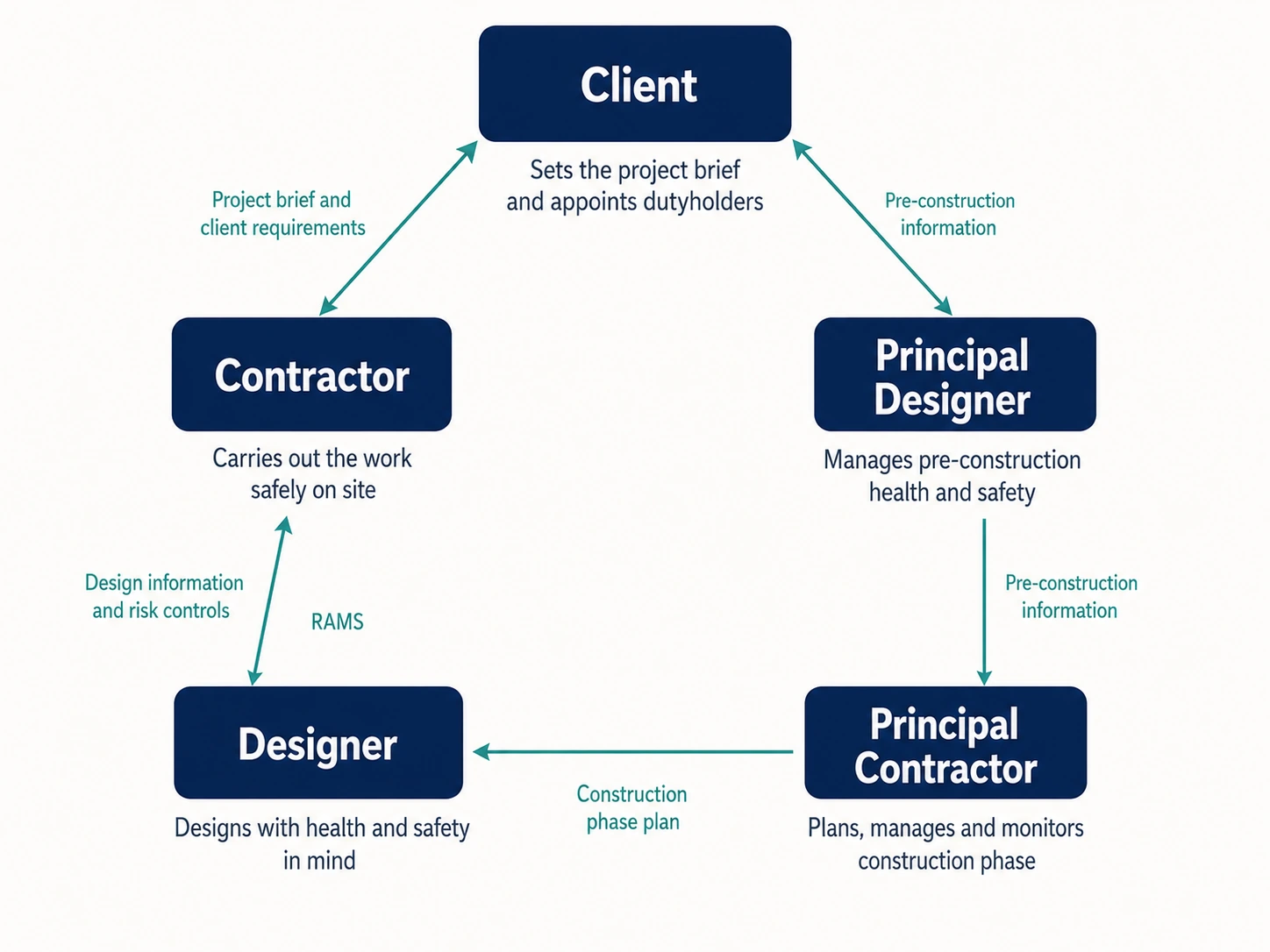
The Construction (Design and Management) Regulations 2015 are the overarching framework for construction health and safety in the UK. They set out duties for five dutyholders: Client, Principal Designer, Principal Contractor, Designer, and Contractor.
Risk assessment under CDM 2015 starts at the design stage. The Principal Designer has a duty to identify and reduce foreseeable risks during design, before construction begins. The information then flows into the Pre-Construction Information that the Principal Contractor uses to plan the build. The Construction Phase Plan documents how the project will be managed safely, and individual RAMS for specific activities sit inside that broader plan.
The interface that matters for RAMS is between the Principal Contractor and the Contractor. The Principal Contractor sets the site-wide rules and reviews the RAMS that contractors submit. The Contractor produces the RAMS for their specific work and is responsible for ensuring it's followed on the ground. The HSE's L153 guidance (Managing health and safety in construction) is the operational rule book.
What goes in a RAMS
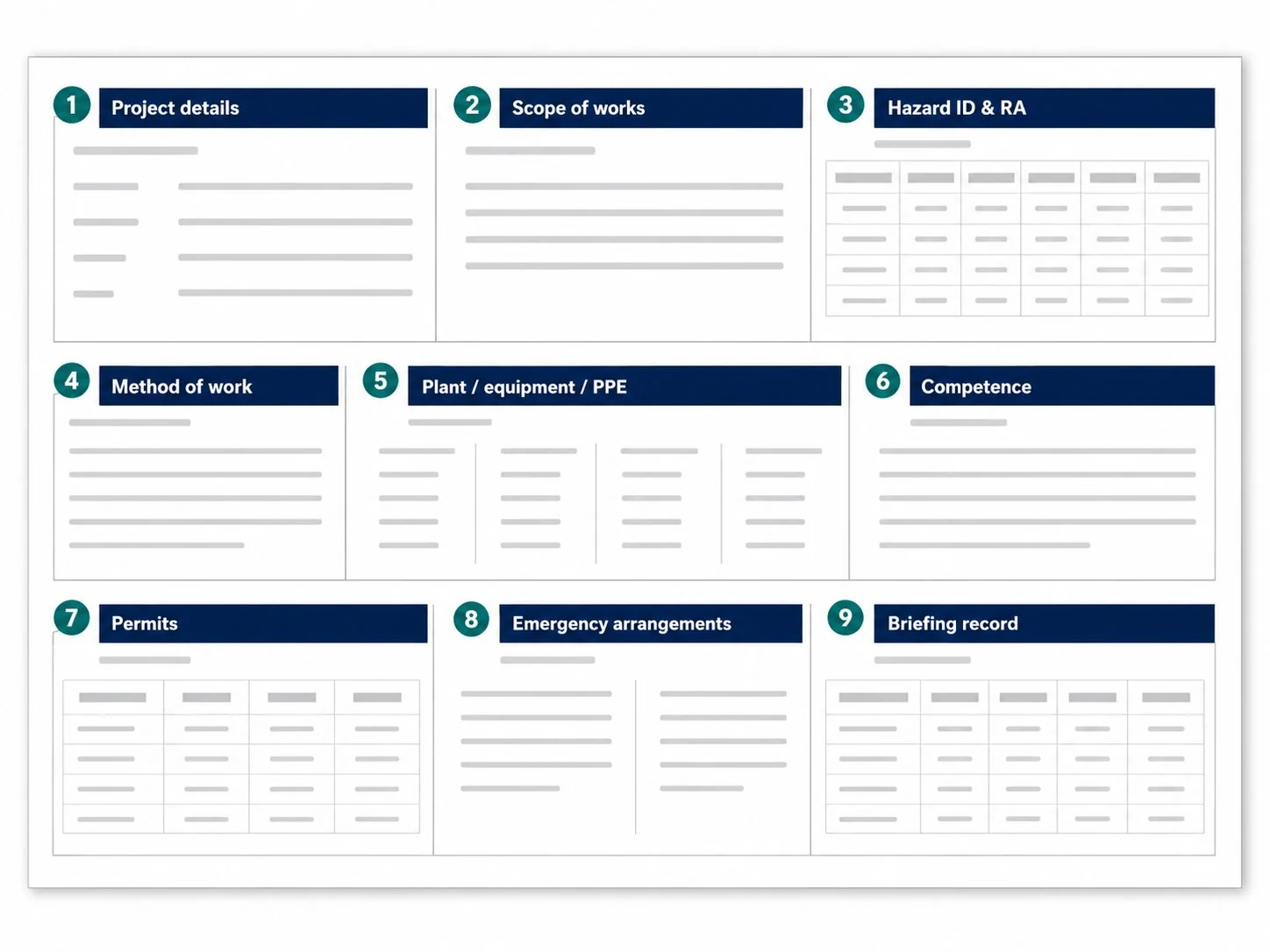
The structure varies between organisations but the core content is consistent.
Project details
Site address, client, principal contractor, contractor, date, version, who wrote it, who approved it.
Scope of works
A description of the job in enough detail that a reader unfamiliar with the project understands what's being done.
Hazard identification and risk assessment
The hazards specific to this scope, who could be harmed, the controls that will be in place, the residual risk after controls. This is the risk assessment part.
Method of work
Step by step. Setup, sequence, supervision, equipment, materials, PPE, emergency arrangements. This is the method statement part.
Plant, equipment and PPE
What gear will be on site and any inspection or maintenance arrangements.
Competence requirements
What qualifications, training or experience the people doing the work need to have.
Permits and notifications
Any permit-to-work, hot work permit, confined space entry, or notifications required.
Emergency arrangements
First aid, fire, what happens if a worker is injured at height, escape routes.
Sign-off and briefing
Who's accepted the document on the contractor side, who's authorised it on the principal contractor side, and the record of the on-site briefing to the workers actually doing the job.
Who writes a RAMS and who signs it off
The contractor responsible for the work writes the RAMS. That can be in-house, or it can be drafted by a specialist consultant working for the contractor. The key requirement is that the author is competent — they have the skills, knowledge, experience and training to understand the work and the hazards.
The Principal Contractor reviews and accepts the document before the work starts. Accepting it means the Principal Contractor is satisfied that the RAMS is suitable for the site conditions and integrates with the broader Construction Phase Plan. It doesn't transfer responsibility — the contractor remains accountable for their own work — but the Principal Contractor's review is a structural part of the safety system.
The workers doing the job have to be briefed on the RAMS before work starts. A signed briefing record is part of the document and is the evidence that the controls in the document actually reached the people on the ground.
A worked roofing example
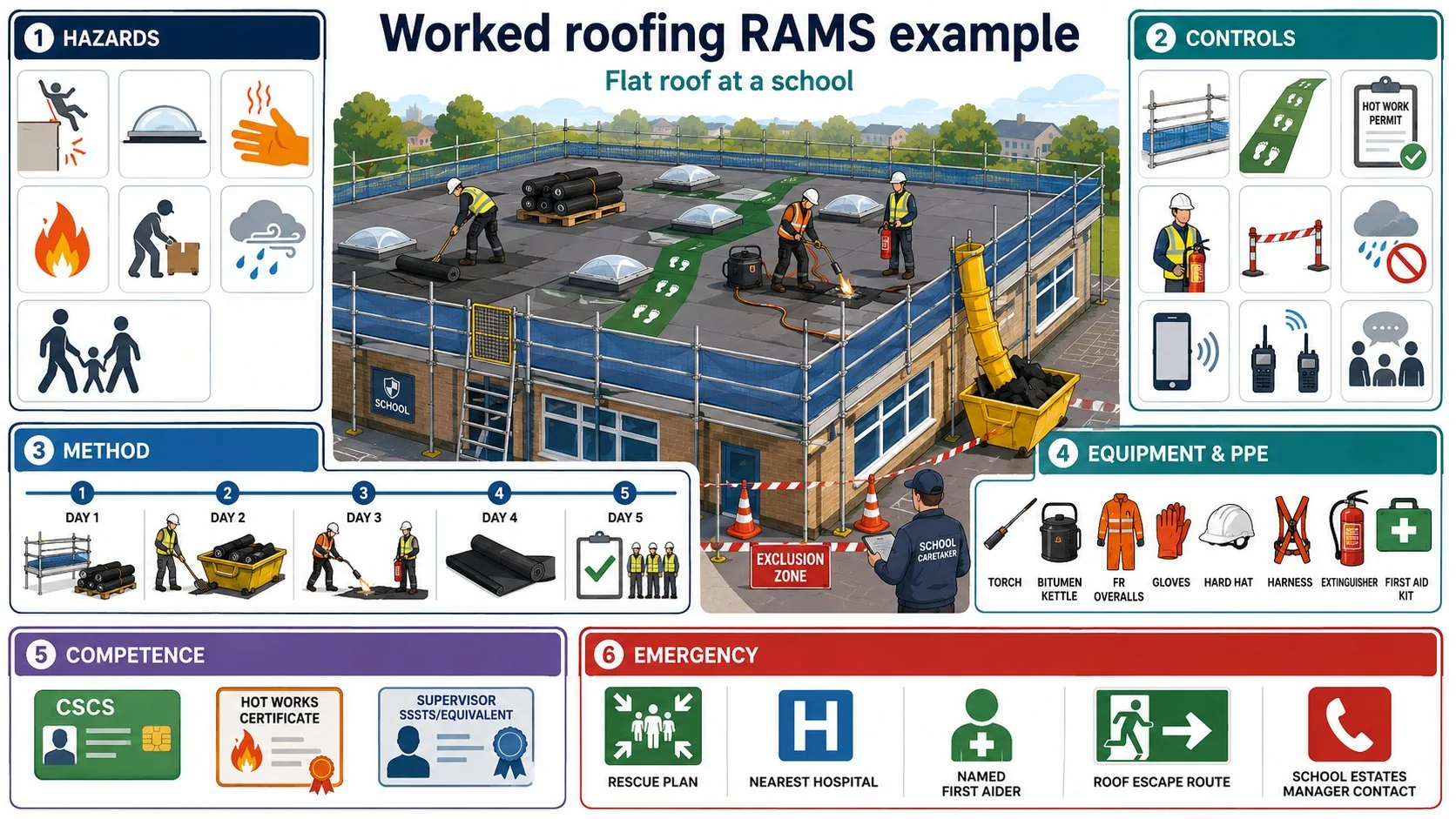
A small contractor is replacing the felt covering on a single-storey flat roof at a school during the summer holiday. The work involves working at height, hot works (for some of the bitumen), and disposal of old material.
The RAMS would cover:
Hazards: falls from the roof edge; falls through fragile rooflights; burns from the hot bitumen; fire spread to the building; manual handling of materials up to the roof; weather (wind, rain); members of the public on site (school staff present despite holiday).
Controls: edge protection scaffold around the perimeter; protected route across the roof avoiding rooflights; fire watch during and after hot works; written hot work permit; defined exclusion zone below; weather decision criteria (work stops at wind above a defined speed, or if surface is wet); communication plan with school caretaker.
Method: day-by-day sequence. Day 1 — scaffold up, materials delivered, hot work permit raised, area cordoned. Day 2 — strip old felt to skip via chute. Day 3 — bitumen application with two-person team, fire watch in place. Day 4 — second pass and finishing. Day 5 — strike scaffold, clear site, brief school staff on completion.
Equipment and PPE: specified torch and bitumen kettle, FR overalls, gloves rated for hot work, hard hats, harnesses (despite collective edge protection, in case of need for short-duration work over an edge), fire extinguisher class A and B/C, first aid kit on the roof.
Competence: all operatives hold CSCS cards, the torch operative holds a relevant hot works qualification, the supervisor holds an SSSTS or equivalent.
Emergency: rescue plan for height work, hospital location, named first aider, fire evacuation route from roof, contact for the school estates manager.
That RAMS runs to about eight pages including the appended risk assessment matrix and the briefing record. It would be reviewed and accepted by the principal contractor (or the client's project manager on a domestic-led project) before any work commenced.
Generic templates vs site-specific RAMS
A persistent issue with RAMS is the use of generic templates that aren't adapted to the specific site. A roofing template that mentions "edge protection" without specifying the actual scaffold design, "weather criteria" without specifying the wind speed, or "fire watch" without naming the responsible person isn't a useful RAMS — it's a draft that hasn't been finished.
The HSE has consistently said in enforcement cases that generic documentation doesn't satisfy the suitable-and-sufficient test. A template is a starting point; the work of producing a defensible RAMS is in making it specific to the site, the team, the equipment and the conditions on the day.
That's also where most disputes between contractors and principal contractors arise. The principal contractor rejects a RAMS as "generic"; the contractor pushes back because the template covers the activity. The right response is usually the principal contractor's: a RAMS that doesn't name the specific scaffolder, specific fire-watch operative, specific extinguisher locations and specific wind threshold is not site-specific yet.
Briefing, not filing
A signed RAMS in a folder doesn't protect anyone. The document only does its job once the people on the ground have been briefed on it, understand it, and have the chance to question or amend it before work starts.
The briefing record at the back of every RAMS is the operational evidence that this happened. Some contractors run the briefing as a structured toolbox talk; some integrate it into the morning huddle. The format matters less than the substance: the workers know what they're doing, why, what the hazards are, what the controls are, and what to do if something doesn't match the plan.
If competence is the foundation of the RAMS being written well, the briefing is the foundation of it being followed. The two together — proper drafting and proper briefing — are what makes the document worth the time it took to produce. Well-structured Risk Assessment Training covers both elements and produces people who can do the work in-house rather than outsourcing every RAMS.
Frequently asked questions
Is a RAMS a legal requirement under UK law?
The term "RAMS" isn't in any UK statute. The two components are legally required in their own right: a risk assessment under the Management of Health and Safety at Work Regulations 1999, and the planning, managing and monitoring duty under the Construction (Design and Management) Regulations 2015. The combined RAMS document is industry convention rather than a specific legal requirement.
Who can write a RAMS?
Anyone competent for the work. Competence here means the skills, knowledge, experience and training to understand the hazards and the realistic controls. For straightforward work, an experienced site supervisor with the right training writes the RAMS for their own team. For complex projects, the work is often drafted by a specialist H&S consultant or an in-house H&S advisor.
How often does a RAMS need to be reviewed?
RAMS are usually job-specific and don't have a periodic review cycle. The review trigger is change: a new site, a change of method, an incident, a near-miss, weather conditions outside the plan, or a complaint from a worker on the ground. A live RAMS on a long project is amended as needed; a one-off RAMS for a short job is closed out at completion.
What's the difference between a method statement and a safe system of work?
A method statement is the document that describes how the work will be done. A safe system of work is the broader concept — the whole set of planning, supervision, equipment, training and procedures that produces a safe outcome. The method statement is one expression of the safe system of work; the actual safe operation requires the system to be followed in practice, not just documented on paper.