


%201.svg)


A working at height risk assessment is a structured examination of any work where a worker could be injured by falling. The duty sits under the Work at Height Regulations 2005, which apply across every UK workplace where work at height takes place — construction, maintenance, window cleaning, retail stockroom access, theatrical rigging, agricultural work, even routine office tasks like changing a ceiling light.
Falls from height are consistently the largest single cause of fatal workplace injury in Great Britain. The Health and Safety Executive's accredited statistics for 2024/25 record 35 worker deaths from falls from height — roughly a quarter of all worker fatalities. The legal framework reflects that level of risk. This page covers what the regulations require, the strict statutory hierarchy of control, and the elements of a defensible assessment that competitor guidance routinely misses.
What "work at height" means in UK law
The 2005 regulations define work at height as work in any place where, if there were no precautions in place, a person could fall a distance liable to cause personal injury. That includes work at, above or below ground level, work involving access to or egress from a place of work, and work involving falling through a fragile surface.
There is no minimum height. This is the single most common misconception in UK working at height law and deserves a clear statement: the 2 metre rule was abolished by the 2005 regulations. Before 2005, certain duties applied only to work above 2 metres; after 2005, the regulations apply at any height from which a fall could cause injury. A worker standing on a kitchen chair changing a smoke alarm is working at height under the regulations, even though the fall is less than a metre. The actual height affects what controls are reasonable and proportionate — but it doesn't determine whether the regulations apply.
The duty also covers work where someone could fall through a surface, not just off an edge. Fragile rooflights, weakened floor sections and similar features are covered specifically by regulation 9.
The strict hierarchy: avoid, prevent, mitigate
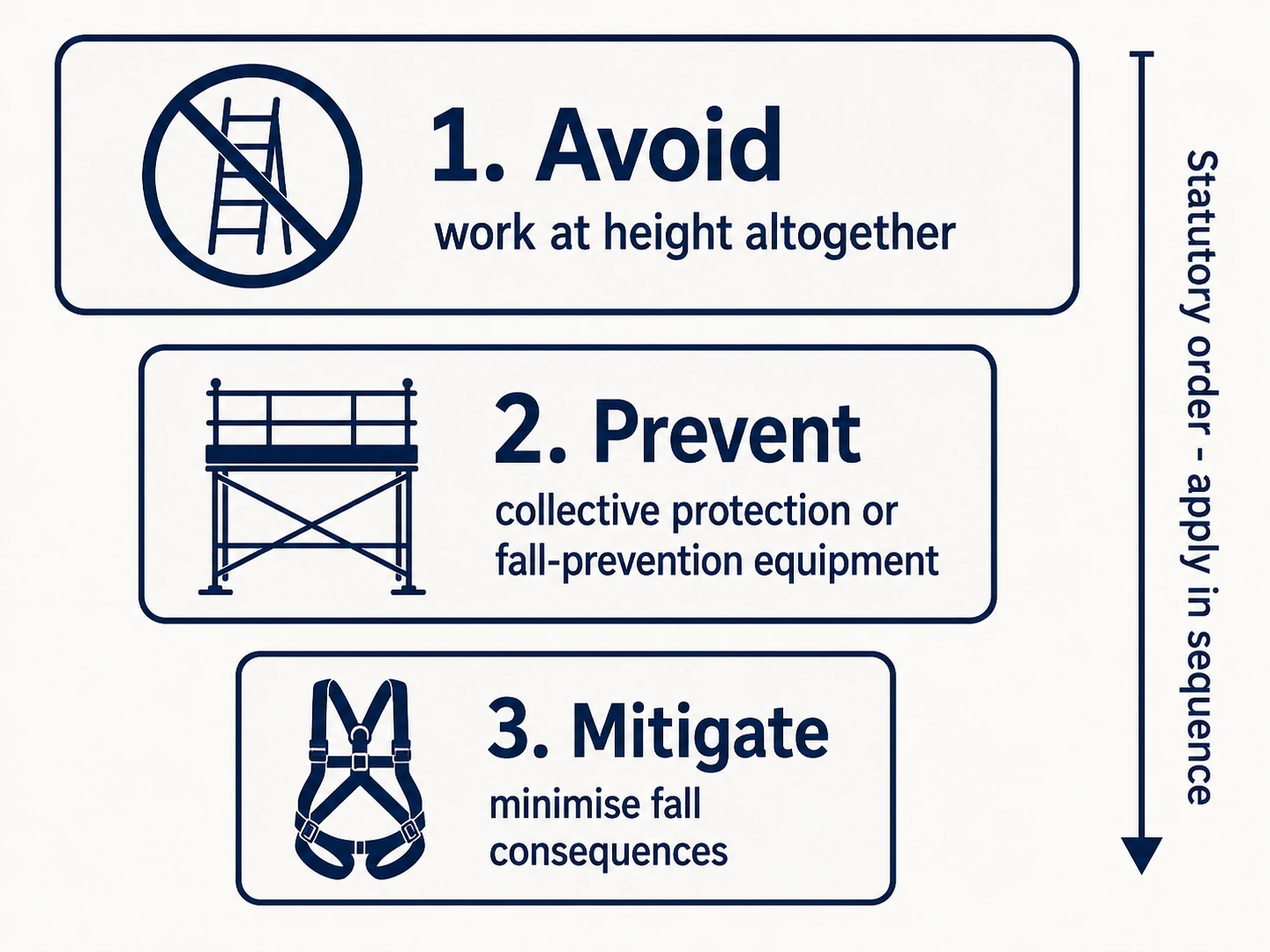
Regulation 6 of the 2005 regulations sets out a hierarchy that the employer must apply in order. Unlike the general hierarchy of control we cover on our five-steps page, this hierarchy is statutory and the order is binding.
First — avoid working at height where it is reasonably practicable to do so
Can the work be done from the ground? Can the equipment be designed so maintenance is done at ground level? Can prefabrication eliminate the need for at-height assembly? Avoidance is the strongest control because it removes the hazard entirely.
Second — where work at height cannot be avoided, prevent falls
Use a workplace that's already safe (a permanent platform with edge protection), or provide work equipment that prevents falls (a scaffold, MEWP, tower scaffold, secure ladder platform).
Third — where the risk of a fall cannot be prevented, mitigate the consequences of a fall
Provide work equipment that minimises the distance and consequences of a fall (a fall arrest system, a safety net, an air bag), and provide training and instruction.
The order is mandatory. An assessor reaching for personal fall arrest equipment (harnesses) before considering collective fall prevention (scaffolds, MEWPs) has inverted the hierarchy. Personal protection comes last because it only protects the wearer, depends on correct fit and use, requires rescue arrangements, and doesn't address the underlying hazard.
Collective versus personal protection
Within the hierarchy, the regulations also prefer collective protection over personal protection. A scaffold that prevents anyone falling off is preferred to a system that catches one worker when they fall. Edge protection that protects everyone on the roof is preferred to a harness worn by one operative.
The preference exists because collective measures work whether or not the worker has remembered to clip on, whether or not their PPE has been inspected, and whether or not they are using it correctly. Personal fall protection works only if all of those conditions are met for every worker, every time, throughout the task.
A persistent failure mode in UK construction is the use of harnesses where collective protection would have been reasonably practicable. Where harnesses are used, the assessment should justify why collective protection wasn't reasonable and document the rescue plan, the inspection regime and the training.
Fragile surfaces

Regulation 9 of the 2005 regulations covers fragile surfaces specifically. A surface is fragile if it would not safely support the weight of a person — typically rooflights, asbestos-cement roofs, weakened decking, certain industrial roofing systems.
Falls through fragile surfaces remain a significant category of fatal workplace injury, particularly in maintenance and refurbishment work on industrial buildings. The HSE's investigations consistently show the same factors: workers unaware that the surface is fragile, no warning signage at access points, no edge protection or fall protection in place, and supervisors who weren't on site to question the method.
The regulations require that no one passes across or near or works on, from or near a fragile surface unless that's the only reasonably practicable way to carry out the work. Where work near a fragile surface is unavoidable, suitable platforms, coverings or fall protection must be in place, and prominent warnings of the danger must be displayed at the approach.
Falling objects
Regulation 10 covers the hazard of objects falling onto people below. Where work at height could result in objects falling, suitable measures must be taken to prevent injury: securing materials, providing toe boards, using netting or covered scaffolds, establishing exclusion zones.
This duty is often overlooked in assessments that focus heavily on the falling worker and not enough on the people below them. On any construction site, the people walking past at street level are at risk from objects dropped from above; the assessment has to address both directions.
Ladders, towers and Schedule 6
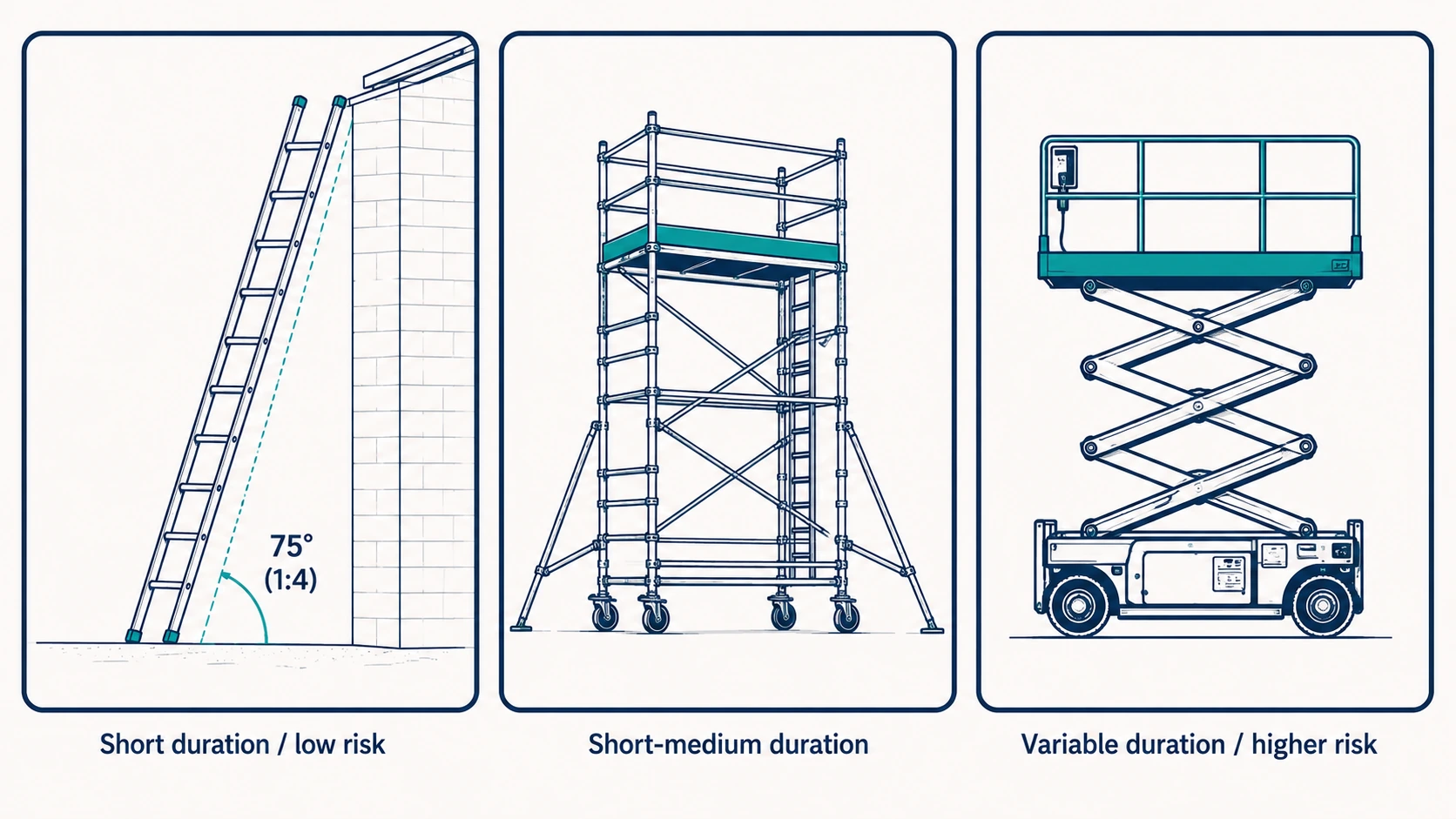
Ladders remain legitimate equipment for work at height, despite a persistent industry myth that "ladders are banned" under the 2005 regulations. They are not banned. The regulations require a risk-based decision about whether a ladder is suitable for the task.
Schedule 6 of the regulations sets out the conditions under which ladders may be used. In essence: ladders are suitable for short-duration work involving low risk, where the use of more substantial equipment isn't reasonably practicable. They must be of suitable type for the work, set up on stable surfaces at the correct angle (the conventional 1:4 rule), prevented from slipping, and either secured or footed where there's any risk of movement.
The right way to read Schedule 6 is as the conditions that justify using a ladder rather than more substantial equipment. Where a job can reasonably be done from a tower scaffold or a MEWP, those should be preferred. Where the task is brief, the height is modest, and the worker can maintain three points of contact, a ladder may be the proportionate choice.
Tower scaffolds are commonly used for short-duration access work. Their use is governed by competence — PASMA (Prefabricated Access Suppliers' and Manufacturers' Association) certification is the industry standard for tower assembly and inspection.
Mobile elevating work platforms (MEWPs) — scissor lifts, boom lifts, vehicle-mounted platforms — are the right choice for many access tasks where ladders or towers would be inadequate. IPAF (International Powered Access Federation) certification is the industry standard for MEWP operation.
Rescue planning
This is the element most commonly missing from UK working at height assessments. Where personal fall protection is used — a harness with a lanyard, attached to an anchor — a rescue plan is mandatory under the 2005 regulations. Not "as good practice". Mandatory.
The reason is suspension trauma. A worker hanging in a harness after a fall is subject to orthostatic intolerance — blood pooling in the legs because the harness leg straps restrict venous return. The condition can produce unconsciousness within minutes and serious injury or death within tens of minutes. A worker who has fallen and is suspended cannot save themselves; they require active rescue by colleagues with the equipment and training to retrieve them.
The rescue plan should identify how a suspended worker would be retrieved, by whom, with what equipment, within what time, and what backup arrangements exist if the primary rescue can't be carried out. "Call the fire brigade" is not, on its own, a rescue plan — fire and rescue services are willing partners, but their arrival time may not match the urgency of the rescue.
A working at height assessment that includes harness use without a rescue plan is incomplete. An assessment that includes harness use with a documented rescue plan, rescue equipment on site, and trained rescuers present is the right standard.
Training and competence
The 2005 regulations require that work at height is planned and supervised by a competent person. Workers carrying out the work must have the necessary skills, knowledge and training for the equipment and method in use.
For specific equipment types, industry-recognised certification is the standard. PASMA for tower scaffold work. IPAF for MEWP operation. NASC TG20 covers tube and fitting scaffolding — a key reference for the design and inspection of conventional scaffolds. NASC SG4 covers the use of harnesses by scaffolders themselves. CISRS (Construction Industry Scaffolders Record Scheme) is the recognised competence framework for scaffolders.
For the assessor of the overall work, the competence required is broader: understanding of the regulations, the hierarchy of control, the available equipment options, the rescue planning duty, and the specific hazards of the work being assessed.
Where this connects in the cluster
Working at height work in construction usually requires a RAMS document that combines the risk assessment with a method statement covering access, sequence, supervision and emergency arrangements. For routine maintenance work outside the CDM framework, a standalone working at height assessment is enough.
The hierarchy of control on our five steps page covers the general principle; the working at height hierarchy is the regulation-specific application. COSHH applies where height work involves hazardous substances — for example, lead removal from old paint. Young persons and pregnancy assessments require specific consideration where the worker is under 18 or pregnant.
For employers with regular working at height activity — construction, building maintenance, roofing, telecoms, scaffolding — competence in working at height assessment is one of the highest-leverage areas of safety management. Formal Risk Assessment Training covers the general method that underpins working at height assessment; equipment-specific certification (PASMA, IPAF, CISRS) layers on top.
Frequently asked questions
At what height does the Work at Height Regulations 2005 apply?
There is no minimum height. The regulations apply to any work where a fall could cause personal injury, regardless of the distance. The pre-2005 "2 metre rule" was abolished by the regulations and shouldn't be relied on.
Are ladders allowed under the Work at Height Regulations?
Yes. Ladders are not banned and remain legitimate equipment for many short-duration tasks involving low risk. Schedule 6 of the regulations sets out the conditions under which ladder use is suitable. The right question is whether a ladder is the proportionate choice for the specific task, not whether ladders are permitted in principle.
What is the hierarchy of fall protection?
Under the 2005 regulations: first, avoid work at height where reasonably practicable; second, prevent falls by using a safe workplace or work equipment that prevents falls; third, mitigate fall consequences with equipment like fall arrest systems and netting. Collective protection is preferred over personal protection within the hierarchy.
Who can carry out a working at height risk assessment?
A competent person — someone with the skills, knowledge, experience and training appropriate to the work. For routine tasks, an experienced supervisor with general working at height training may be competent. For complex or high-risk work, competence usually requires specific qualifications, equipment-specific certification (PASMA, IPAF, CISRS) and recent relevant experience. See our who can carry out a risk assessment page for the broader competence question.
Is the 2 metre rule still law in the UK?
No. The 2 metre rule was abolished by the Work at Height Regulations 2005. The regulations now apply at any height from which a fall could cause injury. Any guidance still citing the 2 metre rule as current law is out of date.
Do I need a rescue plan if my workers use harnesses?
Yes. Where personal fall protection is used, a rescue plan is required under the 2005 regulations. The plan must identify how a suspended worker would be retrieved, by whom, with what equipment, and within what time — to manage the risk of suspension trauma. Harness use without a rescue plan is incomplete and exposes the worker to serious or fatal injury after a fall.