


%201.svg)


A young persons risk assessment is a specific assessment of the workplace hazards as they affect workers under the age of 18. The duty sits under regulation 19 of the Management of Health and Safety at Work Regulations 1999, and it applies to every employer who has workers under 18 — whether as employees, apprentices, work experience students, or in any other capacity.
The reason for a separate duty is that young workers face elevated risk for reasons that go beyond inexperience. Their physical development isn't complete. Their perception of risk is not yet calibrated to adult workplace conditions. They may be reluctant to raise concerns with adult managers. And they often don't yet know what "normal" looks like in a workplace, so they can't easily tell when something is being asked of them that shouldn't be.
This page covers what the regulations require, the additional rules for under-16s, the specific position for work experience placements, and the practical implications for employers who take on apprentices.
Definitions
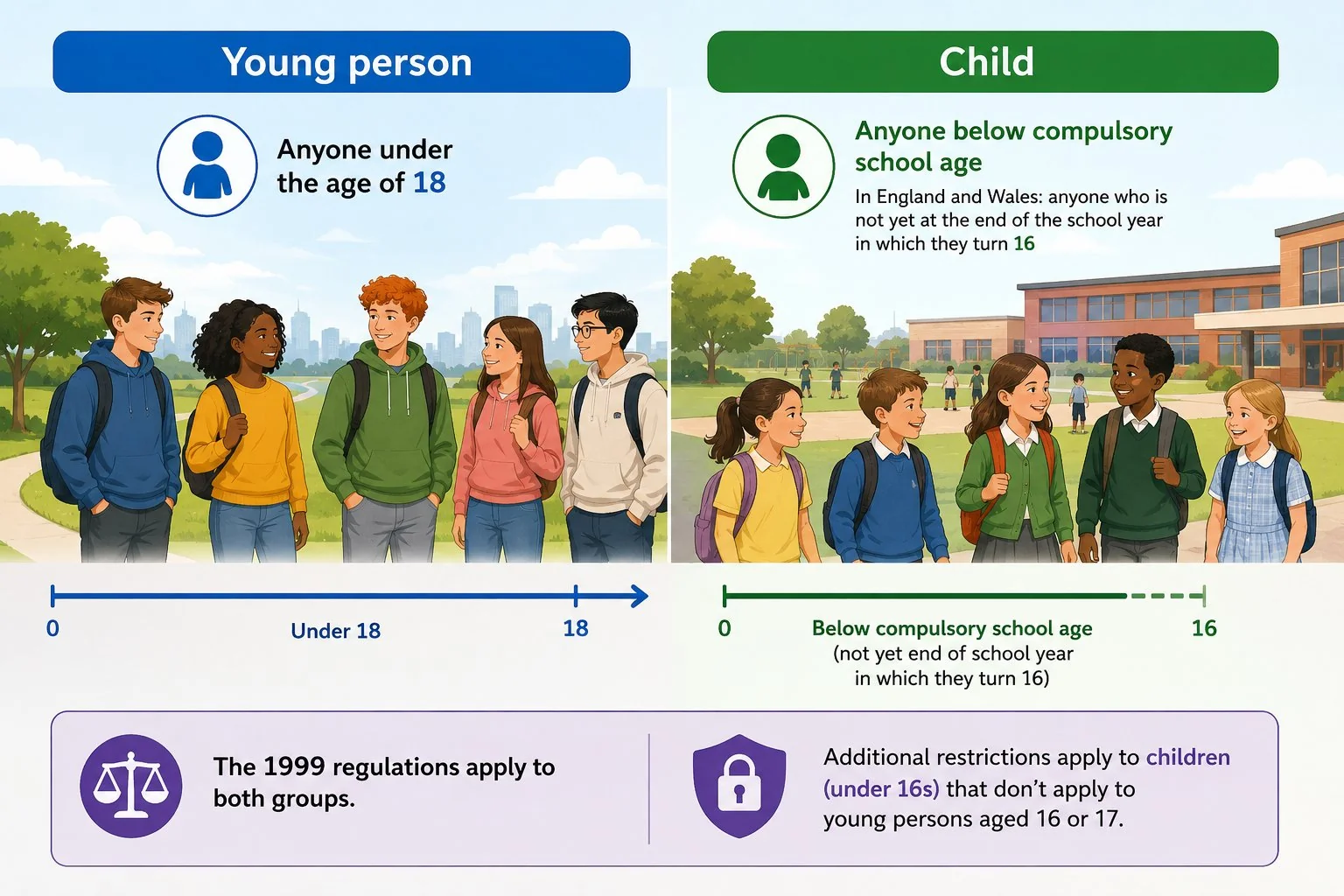
The regulations use two terms, and the distinction matters.
A young person is anyone under the age of 18.
A child is anyone below "compulsory school age". In England and Wales this means anyone who is not yet at the end of the school year in which they turn 16. In Scotland and Northern Ireland slightly different definitions apply but the principle is the same.
The 1999 regulations apply to both groups, but additional restrictions apply to children that don't apply to young persons aged 16 or 17. We come to those in the section on under-16s below.
The legal framework
Regulation 19 of the Management of Health and Safety at Work Regulations 1999 is the specific duty. It requires the employer to ensure that young persons employed by him are protected at work from any risks to their health or safety which are a consequence of their lack of experience, of absence of awareness of existing or potential risks, or of the fact that young persons have not yet fully matured.
The regulation specifies factors the assessment must take into account: the inexperience, immaturity and lack of awareness of risks of young workers; the layout of the workplace; the nature and degree of exposure to physical, biological and chemical agents; the form, range and use of work equipment; the organisation of processes and activities; the extent of safety and health training; and risks from specific agents, processes and work listed in an annex to the EU Young Workers Directive (94/33/EC) — which the regulations implement.
The 1999 regulations sit on top of two other frameworks:
- The Children (Protection at Work) Regulations 1998, which restrict the types of work children may do and the hours they may work, and require local authority work permits for some employments.
- The Working Time Regulations 1998, which set specific limits on hours, breaks and rest periods for young workers.
For specific industries — agriculture, construction, manufacturing with dangerous machinery, work with hazardous substances — additional sector-specific provisions may apply.
What's prohibited or restricted
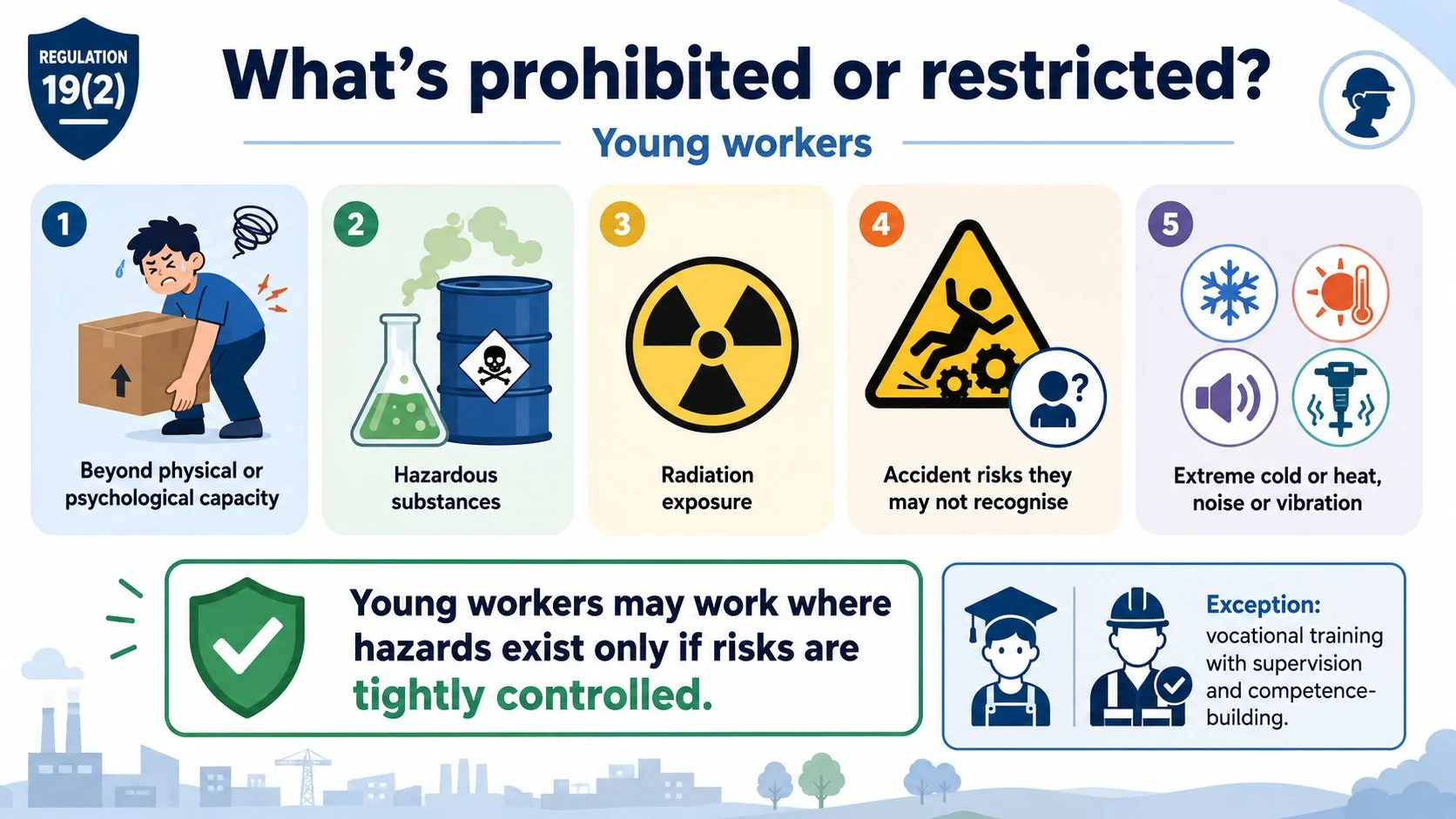
Regulation 19(2) prohibits young workers from being employed for work which is "beyond his physical or psychological capacity"; involves harmful exposure to certain hazardous substances; involves harmful exposure to radiation; involves a risk of accidents which he is unlikely to recognise or avoid because of his lack of experience, training or attention to safety; or involves a risk to health from extreme cold or heat, noise or vibration.
The general thrust of the regulation is that young workers can be employed in workplaces where these hazards exist, but only where the risk has been controlled to the level that an inexperienced person without full risk perception can be safely exposed to it. That's a substantially higher control bar than for adult workers.
There are some exceptions for vocational training, where young workers may be exposed to certain hazards as part of their structured training programme, provided supervision and competence-building arrangements are in place. The apprenticeship interface is covered below.
Restrictions on children
Children below compulsory school age face additional restrictions under the Children (Protection at Work) Regulations 1998.
They may not be employed in industrial undertakings (factories, mines, construction sites) other than where members of the family are working under direct supervision. They may not be employed before 7 am or after 7 pm. They may not work more than two hours on any school day or on a Sunday. They may not work during school hours. There are weekly and weekend limits, and detailed restrictions on the types of work children may do.
Local authorities have additional powers to make by-laws governing children's employment, and many require employers to obtain a work permit before employing a child. Permits are typically issued by the local authority's education department and may attach further conditions. Employers planning to employ children — including for paper rounds, retail Saturday jobs and similar — should check the local authority's specific requirements before the work starts.
The assessment in practice
A young persons risk assessment has the same shape as any general workplace assessment — the five-step framework — but with specific attention to the factors that elevate risk for young workers.
The assessment should consider the work being done, not just the workplace as a whole. A 17-year-old apprentice on a construction site doing the same work as adult colleagues faces different risks than a 16-year-old working on the till in the same employer's office. The relevant question is what this young person is exposed to and whether the controls are calibrated to their level of experience and physical development.
Specific factors to consider include the supervision arrangements (intensity, qualifications of the supervisor, ratio), the induction received, the equipment being used (and whether the young worker has the strength and reach to use it safely), the working pace expected, the hazards present in the workplace generally (whether the young worker is exposed to them or insulated from them), and the working hours and break patterns.
For under-18s, the assessment must be completed before the young worker starts. Parents or guardians of children must be informed of the risks identified and the controls in place before the child commences work.
Work experience placements
Year 10 work experience — typically two weeks for school students aged 14 or 15 — is the most common scenario UK employers actually encounter under regulation 19. The legal framework is the same as for any other employment of a child or young person.
The school is responsible for matching the placement to the student. The employer is responsible for the health and safety of the student while on the placement and must carry out a risk assessment that accounts for the student's age, experience and the work to be done. The school typically requires a copy of the assessment before confirming the placement.
In practice, employers offering work experience placements need to:
- Carry out a specific assessment for the placement before the student arrives, covering the work the student will actually do.
- Brief the student on hazards and controls at induction (with parental information beforehand where the student is a child).
- Provide appropriate supervision — work experience students should not be working unsupervised in any role with material hazards.
- Confine the student's work to activities suitable for their age and experience.
- Have arrangements in place for any incident or concern, including how the school will be contacted.
Employer liability insurance must cover work experience students. Most standard policies do, but the cover should be confirmed before the placement.
Apprentices and under-18s in real workplaces
A 17-year-old apprentice in a construction trade, an engineering company or a hospitality role presents the most demanding application of regulation 19. The apprentice is in a real workplace, doing real work, with real hazards — and the regulation requires that exposure to those hazards is controlled to the level appropriate for someone without complete physical maturity or full adult risk awareness.
The apprenticeship framework — with structured training, defined progression, supervised tasks and a registered training provider — is designed to provide the framework regulation 19 expects. Apprentices can be exposed to most workplace hazards because the training is structured to progressively build their competence and the supervision is calibrated to their stage.
What an apprentice cannot do is be treated as a junior adult worker with the same expectations as their colleagues. The supervision intensity, the equipment they're given, the tasks they're asked to do, and the working hours all need to be calibrated to their age and experience. A construction principal contractor accepting a 17-year-old apprentice on site has the same duty to assess and control as for any other young worker, regardless of whether the apprentice's employer is a sub-contractor with their own H&S arrangements.
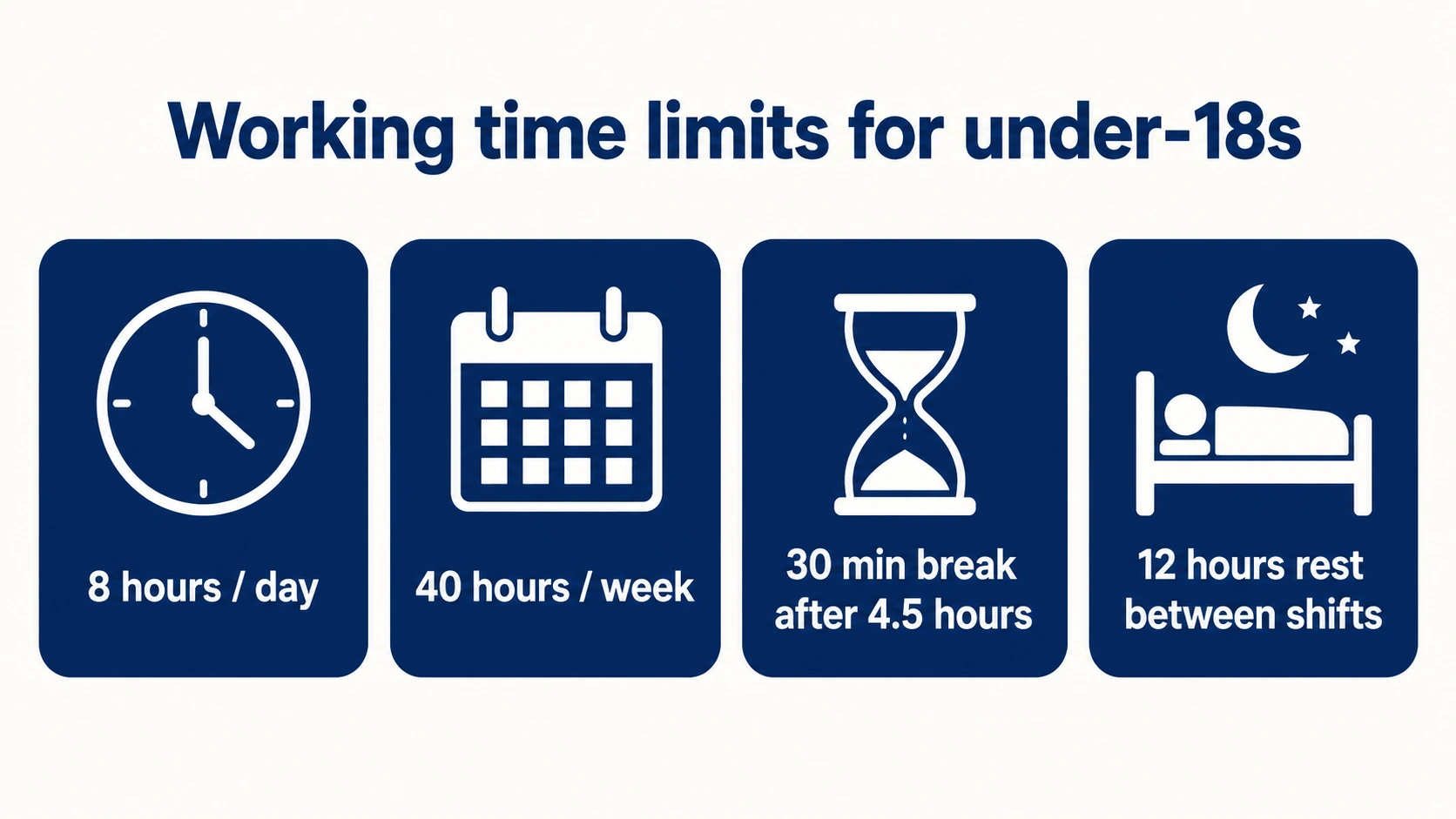
Working hours for under-18s are tighter than for adults. The Working Time Regulations 1998 limit young workers to 8 hours per day and 40 hours per week (with limited exceptions), require a 30-minute break after 4.5 hours of work, require 12 hours' rest between shifts, and require 48 hours' rest per week.
Induction, training and supervision
Three elements consistently distinguish workplaces that handle young workers well from those that don't.
Induction has to be thorough, age-appropriate and verified — the young worker should not be left to "figure it out" or to learn from observing colleagues. Specific time should be set aside before the young worker starts substantive work to cover the workplace layout, the hazards, the controls, the procedures, and who to ask if they're unsure.
Training has to be matched to the tasks the young worker will do. Where the work involves equipment, hazardous substances, manual handling or any specific hazard with its own regulation, the relevant training is required — not as an extra, but as a precondition.
Supervision needs to be intensive at the start and to taper as competence builds. A young worker left unsupervised in a hazardous environment because their formal supervisor was called away is exactly the situation regulation 19 is designed to prevent.
Records and review
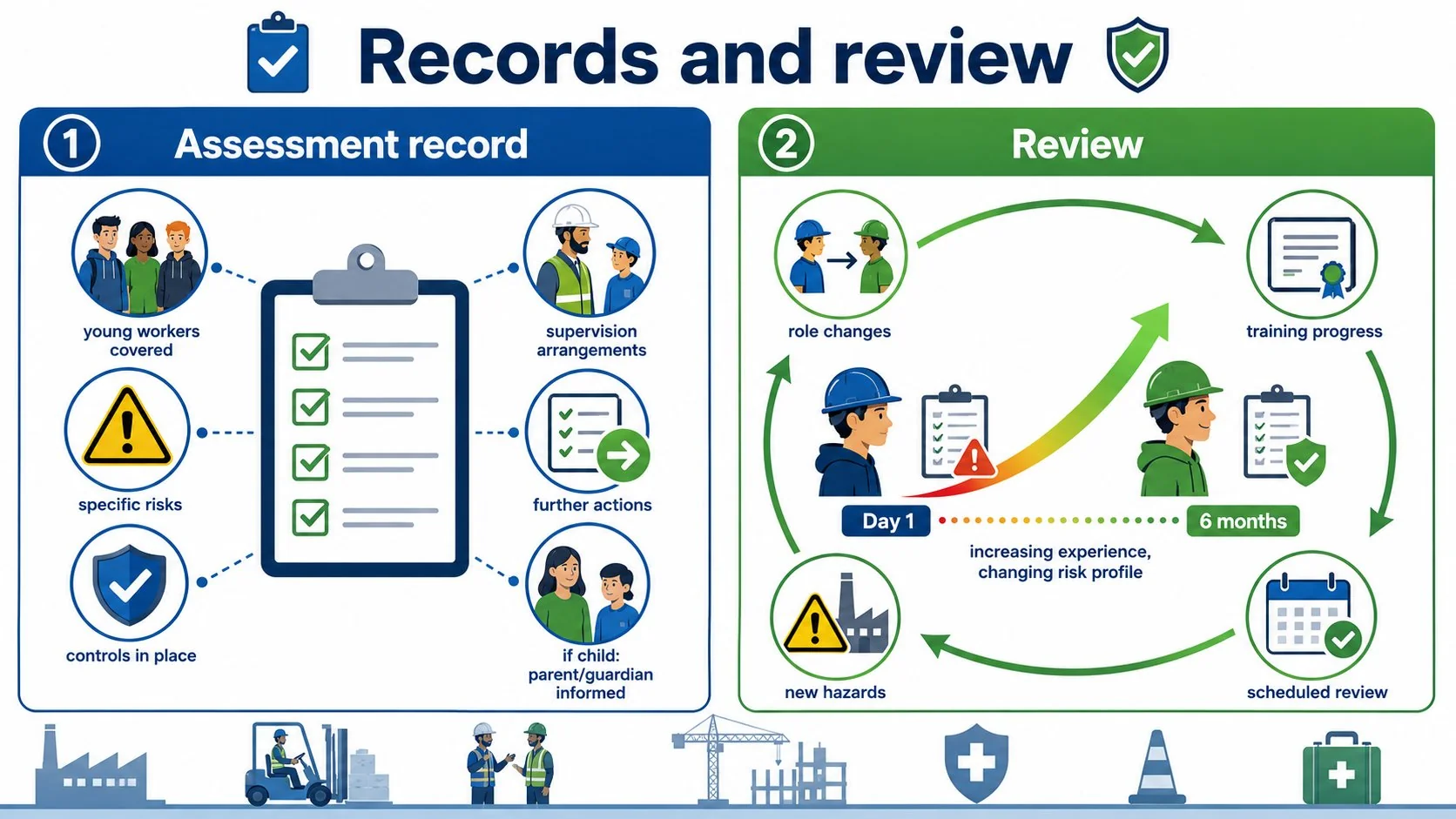
The assessment record should identify the young workers covered, the specific risks considered, the controls in place, the supervision arrangements, and the further actions if any. Where the worker is a child, the record should confirm that the parent or guardian has been informed.
Review is required when the young worker's role changes, when they progress through training stages, when new hazards are introduced, or at intervals reflecting the structured progression of their experience. A young worker who has been competently working for six months is at a different point on the risk curve than one who started yesterday — and the assessment should evolve accordingly.
Where this connects in the cluster
Young persons risk assessment intersects with manual handling (because physical development is incomplete and guideline figures need adjustment), COSHH (because under-18s face restrictions on exposure to certain hazardous substances), and working at height (where additional supervision and equipment considerations apply for young workers).
The general workplace assessment under regulation 3 should consider the foreseeable presence of young workers in the workplace; the regulation 19 assessment is the specific one for individuals or groups of young workers actually present.
For employers who take on work experience placements or apprentices regularly — particularly schools, training providers, construction firms, hospitality groups and retailers — formal Risk Assessment Training helps build the assessor competence the duty requires, with placement-specific arrangements layered on top.
Frequently asked questions
What counts as a young person under UK health and safety law?
A young person is anyone under the age of 18. A child is anyone below compulsory school age (in England and Wales, anyone not yet at the end of the school year in which they turn 16). Both groups are covered by regulation 19 of the Management of Health and Safety at Work Regulations 1999, with additional restrictions applying to children.
Do work experience students need a separate risk assessment?
Yes. Each placement requires a specific assessment for the work the student will actually do, taking account of their age, experience and the hazards present. The school typically requires the assessment before confirming the placement.
Can a 17-year-old apprentice do everything an adult can?
Not without specific consideration. Under-18s have additional protections under regulation 19, working hour limits under the Working Time Regulations 1998, and restrictions on exposure to certain hazards. The apprenticeship framework — structured training and supervision — provides the route through which under-18 apprentices can work with the same hazards as adult colleagues, but the controls must be calibrated to their age and experience.
Who issues a child work permit?
The local authority where the child lives, usually through the education department. Permits are typically required for children employed below compulsory school age and may include conditions about hours, type of work and supervision. Employers planning to employ children should check the local authority's specific requirements before work starts.
What working hours can a 16- or 17-year-old work?
Under the Working Time Regulations 1998, young workers (16- and 17-year-olds out of compulsory education) are limited to 8 hours per day and 40 hours per week, with a 30-minute break after 4.5 hours, 12 hours' rest between shifts, and 48 hours' rest per week. Specific exceptions apply in limited circumstances.