


%201.svg)


A pregnancy risk assessment is a specific assessment of the workplace hazards that could affect a pregnant worker, a new mother or a breastfeeding mother, and a decision about what controls or adjustments are needed to keep her and her child safe. The duty sits under regulation 16 of the Management of Health and Safety at Work Regulations 1999 and runs alongside the broader pregnancy and maternity protections in the Equality Act 2010. The two duties are different. Both apply. Most online guidance covers only the first.
This page sets out the trigger for the duty, the framework for the assessment itself, the hazards that most commonly require attention, and the adjustment hierarchy employers are expected to follow when controls aren't enough.
When the duty triggers
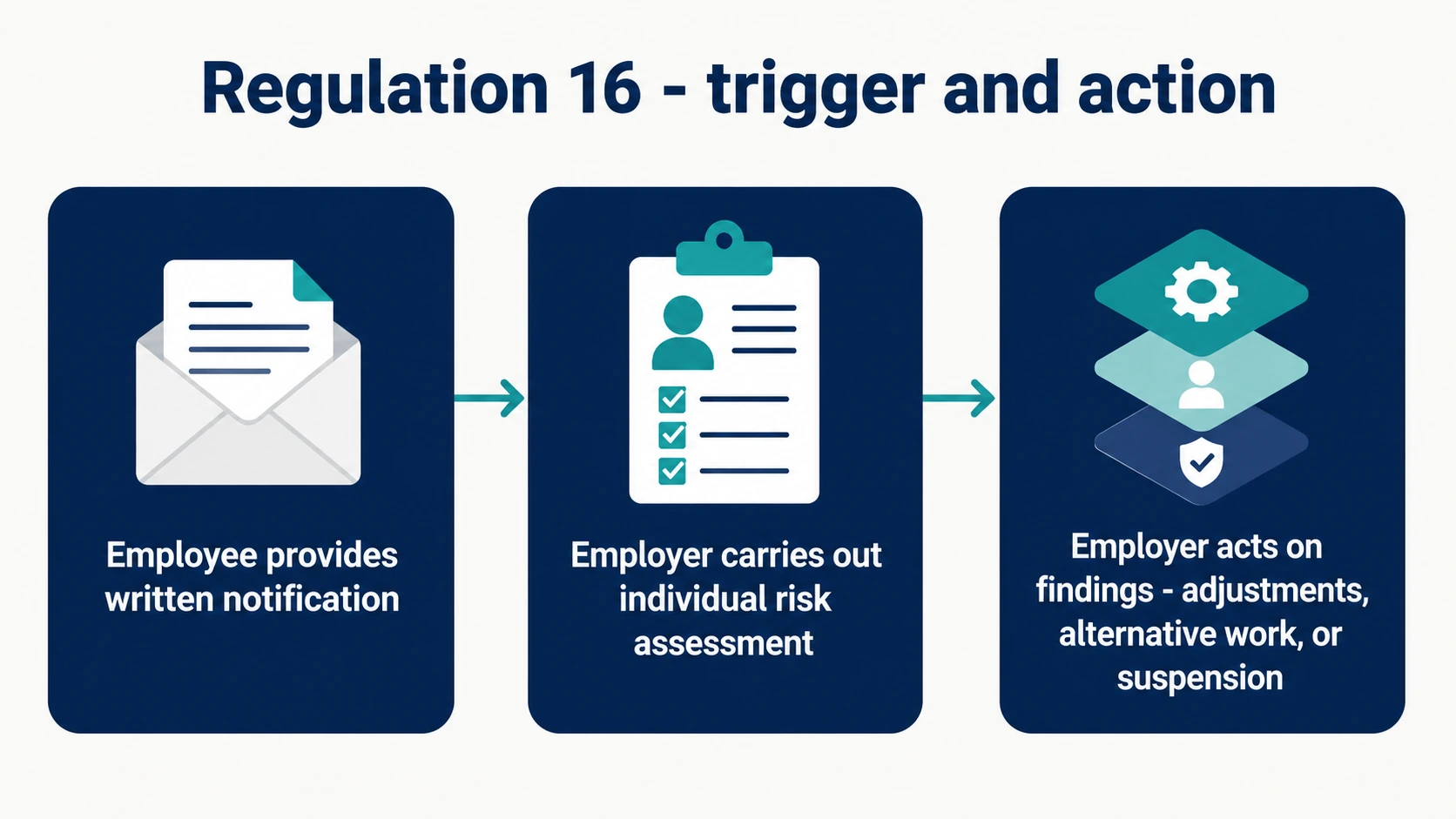
Two conditions need to be met. First, the role must be one in which work could involve risk to the health and safety of a pregnant worker, a new mother or a breastfeeding mother. The regulations are broad about what counts: physical agents, biological agents, chemical agents, processes and working conditions are all in scope. Second, the worker must notify the employer in writing that she is pregnant, has given birth in the previous six months, or is breastfeeding.
The notification mechanism matters. Until the employee tells the employer in writing, the regulation 16 duty hasn't been triggered for that specific individual. The general workplace risk assessment must already have considered pregnancy as a foreseeable issue — that's what regulation 3 requires — but the individual assessment under regulation 16 is triggered by the written notification.
In practice most employers ask for written notification (usually via HR) when a worker informs them of pregnancy. Some accept a copy of the MAT B1 maternity certificate; some have their own form. The format doesn't matter — what matters is that the employer can demonstrate when notification was received, because the regulation 16 duty runs from that date.
Once the written notification is in place, the employer is required to consider the risks specific to the worker and to act on whatever the assessment identifies.
The legal framework, end to end
Regulation 16 of the Management of Health and Safety at Work Regulations 1999 is the central duty. It requires the employer to take account, in the general risk assessment, of the specific risks to new and expectant mothers; and where those risks cannot be avoided through preventive measures or adjustments to working conditions, to follow a defined hierarchy of further action.
Regulation 17 covers the duty to provide information — telling the worker about the risks identified and the measures taken.
Regulation 18 covers night work — the right to be transferred to day work, where night work poses a risk that can't be otherwise controlled, with a medical certificate from a registered practitioner.
The Equality Act 2010 protects pregnancy and maternity as one of nine protected characteristics. The protection runs from the start of pregnancy to the end of statutory maternity leave (or the end of the protected period if the worker isn't entitled to maternity leave). Treating a worker unfavourably because of pregnancy or maternity is direct discrimination, and there's no comparator requirement — the worker doesn't need to show how a non-pregnant person would have been treated. Failure to carry out an adequate pregnancy risk assessment, or failure to act on its findings, has been treated by tribunals as a form of pregnancy and maternity discrimination on top of any health and safety breach.
For specific employment-rights elements — paid time off for antenatal appointments, the right to return to the same job after ordinary maternity leave, the protection against detriment and dismissal — the Maternity and Parental Leave etc. Regulations 1999 and the Employment Rights Act 1996 provide the framework.
Pregnancy-specific hazards

The hazards that most often require attention in a pregnancy risk assessment fall into seven categories.
Manual handling
Pregnancy changes ligament softness, balance and fatigue tolerance. Manual handling tasks that were previously low risk may become unsuitable as pregnancy progresses, particularly from the second trimester onwards. The general manual handling risk assessment duty applies, and the pregnancy-specific assessment should consider whether handling can be eliminated, reduced or reassigned during pregnancy and the early postnatal period.
Prolonged standing or awkward postures
Long periods on the feet are associated with elevated risk of premature delivery and reduced birth weight. Roles that involve sustained standing — retail, hospitality, healthcare, teaching, manufacturing — should consider seated alternatives, additional breaks, or rotation through tasks that allow sitting.
Biological agents
Workers in healthcare, laboratory, veterinary, education, agricultural and waste-handling roles may be exposed to biological agents that pose specific risks during pregnancy — rubella, toxoplasmosis, listeria, parvovirus B19, varicella-zoster, hepatitis B, certain herpesviruses, and others. The COSHH framework covers biological agents, but pregnancy substantially changes the risk assessment.
Chemical agents
Some substances are specifically hazardous to the developing fetus or to breastfed infants. Lead, mercury and other heavy metals; certain solvents; some pharmaceuticals (particularly cytotoxic agents in oncology nursing); some pesticides. Where exposure cannot be eliminated, controls must be tightened for the duration of pregnancy and breastfeeding.
Ionising and non-ionising radiation
Workers in diagnostic radiology, nuclear medicine, dentistry and certain industrial settings need specific dose limits during pregnancy. The Ionising Radiations Regulations 2017 set defined limits for the conceptus and require specific assessment.
Night work and shift patterns
Working at night during pregnancy is associated with elevated risk of miscarriage and preterm delivery. Regulation 18 gives a specific right to transfer to day work where a registered medical practitioner certifies that night work would harm the worker or her child.
Stress and excessive working hours
Pregnancy-related stress, sustained excessive hours and exposure to violence or aggression at work are recognised contributors to adverse outcomes. This intersects with stress risk assessment, and the assessment should consider whether workload, working hours or specific stressors need adjustment.
Some hazards apply more strongly in particular trimesters — manual handling and posture become more limiting in the second and third trimesters, while biological and chemical agents may be highest-risk in the first trimester before pregnancy is widely known. The assessment should be revisited as pregnancy progresses, not just done once at notification.
The individual assessment in practice
Once the employer has been notified in writing, the assessment should be carried out promptly — typically within a few working days. The person carrying it out should be competent for the work, familiar with the role, and able to involve the worker herself in identifying which aspects of the work are presenting difficulty.
The conversation matters. A regulation 16 assessment carried out without speaking to the pregnant worker is unlikely to identify the real issues, because pregnancy-specific concerns vary substantially between workers and between pregnancies. A first-time pregnant worker may not yet know what will become difficult; a worker on her second or third pregnancy often has very specific information about which aspects of the role she expects to need adjusted.
The output of the assessment should record the hazards identified, the conclusions about whether the existing controls are sufficient, the adjustments that have been made, and any further action required. The worker should be given a copy or be involved in agreeing the outcome.
The adjustment hierarchy
Regulation 16 sets out a specific hierarchy of further action when ordinary preventive measures and adjustments to working conditions aren't enough to remove the risk.
Step one — temporarily adjust her working conditions or hours of work
This is the default. Modified duties within the same role, reduced hours, additional breaks, eliminated tasks, equipment changes, modified shift patterns, or adjusted workstation. The aim is to allow the worker to continue her usual role with adjustments that remove the specific risks.
Step two — if it is not reasonable to adjust the conditions, offer suitable alternative work
Where the role itself can't be made safe, the employer must offer alternative work that the worker can do safely and that is suitable for her. Suitable means appropriate to her skills, qualifications and circumstances — not a demotion or punitive reassignment. The alternative work must be on terms and conditions no less favourable than her usual role.
Step three — if no suitable alternative is available, suspend her from work on full pay
This is medical suspension on maternity grounds. The worker remains employed, on her normal pay, until she can safely return to work — usually after maternity leave. The Employment Rights Act 1996 sets out the legal framework for medical suspension on maternity grounds.
The order is mandatory. An employer who jumps to suspension when adjustments would have allowed the worker to continue is on weak ground; so is one who refuses to consider alternative work and instead requires the pregnant worker to take unpaid leave.
Breastfeeding and the return to work
The duty doesn't end at birth. Regulation 16 continues to apply to new mothers — defined as workers who have given birth within the previous six months — and to breastfeeding mothers for as long as breastfeeding continues.
The hazards relevant to breastfeeding mothers overlap with but aren't identical to those relevant during pregnancy. Some chemical and biological agents that aren't a concern during pregnancy become concerns for breastfeeding because of transfer through breast milk. Manual handling remains relevant in the early postnatal period. Night work and shift patterns may need ongoing adjustment.
Employers are also required to provide somewhere for new and expectant mothers to rest (Workplace (Health, Safety and Welfare) Regulations 1992, regulation 25). In practice this often extends to providing a private space for expressing milk, although this is good practice and accepted custom rather than a specific legal requirement under those regulations.
Where this connects in the cluster
Pregnancy risk assessment overlaps with most other vertical assessments. Manual handling is the most common interaction. COSHH for biological and chemical agents. DSE risk assessment for office workers needing workstation adjustments during pregnancy. Stress risk assessment where workload or workplace conditions affect the pregnancy. Night work and shift adjustments where lone or unsocial-hours work is involved.
The general workplace assessment under regulation 3 should have anticipated pregnancy as a foreseeable issue before any specific worker tells you she's pregnant. The regulation 16 individual assessment is the specific one triggered by notification.
For HR teams and line managers who handle pregnancy notifications regularly, building competence in pregnancy risk assessment pays off in both compliance and in reducing tribunal exposure. Formal Risk Assessment Training covers the general method that underpins regulation 16 work, and Maternity Action publishes free guidance for managers and workers on the legal framework.
Frequently asked questions
When do I have to tell my employer I'm pregnant?
For statutory maternity rights, by the end of the 15th week before the expected week of childbirth. For the regulation 16 risk assessment duty to be triggered for you specifically, written notification at any time will engage the duty — and the sooner the better if you're in a role where workplace hazards could affect your pregnancy.
What if my job is unsafe during pregnancy?
Your employer must follow the adjustment hierarchy: first adjust your working conditions or hours; if that isn't reasonable, offer you suitable alternative work; if no suitable alternative is available, suspend you from work on full pay. You should not be required to do work that the assessment identifies as unsafe, and you should not lose pay as a result of necessary adjustments.
What is suspension on maternity grounds?
A specific form of medical suspension provided for in the Employment Rights Act 1996, used when a pregnant worker can't safely do her usual role, no adjustment is reasonably practicable, and no suitable alternative work is available. The worker remains employed and is paid her normal wages throughout the suspension.
Does the duty extend to breastfeeding mothers?
Yes. Regulation 16 covers workers who are pregnant, who have given birth in the previous six months, or who are breastfeeding. Some hazards that aren't a concern during pregnancy become concerns for breastfeeding because of transfer through breast milk.
Can my employer make me take maternity leave early?
Not against your wishes, but if your job genuinely can't be made safe and no suitable alternative exists, the employer's only legal route is suspension on full pay. Pressuring a worker to start maternity leave early to avoid the suspension obligation has been treated by tribunals as a form of pregnancy and maternity discrimination.