

%201.svg)


A fire risk assessment is a structured examination of a building or workplace to identify fire hazards, the people at risk, and the precautions needed to keep them safe. Almost all non-domestic premises in England and Wales need one. The duty sits with the "responsible person", a role defined in the Regulatory Reform (Fire Safety) Order 2005 — the central piece of legislation in this area, usually shortened to the Fire Safety Order or FSO.
Since the Grenfell Tower fire in 2017, the framework has expanded substantially. Four further pieces of legislation, two updated British Standards and a new competence standard for fire risk assessors have changed what a defensible assessment now looks like. Most online guides on this topic still describe the pre-2021 framework. This page covers the current position.
The legal framework, in order
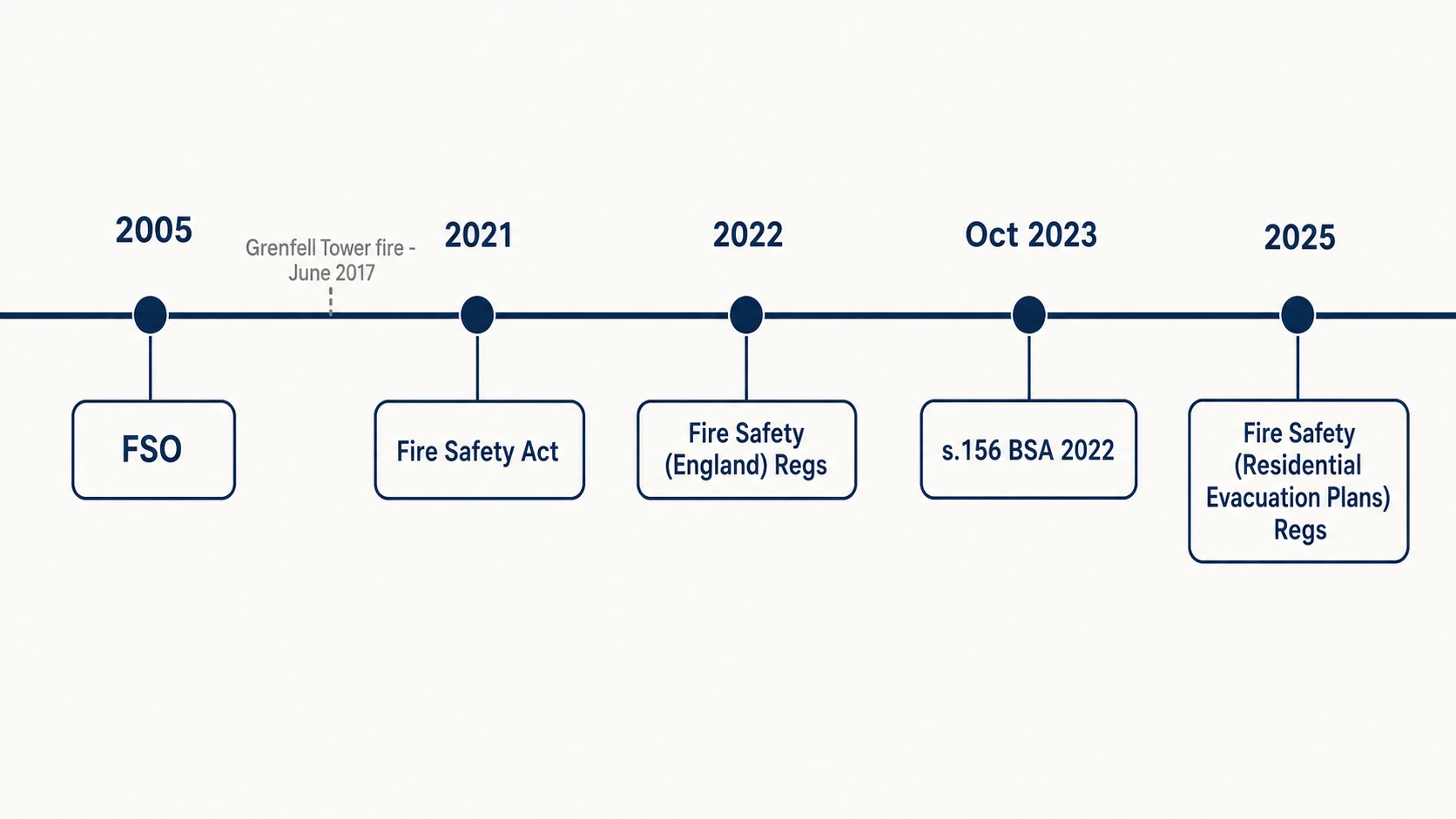
The FSO 2005 is the parent legislation. It came into force in October 2006 and consolidated the previous patchwork of fire-certification rules. It places a duty on the "responsible person" — usually the employer, the owner, or whoever has control of the premises — to carry out and keep up to date a fire risk assessment, and to put general fire precautions in place to reduce the risk of fire and to ensure that occupants can escape safely.
The FSO applies to all workplaces and to the common parts of multi-occupied residential buildings. It doesn't apply inside single private dwellings. The enforcing authority is the local Fire and Rescue Service, which can carry out fire safety audits, issue enforcement notices, and prosecute serious breaches.
Four subsequent pieces of legislation have changed what the FSO requires.
The Fire Safety Act 2021 received Royal Assent in April 2021 and clarified that the FSO covers the external walls, balconies, and flat entrance doors of multi-occupied residential buildings — issues that had been contested before Grenfell. The clarification matters because it brings cladding systems, structural fire protection between flats, and individual flat front doors squarely into the responsible person's risk assessment.
The Fire Safety (England) Regulations 2022 came into force on 23 January 2023. They introduced specific duties for responsible persons in residential buildings — particularly higher-risk ones — including providing fire safety instructions to residents, checking flat entrance doors, providing wayfinding signage in high-rise buildings, and ensuring fire and rescue services have access to up-to-date floor plans.
Section 156 of the Building Safety Act 2022 came into force on 1 October 2023. It significantly tightened the FSO's record-keeping requirements: the responsible person must now record their fire risk assessment in full (not just the significant findings), record the identity of anyone they engage to carry out the assessment, share information with any incoming responsible person when premises change hands, and provide residents with relevant fire safety information. These requirements apply universally — not only to higher-risk buildings.
The Fire Safety (Residential Evacuation Plans) (England) Regulations 2025 introduce a further duty: in specified residential buildings the responsible person must offer to carry out a "person-centred fire risk assessment" for any resident whose ability to evacuate without assistance is compromised, and must carry one out for every relevant resident who requests it. The 2025 Regulations are the latest layer and are barely covered in online guidance to date.
Alongside the statutory framework, two British Standards govern the technical practice. BS 9991 was substantially revised in 2024 — BS 9991:2024 now applies to a wider range of residential buildings including residential care homes, and tightens design and management standards for fire safety in those settings. BS 8674:2025 is brand new and sets out the competence framework expected of fire risk assessors. The two PAS documents — PAS 79-1 for housing and PAS 79-2 for non-housing — are widely used by professional assessors as the methodology framework.
The responsible person
The FSO uses a single term for the duty-holder: the responsible person. In a workplace, this is usually the employer. In any other premises (including a block of flats), it's the person with control of the premises. There can be more than one responsible person in a single building — a freeholder, a managing agent and a commercial tenant might each have responsibilities for different parts.
For higher-risk buildings — defined in the Building Safety Act 2022 as buildings over 18 metres tall or with at least seven storeys, and containing two or more residential units — the Act introduced two additional roles. The Accountable Person is the entity legally responsible for the building's structure and exterior. The Principal Accountable Person is the lead role where multiple Accountable Persons exist. These roles work in parallel with the responsible person under the FSO, not as replacements.
The responsible person can engage someone else to carry out the actual fire risk assessment — and almost always does for anything beyond simple premises — but the legal duty remains with the responsible person. Engaging a consultant does not transfer accountability. We cover the competence question in more detail on our page on who can carry out a risk assessment.
The five steps applied to fire
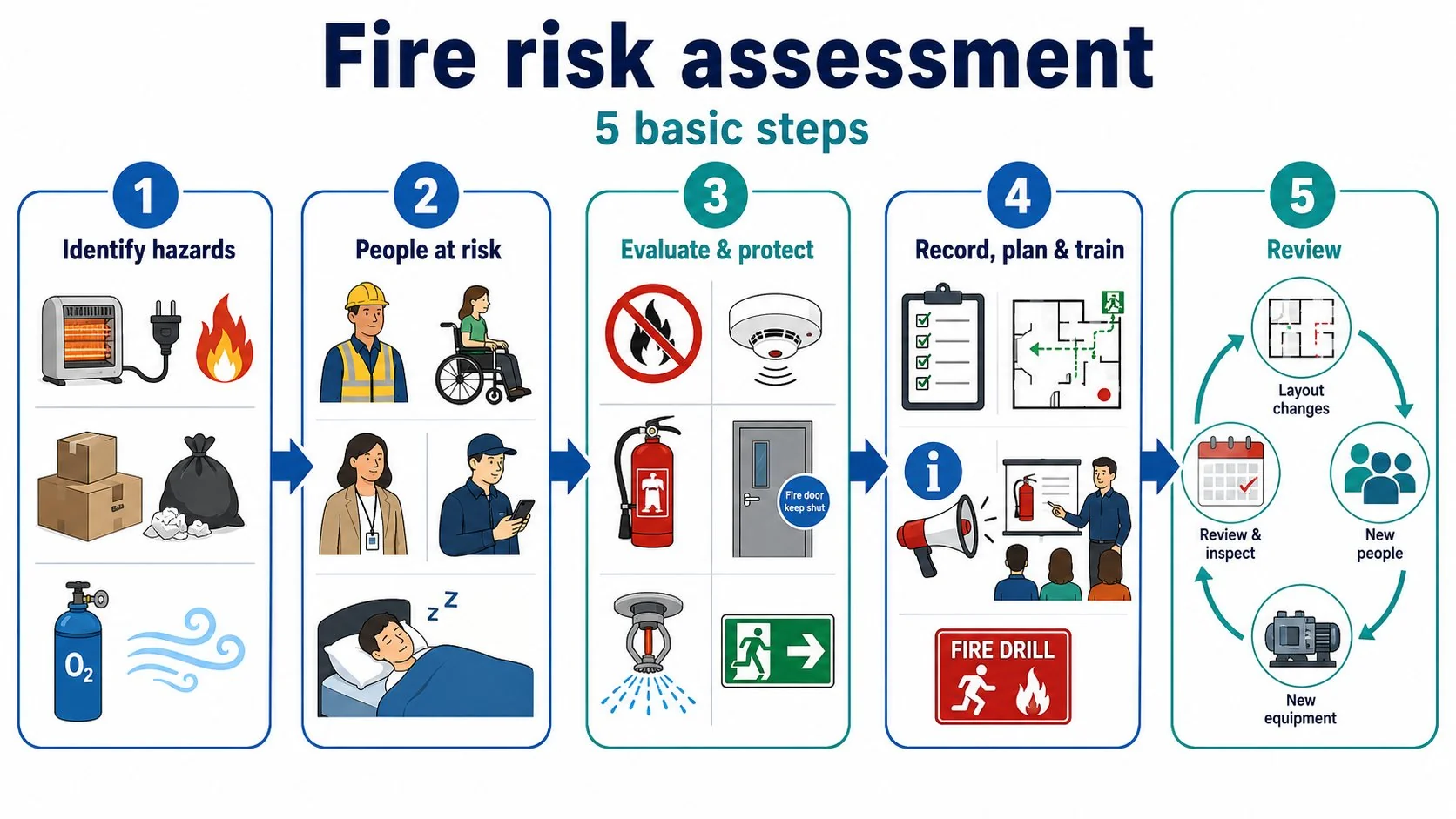
The general method follows the same five steps used in any UK workplace risk assessment, translated into fire-specific terms.
Identify the fire hazards
Sources of ignition (heaters, electrical equipment, cooking, smoking, hot work, arson), sources of fuel (combustible materials, stored stock, waste, soft furnishings, fixtures), and sources of oxygen beyond the air in the room (oxygen cylinders, oxidising chemicals, mechanical ventilation that could feed a fire).
Identify the people at risk
Everyone in the building, with particular attention to those who may struggle to evacuate without help: residents with mobility, cognitive or sensory impairments; visitors unfamiliar with the building; lone workers in remote parts of the premises; sleeping occupants in residential premises; large groups gathered in one place.
Evaluate, remove, reduce and protect from risk
Can the hazard be removed entirely — replacing flammable materials with safer alternatives, eliminating sources of ignition, removing unnecessary combustibles? If not, can it be reduced — separation between fuel and ignition, smaller quantities, controlled access? And what protection is in place — detection, alarm, compartmentation, fire-resistant doors, sprinklers, emergency lighting, signage, means of escape?
Record, plan, inform, train
The FSO has always required significant findings to be recorded; section 156 of the Building Safety Act 2022 has extended this to the full assessment. Emergency plans must be in place. Occupants must be informed of the procedures. Staff must be trained. Fire drills must be carried out.
Review
Whenever there is significant change — to the use of the premises, the layout, the people present, the controls — and at regular intervals to confirm the assessment is still valid. Higher-risk premises warrant more frequent review.
Multi-occupied residential buildings
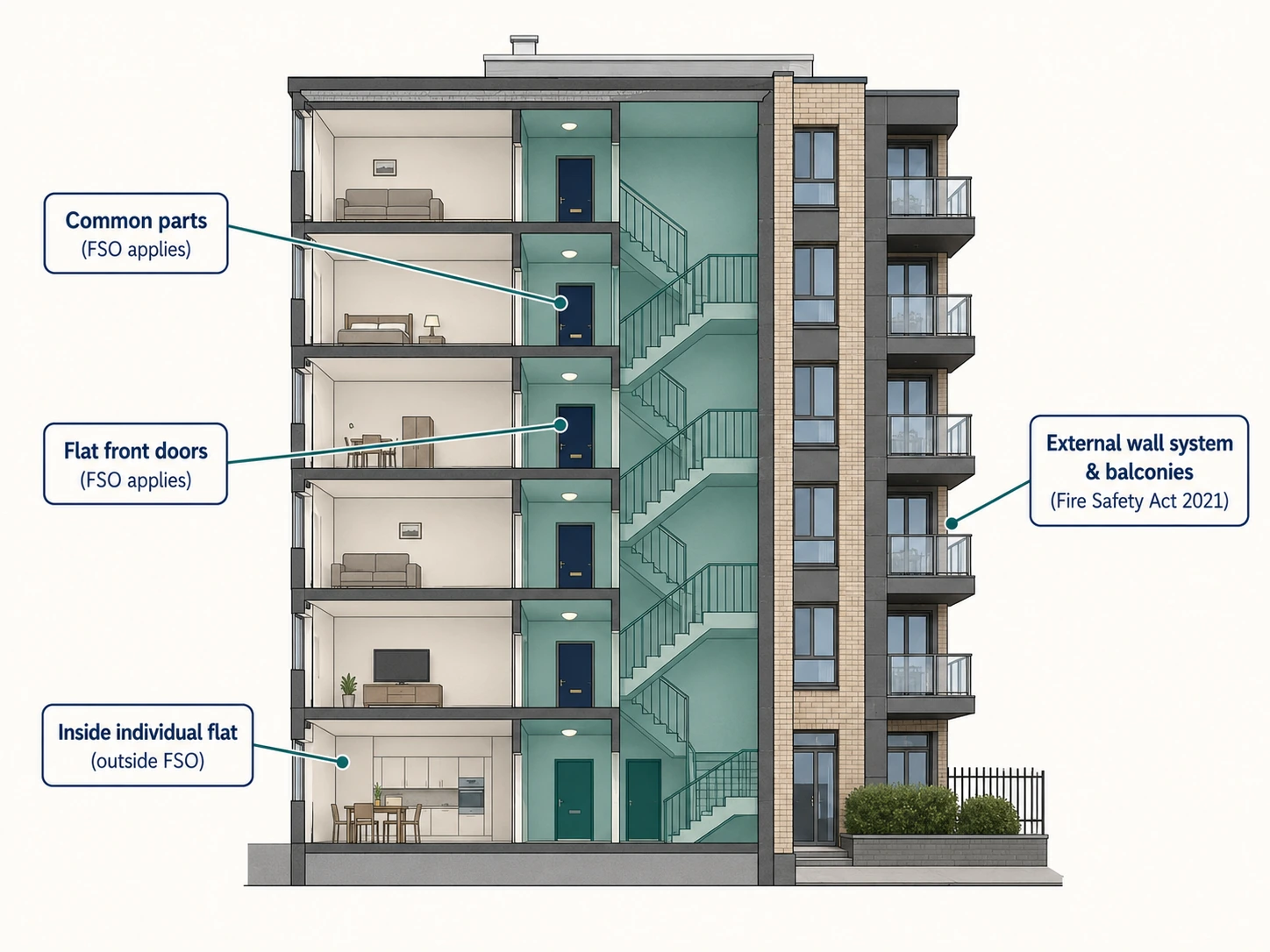
Multi-occupied residential buildings — blocks of flats, houses in multiple occupation, sheltered housing, care settings with self-contained accommodation — are the area where the framework has changed most since Grenfell.
The FSO covers the common parts: hallways, stairwells, plant rooms, roof spaces, refuse areas. Since the Fire Safety Act 2021 it also expressly covers the external walls (including cladding and balconies) and the front doors of individual flats where those doors open into common parts. The interior of an individual flat remains outside the FSO.
The 2022 regulations added specific duties for the responsible person in residential blocks. In blocks over 11 metres tall the responsible person must check flat front doors quarterly and the building's common door fire doors annually. In blocks over 18 metres they must additionally provide the Fire and Rescue Service with up-to-date floor plans, building plans and electronic information on the external wall system. Wayfinding signage is required in high-rise buildings to help firefighters navigate in low visibility.
The 2025 Regulations introduce person-centred fire risk assessment in specified residential buildings. This is in addition to the building-wide assessment under the FSO. The responsible person must take steps to identify residents whose ability to evacuate independently is compromised — by physical disability, cognitive impairment, dementia, or other condition — and offer each of them a personalised assessment. Where a resident accepts the offer, the person-centred assessment covers their specific evacuation needs and feeds into the building's overall fire strategy.
Recording the assessment
The recording duty changed significantly in October 2023. Before section 156 of the Building Safety Act 2022 came into force, the responsible person only had to record the significant findings of the assessment if they employed five or more people. Now, every responsible person must record the assessment in full and identify the person who carried it out.
For most existing fire risk assessments the practical effect is small — most competent assessors were already producing full written reports — but the change closes a loophole that allowed minimal record-keeping in some small premises.
The assessment also has to be shared with any incoming responsible person if the premises change hands, and relevant information has to be provided to residents in domestic blocks.
Who can carry out a fire risk assessment
The FSO requires the assessment to be carried out by a competent person. Competence is the same combination as elsewhere in UK health and safety law: skills, knowledge, experience and training appropriate to the complexity of the premises.
For very simple premises — a small office, a low-occupancy retail unit, a single-tenant industrial building with no overnight presence — a manager with appropriate training may be competent to carry out the assessment in-house. For anything more complex, and certainly for any multi-occupied residential building, the work is almost always carried out by a specialist external assessor.
BS 8674:2025 is the new British Standard for fire risk assessor competence. It sets out a framework of knowledge, experience and ongoing professional development that competent assessors are expected to meet. The standard is new, but it formalises what professional bodies have been recommending for years. The National Fire Chiefs Council maintains guidance and a register of competent fire risk assessors which is the practical starting point for sourcing one.
The methodological frameworks used by competent assessors are PAS 79-1 (for housing premises) and PAS 79-2 (for non-housing premises). Both are published by BSI and both set out the structure of a defensible assessment.
The penalty for engaging an unsuitable assessor falls on the responsible person, not the assessor. The responsible person must take "reasonable steps" to satisfy themselves that the assessor is competent — a check of qualifications, professional registration, indemnity insurance and recent relevant experience is what "reasonable steps" looks like in practice.
Enforcement and penalties
The Fire and Rescue Service is the enforcing authority for the FSO. Fire safety audits can be unannounced; they can also be triggered by a complaint, a fire, or a routine inspection. Where the audit finds problems the inspector can issue an alterations notice, an enforcement notice (requiring specific action by a deadline), or a prohibition notice (stopping use of part or all of the premises immediately).
Serious breaches result in prosecution. Penalties for the most serious breaches — those that put people at risk of death or serious injury — can include unlimited fines and, in the worst cases, custodial sentences. The post-Grenfell sentencing climate is materially tougher than it was a decade ago, and the introduction of section 156 has expanded the documentary evidence available to prosecutors.
Where the cluster connects
A fire risk assessment is the central document for fire safety in any premises, but it doesn't sit on its own. The general workplace assessment under the Management of Health and Safety at Work Regulations 1999 covers fire risk to workers; the fire risk assessment under the FSO covers fire risk to everyone in the building. The two overlap and should be consistent.
Where construction work is being carried out, the Construction (Design and Management) Regulations 2015 require fire safety to be addressed in the Construction Phase Plan. Specific activities — hot work in particular — typically need their own RAMS that ties back to the building's overall fire strategy.
For organisations whose staff need to develop the competence to carry out their own fire risk assessments — or to oversee external assessors with informed judgement — formal Risk Assessment Training is the practical route. The fire-specific element should sit on top of a solid foundation in the general method.
Frequently asked questions
Who is the responsible person for a fire risk assessment?
The person with control of the premises. In a workplace, usually the employer. In a block of flats, often the freeholder or managing agent, but commercial tenants and other parties can be responsible persons for the parts they control. Multiple responsible persons can exist in a single building, each responsible for their own area.
How often should a fire risk assessment be reviewed?
There is no fixed statutory review period. The FSO requires the assessment to be kept up to date — meaning reviewed whenever there's significant change to the building, its use, its occupants, or the precautions in place. Many responsible persons adopt an annual cycle as good practice; higher-risk buildings often warrant more frequent review. For more detail see our page on how often a risk assessment should be reviewed.
Do I need a competent person to carry out a fire risk assessment?
The FSO requires the assessment to be carried out by a competent person. For very simple premises that can be an appropriately trained manager. For most premises it means an external fire risk assessor — and for residential buildings or any premises with significant risk, an assessor with relevant qualifications and ideally one listed on a recognised competence register.
What changed under section 156 of the Building Safety Act 2022?
Section 156 amended the FSO with effect from 1 October 2023. The main changes were a full-recording requirement (replacing the previous "significant findings" minimum), a duty to record the identity of the assessor, a duty to share information when premises change hands, and a duty to provide residents in residential premises with relevant fire safety information.
Is a fire risk assessment required for a single private dwelling?
No. The FSO doesn't apply inside single private dwellings. It does apply to the common parts of buildings containing two or more dwellings, and to the external walls and flat entrance doors of those buildings, but the inside of an individual house or flat is outside its scope.
What is a person-centred fire risk assessment?
A personalised assessment for an individual resident whose ability to evacuate without assistance is compromised — for example, by physical disability, dementia, or any other condition. Under the Fire Safety (Residential Evacuation Plans) (England) Regulations 2025, responsible persons in specified residential buildings must offer person-centred fire risk assessments to relevant residents and carry them out for any resident who requests one.