
When a worker raises a concern about an unsafe practice, a safety breach or another public-safety risk and is ignored or punished for it, that is not just an employment problem — it is an early warning that a hazard is going unmanaged. The UK numbers on whistleblowing come from several official and independent sources: the Ministry of Justice’s quarterly Tribunal Statistics, the Financial Conduct Authority’s quarterly whistleblowing data and its Prescribed Persons Annual Report, GOV.UK prescribed-person reports, and casework from the whistleblowing charity Protect. This page pulls those figures into one citable reference — how many people speak up, how the tribunal caseload is moving, and what happens to those who raise concerns. Every figure carries a named source and its data period.
Key facts and figures
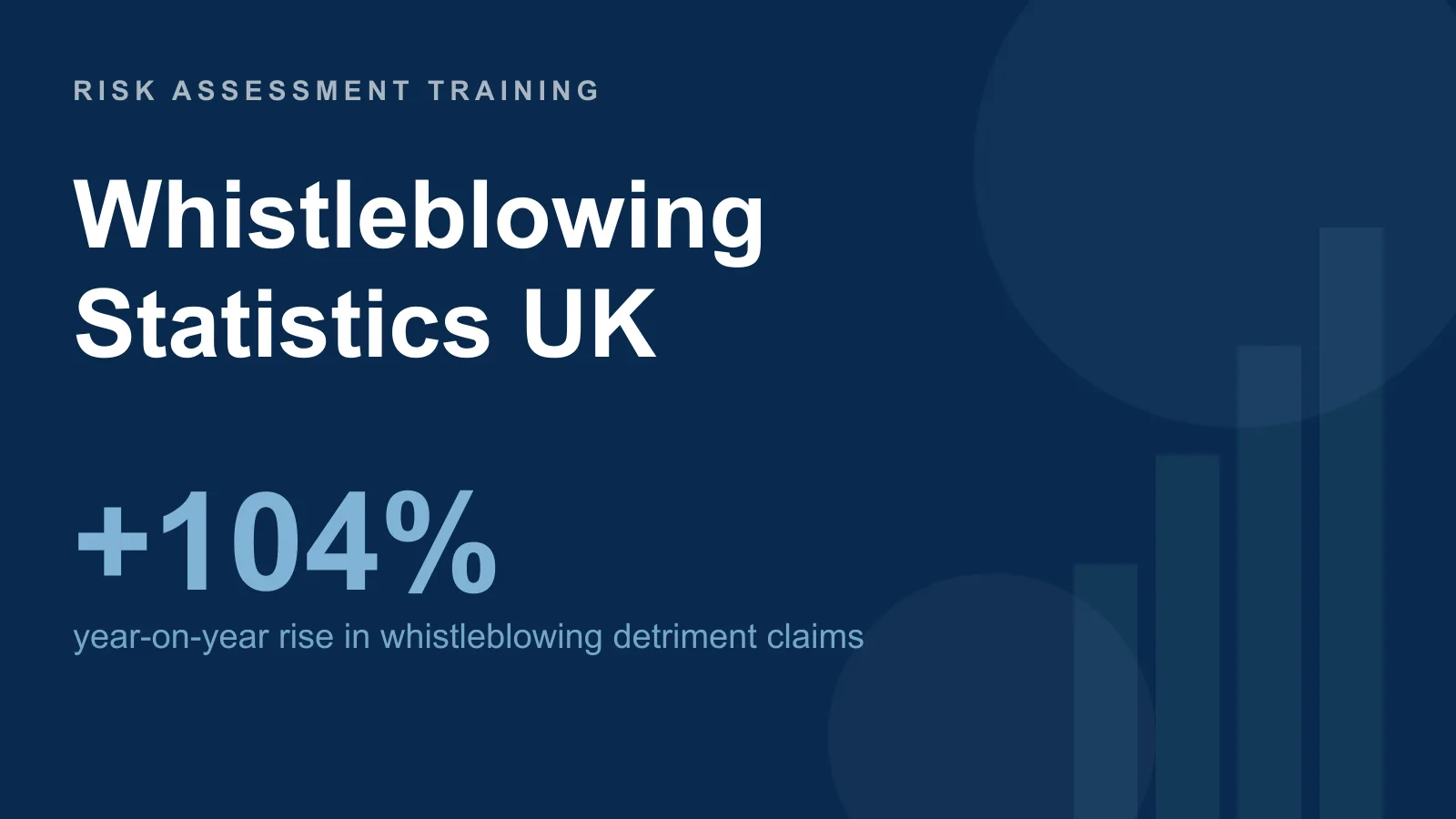
- 1,546 whistleblowing detriment claims reached employment tribunals in a single quarter — a 104% year-on-year rise (Q2 2025 vs Q2 2026, MoJ).
- 1,796 total whistleblowing tribunal claims (detriment plus dismissal) — up 102% year on year, the fastest-growing major claim type (MoJ, 2025/26).
- 405 new whistleblowing reports reached the FCA in Q3 2025 (Jul–Sep), up 25.8% on the same quarter of 2024.
- 1,131 new whistleblowing reports reached the FCA across 2024/25, containing 2,684 separate allegations of wrongdoing.
- 3,336 cases were handled by the charity Protect’s advice line in 2024 — a 10% rise on 2023.
- 40% of whistleblowers told Protect their concern had been ignored by their employer (2024 casework).
- 68% of whistleblowers said they faced victimisation or felt forced to resign (Protect, 2024).
- 45% of workers said they had seen or experienced health & safety breaches during their careers (CIPD, 2024).
All figures are the latest available as of July 2026. Because the two headline series refresh every quarter — the MoJ’s Tribunal Statistics and the FCA’s whistleblowing data — this page is reviewed each quarter and given a deeper refresh annually when Protect’s casework, the FCA Prescribed Persons Annual Report and the GOV.UK prescribed-person figures are published.
How many whistleblowing tribunal claims are there in the UK?
1,546 whistleblowing detriment claims were lodged with employment tribunals in the most recent comparable quarter, a 104% increase on the same quarter a year earlier (Q2 2025 compared with Q2 2026), according to the Ministry of Justice’s Tribunal Statistics Quarterly. Detriment claims are those where a worker alleges they were treated worse — sidelined, disciplined or otherwise penalised — for making a “protected disclosure” under the Public Interest Disclosure Act 1998 (PIDA).
Add the dismissal claims — where a worker alleges they were sacked for blowing the whistle — and the total reaches 1,796 whistleblowing claims, up 102% year on year from 888. In the MoJ data for 2025/26 this made whistleblowing the fastest-growing of the major claim types. These counts are the whistleblowing/PIDA slice of the tribunal caseload only; we do not reproduce the general employment-tribunal-volume figures here, and discrimination or harassment claim statistics are covered on our sister site rather than on this page.
One figure worth holding alongside the growth is the outcome data: 519 whistleblowing cases were recorded as unsuccessful at hearing in the 2025/26 series — roughly a third of detriment claims fail at tribunal. A rising caseload does not mean rising vindication; it means more disputes are reaching the point where a concern has already turned into a legal fight.
Are whistleblowing claims increasing in the UK?
Yes — sharply. The 102% year-on-year rise in total whistleblowing claims (from 888 to 1,796) recorded in the MoJ’s 2025/26 quarterly data outpaced the growth in almost every other major claim category, making whistleblowing the fastest-growing major claim type. The detriment sub-total rose even faster in percentage terms, up 104% to 1,546.
Several forces sit behind the trend. Awareness of PIDA protection has grown, employment lawyers report more workers naming whistleblowing detriment explicitly, and the wider tribunal system has been carrying a heavier caseload since fees were abolished in 2017. For an employer, the practical reading is simple: the volume of disputes that begin with “I raised a concern and was punished for it” is climbing quickly, and each one represents a concern that a functioning speak-up process should have resolved internally long before it reached a tribunal.
| Whistleblowing tribunal measure | Latest figure | Change / context |
|---|---|---|
| Detriment claims (single quarter) | 1,546 | +104% year on year (Q2 2025 vs Q2 2026) |
| Total claims (detriment + dismissal) | 1,796 | +102% year on year, up from 888 |
| Cases unsuccessful at hearing | 519 | ≈ one third of detriment claims fail |
| Fastest-growing major claim type | Whistleblowing | MoJ Tribunal Statistics, 2025/26 |
Source: Ministry of Justice, Tribunal Statistics Quarterly (whistleblowing/PIDA jurisdiction), latest quarter published May 2026.
How many whistleblowing reports does the FCA receive?
405 new whistleblowing reports reached the Financial Conduct Authority in Q3 2025 (July to September), up 25.8% on the 322 received in the same quarter of 2024. Those 405 reports contained 1,379 separate allegations of wrongdoing — because a single report often flags several distinct problems at once. The following quarter, Q4 2025 (October to December), brought 281 new reports containing 788 allegations.
Across the full financial year, the FCA received 1,131 new whistleblowing reports in 2024/25 (1 April 2024 to 31 March 2025), generating 2,684 allegations, according to its Prescribed Persons Annual Report. The FCA is one of dozens of “prescribed persons” — bodies a worker can disclose to outside their own employer while keeping legal protection — and its data is the most granular of the lot. Crucially, whistleblower information enabled the FCA to take direct action against firms 908 times in 2024/25, which is the clearest evidence in the UK system that speaking up changes regulatory outcomes rather than simply generating paperwork.
The FCA covers financial services rather than workplace safety specifically, but its data is included here because it is the UK’s best-maintained public series on how many concerns are raised and how many lead to action. Prescribed-person reporting across all regulators is summarised annually by GOV.UK’s whistleblower statistics, which pulls together the numbers each prescribed body must publish for the year to 31 March.
What percentage of whistleblowers have their concerns ignored?
40% — two in five — of whistleblowers who contacted the charity Protect said their concern had been ignored by their employer, according to Protect’s 2024 advice-line casework. That single figure is the crux of the “unheeded concern” problem: a hazard flagged and then filed away is a hazard still live.
The victimisation numbers are starker still. More than two-thirds — 68% — of whistleblowers told Protect they faced victimisation or felt forced to resign after raising a concern. Protect worked on 3,336 cases through its advice line in 2024, a 10% rise on the previous year, and its casework consistently shows that the personal cost of speaking up remains high even where the underlying concern is valid. When workers learn that the last person who raised a safety concern was pushed out, the rational response is silence — which is exactly how genuine risks stay hidden.
These charity figures reflect the people who reach out for help rather than a representative sample of all UK workers, so they describe the experience of active whistleblowers rather than the workforce as a whole. Even with that caveat, the direction is unambiguous: raising a concern too often triggers retaliation instead of resolution.
What are the most common whistleblowing concerns at work?
Health and social work was the single largest sector in Protect’s 2024 casework at 30% of cases, ahead of education (13%) and financial and insurance services (7%). That concentration matters for a safety audience: the sectors where the public is most exposed to harm are also the sectors generating the most whistleblowing casework.
On the health-and-safety slice specifically, CIPD research in 2024 found that 45% of workers said they had seen or experienced health & safety breaches during their careers — including unsafe practices (24%) and verbal mistreatment (25%). Yet only about half of employees (50%) knew their organisation’s whistleblowing procedure at all, so a large share of those who witness a breach have no clear, confidence-inspiring route to report it.
As a historical illustration of how safety concerns surge in a crisis: during the pandemic, 48% of the coronavirus-related reports the HSE received raised social-distancing concerns. That figure is a snapshot of an exceptional period rather than a current measure, but it shows how quickly workers turn to reporting channels when they believe a real safety risk is being ignored — and why an internal process that actually listens is a genuine risk-management control, not an HR formality.
| Speak-up measure | Figure | Source (period) |
|---|---|---|
| Cases handled by Protect advice line | 3,336 | Protect casework (2024) |
| Top sector: health & social work | 30% | Protect casework (2024) |
| Concern ignored by employer | 40% | Protect casework (2024) |
| Faced victimisation / forced to resign | 68% | Protect casework (2024) |
| Workers who witnessed H&S breaches | 45% | CIPD research (2024) |
| Employees who knew the whistleblowing procedure | 50% | CIPD research (2024) |
Why do whistleblowing statistics matter for risk management?
An ignored concern is a leading indicator of unmanaged risk. The whole logic of the HSE’s five-step risk-assessment process is to spot hazards before they cause harm, and the people best placed to spot a live hazard are the workers doing the job. When 40% of whistleblowers say their concern was ignored and only half of employees even know how to report one, an organisation is effectively switching off its most sensitive early-warning system.
The reporting data and the safety data point the same way. A workplace that treats a raised concern as a nuisance to be managed will keep appearing in the tribunal and casework statistics; a workplace that treats it as free hazard-spotting will tend to catch problems while they are still cheap to fix. A competent speak-up culture is best read as a companion control to the formal risk assessment — the mechanism that keeps the assessment honest between reviews. For how the underlying duty works, see our guide to what a risk assessment is and the five-step process, and for the specific duty to keep assessments current, how often a risk assessment should be reviewed.
Frequently asked questions
How many whistleblowing tribunal claims are there in the UK?
In the most recent comparable quarter, 1,546 whistleblowing detriment claims reached employment tribunals — up 104% year on year (Q2 2025 vs Q2 2026, MoJ). Including dismissal claims, total whistleblowing claims reached 1,796, up 102% from 888, making it the fastest-growing major claim type in the 2025/26 data.
Are whistleblowing claims increasing in the UK?
Yes. Total whistleblowing tribunal claims rose 102% year on year in the MoJ’s 2025/26 quarterly statistics, outpacing almost every other major claim category. The FCA also saw new whistleblowing reports rise 25.8% in Q3 2025 compared with Q3 2024. Both the tribunal caseload and the volume of reports to regulators are climbing.
What percentage of whistleblowers have their concerns ignored?
Around 40% — two in five — of whistleblowers who contacted the charity Protect in 2024 said their concern had been ignored by their employer. A further 68% said they faced victimisation or felt forced to resign after raising a concern. These figures reflect people who sought advice from Protect rather than a representative sample of all workers.
What are the most common whistleblowing concerns at work?
By sector, Protect’s 2024 casework was led by health and social work (30% of cases), then education (13%) and financial and insurance services (7%). On health and safety specifically, CIPD research in 2024 found 45% of workers had seen or experienced H&S breaches during their careers, yet only 50% knew their organisation’s whistleblowing procedure.
How often are these statistics updated?
The MoJ’s Tribunal Statistics and the FCA’s whistleblowing data are both published every quarter, so the headline figures here are refreshed quarterly. Protect’s casework, the FCA Prescribed Persons Annual Report and the GOV.UK prescribed-person statistics are annual. All figures on this page are the latest available as of July 2026.
Related guides
- Work-Related Stress Statistics UK: HSE Facts & Data
- Risk Assessment Statistics UK: Compliance Facts & Data (2026)
- HSE Enforcement Statistics UK: Fines, Prosecutions & Notices
- Lone working risk assessment: keeping isolated workers safe
- Who can carry out a risk assessment? The competence question explained
Sources & references
- Ministry of Justice — Tribunal Statistics Quarterly (whistleblowing/PIDA claims, latest quarter May 2026)
- Financial Conduct Authority — Whistleblowing quarterly data (2025 Q4)
- Financial Conduct Authority — Prescribed Persons Annual Report 2024/25
- GOV.UK — Whistleblower (prescribed person) statistics 2024 to 2025
- Protect — whistleblowing charity advice-line casework (2024 data)
- CIPD — whistleblowing and workplace health & safety research (2024)
- Safecall — Whistleblowing Benchmark Report (2023 data, 2024 edition)
- legislation.gov.uk — Public Interest Disclosure Act 1998 (PIDA)
Build a workforce that spots hazards early — train your team to assess and report workplace risk with confidence.
Explore the Risk Assessment Training course →
Mark writes about workplace health & safety, risk assessment and accredited online training for Risk Assessment Training, part of Online CPD Academy.