
Work-related stress, depression and anxiety is now the single biggest category of work-related ill health in Great Britain, and it hit a record level in the latest official figures. Under the Management of Health and Safety at Work Regulations 1999 it is also a hazard employers are legally required to risk-assess — which makes these numbers compliance data, not just wellbeing commentary. This page brings the key UK statistics together in one fully cited place, drawing primarily on the HSE’s annual work-related stress statistics, with supporting data from the ONS, the CIPD/Simplyhealth Health and Wellbeing at Work survey, Deloitte and Mental Health UK.
Key facts and figures
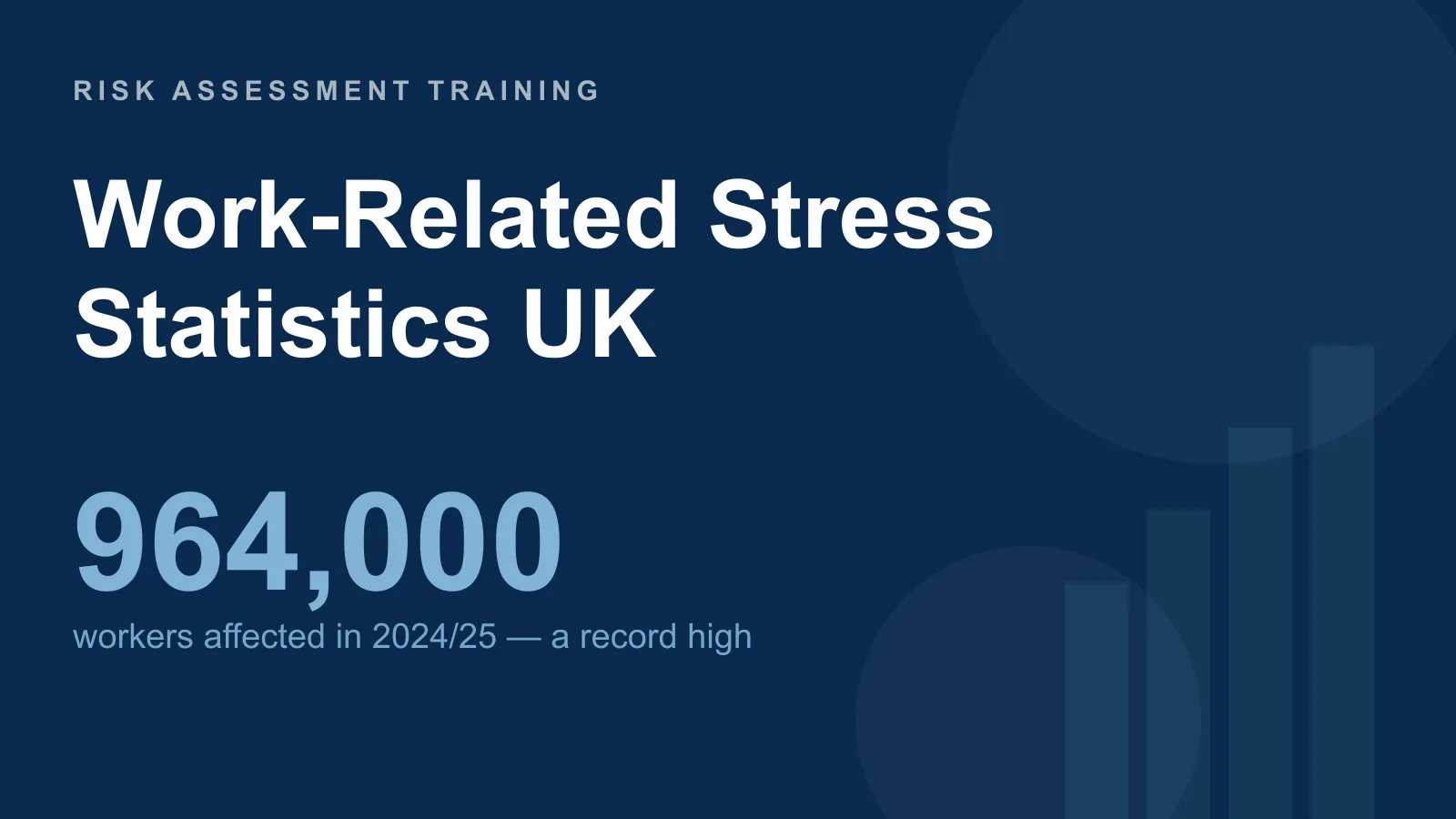
- 964,000 workers suffered work-related stress, depression or anxiety in 2024/25 — a record high.
- +24% in a single year: total cases rose from 776,000 in 2023/24.
- 409,000 of the 2024/25 cases were new cases that began during the year.
- 22.1 million working days were lost to stress, depression or anxiety in 2024/25 — 62% of all days lost to work-related ill health.
- 22.9 days were lost on average for every case in 2024/25.
- 52% of all work-related ill health cases in 2024/25 were stress, depression or anxiety.
- ~25% higher — the prevalence rate for women (3,220 per 100,000 workers) compared with men (2,580) in 2024/25.
- £51 billion — the estimated annual cost of poor employee mental health to UK employers (Deloitte, 2024).
These are the latest figures available as of July 2026. The HSE publishes its work-related stress, depression or anxiety statistics every November as part of its annual health and safety statistics release, and this page is updated when new data is released.
How many workers suffer work-related stress in the UK?
964,000 workers suffered from work-related stress, depression or anxiety in 2024/25, according to the HSE’s annual statistics published on 20 November 2025. That is the highest total on record, up 24% on the 776,000 cases reported in 2023/24 — a striking jump for a single year in a series that measures long-term national ill health.
Of the 2024/25 total, 409,000 were new cases that started during the year, up from around 300,000 the year before; the remainder were long-standing conditions that workers continued to experience. The overall prevalence rate works out at 2,770 cases per 100,000 workers — roughly 2.8% of the working population reporting work-related stress, depression or anxiety in a single year.
Stress, depression or anxiety accounted for 52% of all work-related ill health cases in 2024/25 — 964,000 of the 1.9 million workers who reported any work-related ill health condition. In other words, stress-related conditions now outnumber every other category of work-related ill health combined, including musculoskeletal disorders.
A note on coverage: the HSE’s figures are accredited official statistics for Great Britain (England, Scotland and Wales), based on self-reports collected through the Labour Force Survey. Northern Ireland’s workplace health data is reported separately.
| Measure | 2024/25 figure | Context |
|---|---|---|
| Workers affected (all cases) | 964,000 | Record high — up 24% on 776,000 in 2023/24 |
| New cases | 409,000 | Up from around 300,000 in 2023/24 |
| Working days lost | 22.1 million | 62% of all days lost to work-related ill health |
| Average days lost per case | 22.9 days | More than a working month per affected worker |
| Share of all ill health cases | 52% | 964,000 of 1.9 million total cases |
| Prevalence rate | 2,770 per 100,000 workers | Women 3,220 vs men 2,580 per 100,000 |
How many working days are lost to stress each year?
22.1 million working days were lost to work-related stress, depression or anxiety in 2024/25 — 62% of all working days lost to work-related ill health in Great Britain that year. On average each case cost 22.9 working days, which means the typical affected worker loses more than a full working month of time or capacity.
The wider absence data points the same way. The ONS estimates that 148.9 million working days were lost to sickness absence and injury of all kinds across the UK in 2024 — around 4.4 days per worker — with mental health conditions accounting for 9.8% of all days lost. The CIPD/Simplyhealth Health and Wellbeing at Work survey (September 2025) put average sickness absence at 9.4 days per employee per year, the highest level it has recorded in over 15 years.
Put together, the two datasets tell a consistent story: overall absence is at a multi-year high, and stress-related conditions are the largest single driver of the work-related share of it.
Who is most affected by work-related stress?
Women report work-related stress at a rate around 25% higher than men. In 2024/25 the prevalence rate for women was 3,220 cases per 100,000 workers, against 2,580 per 100,000 for men. Part of that gap reflects the composition of the workforce: the sectors where stress rates run highest employ large numbers of women.
By industry, the HSE’s statistics consistently show above-average rates of work-related stress, depression or anxiety in public-facing, high-demand sectors — notably human health and social work, public administration and defence, and education. These are workplaces that combine sustained demand pressure, emotional load and limited individual control over workload, the exact combination the HSE’s Management Standards identify as high-risk work design.
The employer-side data agrees with the worker-side data. In the CIPD/Simplyhealth survey (September 2025), 64% of organisations reported stress-related absence in the previous year — rising to 84% of public-sector organisations. Stress-related absence is no longer a minority experience for UK employers; it is the norm, and in the public sector it is nearly universal.
What causes work-related stress?
Workload is the most commonly cited cause. Among organisations reporting stress-related absence, 41% named heavy workloads as the top cause in the CIPD/Simplyhealth Health and Wellbeing at Work survey (September 2025) — well ahead of any other single factor.
The HSE structures the causes of work-related stress around its six Management Standards: demands, control, support, relationships, role and change. These are the six areas of work design where the evidence shows poor management reliably produces ill health — excessive demands, lack of control over how work is done, inadequate support, destructive relationships (including bullying and harassment), unclear or conflicting roles, and badly managed organisational change.
The pressure is not confined to a minority of workplaces. Mental Health UK’s Burnout Report 2026 (YouGov fieldwork, published January 2026) found that 91% of UK adults experienced high or extreme pressure or stress in the past year, and that 1 in 5 workers took time off sick in the past year because of poor mental health caused by pressure or stress.
Do employers have to risk-assess work-related stress?
Yes. Regulation 3 of the Management of Health and Safety at Work Regulations 1999 requires every employer to carry out a suitable and sufficient assessment of the risks to employees’ health — and the HSE is explicit that this includes risks to mental health. Employers with five or more employees must record the significant findings in writing. Work-related stress sits under the same statutory duty as any physical hazard: a wellbeing programme, however generous, does not discharge it.
The recognised assessment framework is the HSE’s Management Standards approach: the six work-design areas above, plus a validated 35-item Indicator Tool for surveying staff and analysing where the organisation’s risks sit. The HSE’s Working Minds campaign, running since 2021, exists largely to persuade employers — particularly smaller ones — that stress risk assessment is a legal duty rather than an optional extra. For a practical walkthrough of the method, see our stress risk assessment guide; for the general duty, see what a risk assessment is in UK workplace law.
Practice still lags the law. Even in the public sector — where stress-related absence is most widespread — the CIPD found that only 58% of public-sector employers use stress risk assessments or stress audits (September 2025). Given that stress accounted for 52% of all work-related ill health in 2024/25, a substantial share of UK employers are not formally assessing their single largest health risk.
What does work-related stress cost UK employers?
£51 billion a year. Deloitte’s 2024 Mental health and employers analysis estimated that poor employee mental health costs UK employers £51 billion annually — made up of around £24 billion in presenteeism (people working while unwell), £20 billion in staff turnover and £7 billion in absenteeism. The same research found an average return of £4.70 for every £1 employers invest in workplace mental health interventions.
The HSE’s own cost model points in the same direction: workplace injuries and new cases of work-related ill health cost Great Britain an estimated £22.9 billion in 2023/24, the most recent costs estimate published alongside the November 2025 statistics release. With stress, depression or anxiety making up 52% of ill health cases in 2024/25, stress is a large component of that bill — and one of the few where prevention is both legally required and demonstrably cost-positive.
Is work-related stress getting worse?
By the headline measure, yes — 2024/25 set a record. The rise from 776,000 cases in 2023/24 to 964,000 in 2024/25 is a 24% year-on-year increase, and the TUC described the November 2025 release as showing record levels of work-related stress in Britain’s workplaces.
The usual caveat applies: the HSE’s figures are self-reported through the Labour Force Survey, so greater awareness of mental health and greater willingness to report may account for part of the increase. But the direction is corroborated by independent sources measuring different things — the CIPD’s 9.4 days average absence in 2025 is its highest in more than 15 years, 64% of organisations report stress-related absence, and Mental Health UK found 1 in 5 workers took stress-related sick leave in the year to January 2026.
The next data point arrives in November 2026, when the HSE publishes its 2025/26 statistics. This page will be updated when it does.
Frequently asked questions
What are the latest HSE stress statistics?
For 2024/25 (published 20 November 2025): 964,000 workers suffered work-related stress, depression or anxiety — a record high — including 409,000 new cases. 22.1 million working days were lost, an average of 22.9 days per case, and stress accounted for 52% of all work-related ill health cases in Great Britain.
How many working days are lost to stress in the UK each year?
22.1 million working days were lost to work-related stress, depression or anxiety in 2024/25 — 62% of all days lost to work-related ill health. For context, the ONS estimates 148.9 million days were lost to sickness absence of all kinds across the UK in 2024.
What is the main cause of work-related stress?
Heavy workload. It was cited as the top cause of stress-related absence by 41% of organisations in the CIPD/Simplyhealth survey (September 2025). The HSE groups the causes into six Management Standards: demands, control, support, relationships, role and change.
Is work-related stress a health and safety issue in UK law?
Yes. Regulation 3 of the Management of Health and Safety at Work Regulations 1999 requires a suitable and sufficient assessment of all foreseeable risks to health, including mental health. Employers with five or more employees must record the significant findings in writing.
Why does the HSE count stress, depression and anxiety together?
The figures come from the Labour Force Survey, where workers self-report conditions they believe were caused or made worse by work. Stress, depression and anxiety are reported as a single category because respondents describe overlapping symptoms rather than clinical diagnoses — which is why HSE publications always refer to “stress, depression or anxiety”.
When are the next work-related stress statistics published?
November 2026. The HSE publishes its work-related stress, depression or anxiety report each November as part of the annual health and safety statistics release, covering the year to the previous April.
Related guides
- Risk Assessment Statistics UK: Compliance Facts & Data
- HSE Enforcement Statistics UK: Fines, Prosecutions & Notices
- Stress risk assessment: the HSE Management Standards and what employers must do
- What is a risk assessment? A guide to UK workplace law
- Working from home risk assessment: the duty for home and hybrid workers
- How often should a risk assessment be reviewed?
Sources & references
- HSE — Work-related stress, depression or anxiety statistics in Great Britain, 2025 (2024/25 data, published 20 November 2025)
- HSE — Annual workplace health and safety statistics press release, 20 November 2025
- HSE — Stress at work: the Management Standards
- ONS — Sickness absence in the UK labour market (2024 data)
- CIPD / Simplyhealth — Health and Wellbeing at Work survey, September 2025
- Deloitte — Mental health and employers: the case for investment (2024)
- Mental Health UK — The Burnout Report 2026 (published January 2026)
- TUC — Record levels of work-related stress in Britain’s workplaces (November 2025)
- legislation.gov.uk — Management of Health and Safety at Work Regulations 1999, regulation 3
Work-related stress must be risk-assessed like any other workplace hazard. Learn the HSE’s five-step method with RoSPA-approved training.
Explore Risk Assessment Training →
Mark writes about workplace health & safety, risk assessment and accredited online training for Risk Assessment Training, part of Online CPD Academy.