
Small and medium-sized enterprises make up almost every business in the UK, yet a large minority still fall short of the most basic health and safety duties. This page pulls the numbers together for the small employer with no in-house safety department, drawing on the Department for Business and Trade’s Longitudinal Small Business Survey (LSBS 2024) and its Business Population Estimates (BPE 2025) for the official picture of how many SMEs exist and how they seek advice and training, and on the Hiscox Risk Readiness Report (2023) for the granular detail on risk-assessment policies, safety resourcing and insurance gaps. Every figure carries its source and data period, so you can cite it with confidence.
Key facts and figures
- 99.8% of the UK’s 5.7 million private-sector businesses were SMEs at the start of 2025, employing around 16.9 million people — 60% of private-sector jobs (BPE 2025).
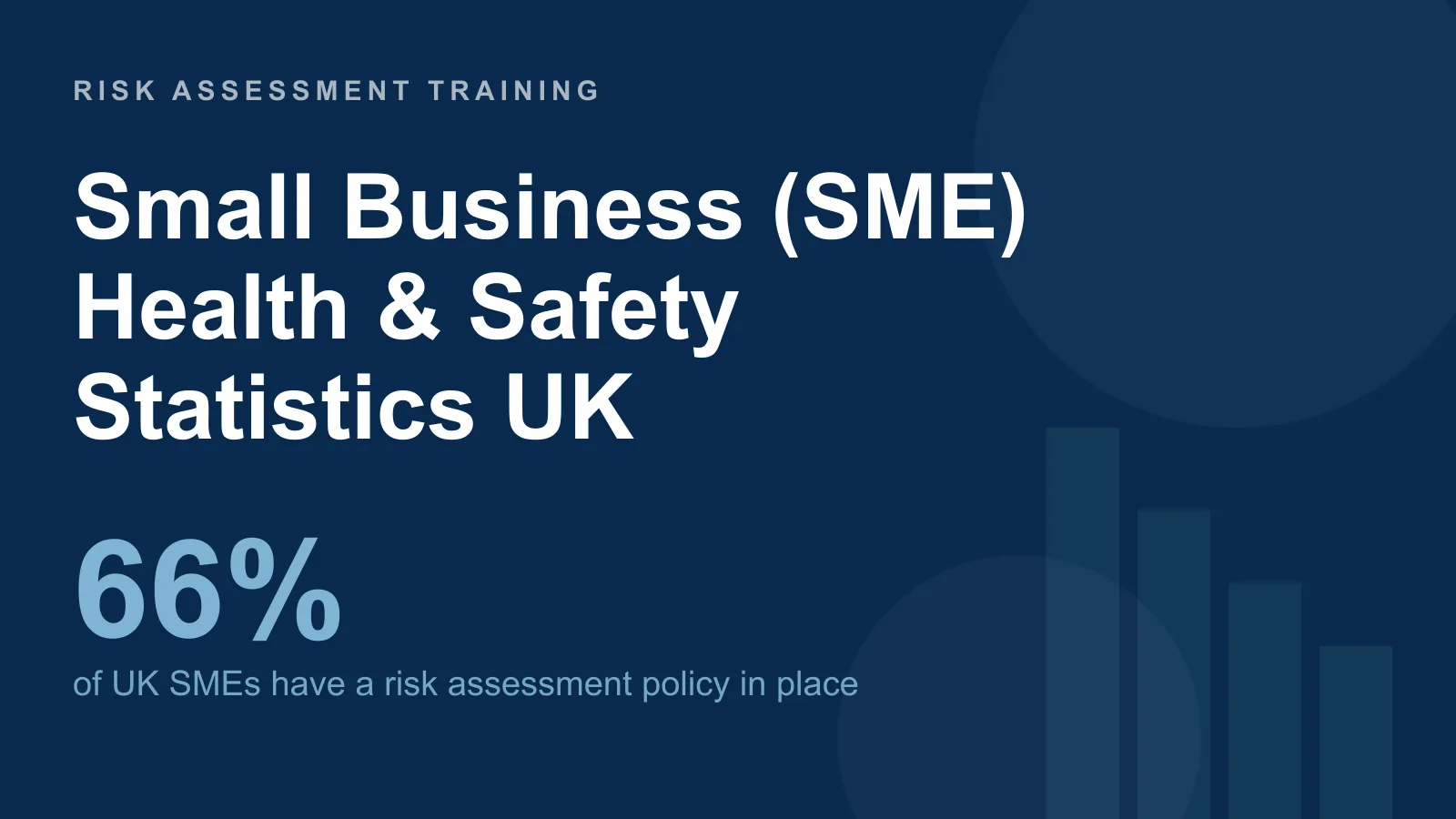
- 66% of UK SMEs had a risk assessment policy in place; 30% did not and 4% were unsure (Hiscox 2023).
- 36% of SMEs provided annual health & safety training (Hiscox 2023).
- 28% of SMEs had a dedicated health & safety staff member (Hiscox 2023).
- 16% of SMEs had none of the core safety measures — no policy, training, first aid, dedicated staff or literature (Hiscox 2023).
- 31% of SME leaders ranked health & safety as their highest priority (Hiscox 2023).
- 24% of SMEs had no public liability insurance, and 67% of those had no plan to obtain it within 12 months (Hiscox 2023).
- 45% of SME employers arranged or funded any staff training in 2024 — from 39% of micro firms to 82% of medium ones (LSBS 2024).
All figures are the latest available as of July 2026. The official baseline is refreshed each year — the LSBS is published every autumn and the Business Population Estimates each October — while the granular behavioural figures come from the ad-hoc Hiscox survey and are flagged with their 2023 date and swapped out when a newer commercial poll lands.
How many UK businesses are SMEs?
99.8% of the UK’s private-sector businesses were SMEs — firms with fewer than 250 employees — at the start of 2025, according to the Department for Business and Trade’s Business Population Estimates published in October 2025. That is 5.7 million businesses in total, of which 5.64 million were “small” (0–49 employees) and 38,435 were medium-sized (50–249 employees). Only around 8,250 firms were large.
The workforce numbers matter just as much as the count. SMEs accounted for roughly 60% of private-sector employment in 2025 — about 16.9 million jobs — so the health and safety behaviour of small firms shapes the working conditions of the majority of the private-sector workforce. It is also worth noting how small “small” really is: 75% of all UK businesses have no employees at all beyond the owner or partners, which is why so much of the compliance burden lands on people running a business single-handed. Every one of these employers with staff carries the same legal duty to assess risk as a multinational — see our guide to what a risk assessment is under UK law.
What percentage of small businesses have a risk assessment policy?
66% of UK SMEs had a risk assessment policy in place, according to the Hiscox Risk Readiness Report published in May 2023 — meaning 30% had no such policy and a further 4% were unsure, so almost one in three SMEs were operating without one. The finding was widely reported at the time by the safety press, with IOSH Magazine leading on the headline that “almost one in three SMEs have no risk assessment policy”.
The forward-looking number is arguably more concerning than the snapshot. Of the SMEs that had no risk assessment policy, only 16% planned to introduce one within the next 12 months (Hiscox 2023) — so the gap was not on a path to closing on its own. This is a policy-and-behaviour statistic about small firms specifically; it is not the same as the overall completion rate for risk assessments across all UK employers, which we cover separately on our risk assessment statistics page rather than re-tabulate here.
How many SMEs provide health & safety training and dedicated staff?
36% of SMEs provided annual health and safety training, and only 28% had a dedicated member of staff responsible for health and safety, according to the Hiscox Risk Readiness Report (2023). Provision of the other basics was patchy too: 52% of SMEs gave staff access to first aid facilities, and 42% provided health and safety information such as posters or leaflets. Most starkly, 16% of SMEs had none of these core measures in place — no policy, no training, no first aid, no dedicated staff and no literature.
Priorities help explain the gap. Just 31% of SME leaders ranked health and safety as their highest priority (Hiscox 2023), which in a small firm — where the owner is typically also the safety manager, the buyer and the salesperson — tends to translate directly into whether basic controls get put in place. The official training data from the DBT survey tells a consistent story from a different angle: 45% of SME employers arranged or funded any staff training at all in 2024, a figure that climbs steeply with size, from 39% of micro firms to 72% of small and 82% of medium ones (LSBS 2024). Smaller firms train less, and health and safety training is one of the first things to slip when time and budget are tight. If that is your business, our online Risk Assessment Training course is built to close exactly this gap without pulling anyone off the job for a day.
| Safety measure in place | Share of SMEs | Source & period |
|---|---|---|
| Risk assessment policy | 66% | Hiscox 2023 |
| Access to first aid facilities | 52% | Hiscox 2023 |
| Health & safety information (posters/leaflets) | 42% | Hiscox 2023 |
| Annual health & safety training | 36% | Hiscox 2023 |
| Health & safety ranked highest priority | 31% | Hiscox 2023 |
| Dedicated health & safety staff member | 28% | Hiscox 2023 |
| None of the core safety measures | 16% | Hiscox 2023 |
How often do small firms seek health & safety advice?
6% of micro employers, 11% of small employers and 8% of medium employers sought external health and safety advice or information in the past year, according to the DBT Longitudinal Small Business Survey (2024 wave, published September 2025) — rising to around 15% in the manufacturing and construction sectors where the risks are highest. Health and safety is only one of many things a small firm might reach out about, and the broader picture is that SMEs seek external help sparingly: only 27% of SME employers sought any external information or advice at all in 2024 (25% of micro, 35% of small and 44% of medium firms).
The pattern across every one of these measures is the same: the smaller the business, the less likely it is to have formal safety arrangements, to train staff or to seek advice — with the sole exception of higher-risk sectors, where advice-seeking rises regardless of size. For the small employer, this is precisely where accessible, low-cost online training earns its place: it substitutes for the in-house safety adviser that four out of five micro firms simply do not have. IOSH, the professional body for safety practitioners, makes the same point in its policy position on SMEs and occupational safety, noting that smaller firms often lack the in-house expertise and resources that larger organisations take for granted.
Does risk-assessment adoption vary by sector?
92% of engineering and manufacturing SMEs had a risk assessment policy, compared with just 60% in retail, according to the Hiscox Risk Readiness Report (2023) — a 32-percentage-point spread that shows the headline “66% of SMEs” figure hides very different realities depending on the trade. Higher-hazard sectors, where the consequences of getting it wrong are visible and the regulatory attention more intense, were markedly more likely to have formal arrangements in place.
That sector effect lines up with the advice-seeking data from the official survey: manufacturing and construction firms were roughly twice as likely as the SME average to seek health and safety advice (around 15% versus 6–11%) in 2024 (LSBS 2024). The takeaway for lower-risk service and retail SMEs is not that they are safe by default — it is that they are the least likely to have looked at their risks systematically, and the “low-hazard” label can breed a complacency the law does not recognise. The legal duty to make a suitable and sufficient assessment applies to the corner shop just as it does to the factory.
Do small businesses have the right insurance?
24% of SMEs had no public liability insurance, and of those, 67% had no plan to obtain it within the next 12 months, according to the Hiscox Risk Readiness Report (2023). Public liability cover is not itself a legal requirement, but the finding is a useful proxy for how a quarter of small firms approach risk transfer generally: a gap they are aware of and not intending to close. (Employers’ liability insurance, by contrast, is a legal requirement for most businesses with staff under the Employers’ Liability (Compulsory Insurance) Act 1969, with fines of up to £2,500 for each day a business is uninsured.)
The cost of getting risk management wrong showed up in the same survey. The average SME reported 3.2 workplace accidents in the previous 12 months, at an average financial hit of £17,185 per business (Hiscox 2023) — a figure that captures lost time, remediation and the knock-on costs that fall hardest on a small firm with no slack in the system. That is the business case for spending a little on prevention: a single serious incident can cost more than years of training and insurance combined.
Are small businesses more likely to have workplace accidents?
Yes — smaller firms carry a materially higher fatal-accident rate than larger ones. According to IOSH’s policy position on SMEs and occupational safety, the fatal-injury rate in businesses with fewer than 50 workers is around double that of larger companies. We flag that here as context only and do not tabulate injury figures on this page — the full injury and fatality data sits with the HSE’s national statistics, which we summarise on our risk assessment statistics page.
The reason the gap exists is exactly what the resourcing numbers describe: smaller firms are less likely to have a safety policy, a trained workforce, dedicated safety staff or access to advice. Higher exposure meets lower control. That is not an argument that small businesses are careless — it is a structural feature of running a business with no dedicated safety function, and it is the strongest single argument for the accessible, proportionate training this site exists to provide.
Frequently asked questions
What percentage of UK small businesses have a risk assessment policy?
Around 66% of UK SMEs had a risk assessment policy in place in 2023, according to the Hiscox Risk Readiness Report — meaning almost one in three (30%) had none, with a further 4% unsure. Of those without a policy, only 16% planned to introduce one within 12 months. Adoption varied sharply by sector, from 92% in engineering and manufacturing to 60% in retail.
How many SMEs provide annual health and safety training?
Just 36% of SMEs provided annual health and safety training in 2023 (Hiscox), and only 28% had a dedicated member of staff responsible for safety. On the broader official measure, 45% of SME employers arranged or funded any staff training in 2024, ranging from 39% of micro firms to 82% of medium ones (LSBS 2024).
How many UK businesses are SMEs and how many people do they employ?
At the start of 2025 there were 5.7 million private-sector businesses in the UK, of which 99.8% were SMEs (fewer than 250 employees). They accounted for around 60% of private-sector employment — roughly 16.9 million jobs — according to the Department for Business and Trade’s Business Population Estimates 2025. Three-quarters of all businesses have no employees beyond the owner.
Are small businesses more likely to have workplace accidents than large ones?
Yes. IOSH reports that the fatal-injury rate in firms with fewer than 50 workers is around double that of larger companies. Smaller firms are also less likely to have a safety policy, trained staff or access to advice, so higher exposure meets lower control. For the national injury and fatality figures see our risk assessment statistics page.
How often are these SME statistics updated?
The official baseline refreshes annually: the DBT Longitudinal Small Business Survey is published each autumn and the Business Population Estimates each October. The detailed behavioural figures come from the Hiscox Risk Readiness Report (2023), an ad-hoc commercial survey with no fixed release cycle, so they carry their 2023 date and are updated when a newer poll is published. This page is reviewed against each release and figures are the latest available as of July 2026.
Related guides
- Risk Assessment Statistics UK: Compliance Facts & Data
- Health & Safety Training Statistics UK
- HSE Enforcement Statistics UK: Fines, Prosecutions & Notices
- What is a risk assessment? A guide to UK workplace law
- The 5 steps to risk assessment: how to do one properly
- Who can carry out a risk assessment? The competence question explained
Sources & references
- Department for Business and Trade — Longitudinal Small Business Survey 2024 (SME employers, 1 to 249 employees)
- Department for Business and Trade — Business Population Estimates for the UK and regions 2025 (statistical release)
- Hiscox — Risk Readiness Report 2023 (survey of 1,500 SME leaders)
- IOSH Magazine — Almost one in three SMEs have no risk assessment policy (reporting Hiscox 2023)
- IOSH — SMEs and occupational safety and health (policy position)
- Health and Safety Executive — Health and safety statistics for Great Britain 2024/25
- Federation of Small Businesses — UK small business statistics
Give your small team the safety knowledge a big firm gets in-house — accredited risk assessment training, done online in about 90 minutes.
Explore the Risk Assessment Training course →
Mark writes about workplace health & safety, risk assessment and accredited online training for Risk Assessment Training, part of Online CPD Academy.