
How many UK employers actually provide health and safety training, how much do they spend on training overall, and how much of the workforce it reaches are all measured — chiefly by the Department for Education’s Employer Skills Survey, with the DWP Employer Survey and the Scottish Government’s own skills survey filling in the picture. This page pulls those numbers into one citable reference on health and safety training as a product category: provision rates, total and per-head training spend, e-learning uptake and workforce coverage. It deliberately stays on training provision rather than injury or ill-health counts, and every figure carries its data period and named source.
Key facts and figures
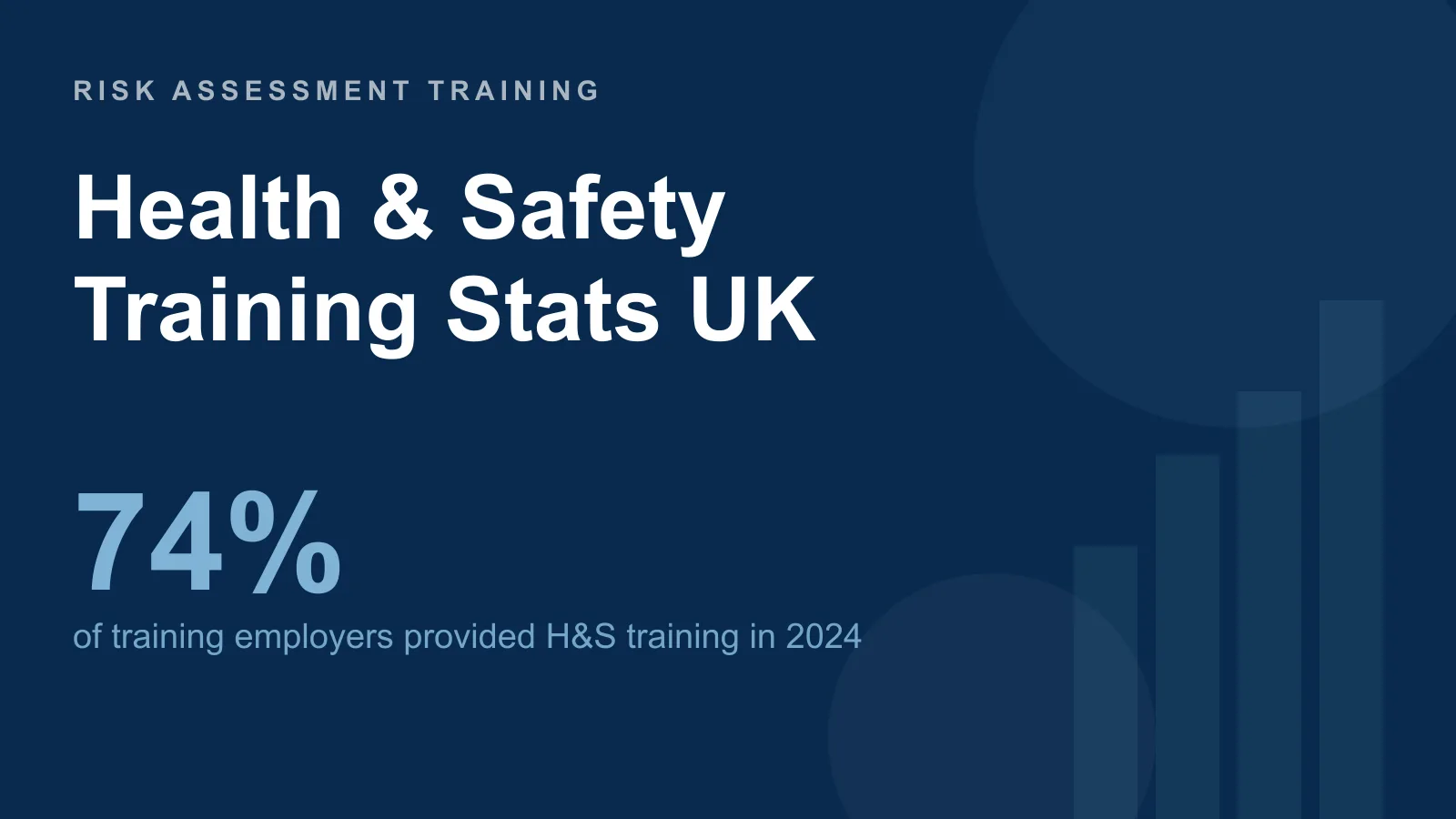
- 74% of employers that trained in the previous 12 months provided health and safety training — the second most common training type, up from 71% in 2022.
- 85% of training employers provided job-specific training, the only type ahead of health and safety.
- 59% of UK employers provided any training in the previous 12 months in 2024, down from 60% in 2022.
- 70% of training employers funded or arranged online training or e-learning, up from 67% in 2022 and 51% in 2017.
- 19.6 million staff received training over the year — 63% of the workforce, up from 18.2 million (60%) in 2022.
- £53.0 billion was the total UK employer training spend, down 10.2% in real terms from £59.0bn in 2022 — the lowest since the series began in 2011.
- £2,710 was spent per person trained, down from £3,250 in 2022; spend per employee fell to £1,700 from £1,960.
- 70% of GB employers provide health and safety training or guidance to prevent ill-health or improve wellbeing, down from 75% in 2022 (DWP measure).
All figures are the latest available as of July 2026. The anchor source — the DfE Employer Skills Survey — is biennial, so this page is refreshed when the next wave (fieldwork 2026, publication expected around 2027) is released, with the DWP Employer Survey and the Scottish survey updating the picture in the alternate years.
What percentage of UK employers provide health and safety training?
74% of UK employers that had trained staff in the previous 12 months provided health and safety training, according to the DfE Employer Skills Survey 2024 (fieldwork June 2024 to February 2025, published November 2025). That makes health and safety the second most common type of training employers arrange, up from 71% in the 2022 wave. Only job-specific training was more common, provided by 85% of training employers.
The two numbers describe different populations, so it is worth being precise. The 74% figure is the share of training employers offering health and safety training — not the share of all businesses. In 2024, 59% of all UK employers provided any training at all in the previous 12 months, a slight fall from 60% in 2022. Put together, roughly three in five employers train, and of those, close to three in four include health and safety in the mix. That places the topic firmly among the most widely delivered forms of workplace training in the country, which is what you would expect given the underlying legal duty covered below.
| Training type | Share of training employers (2024) | 2022 |
|---|---|---|
| Job-specific training | 85% | — |
| Health and safety training | 74% | 71% |
| Any training (share of all employers) | 59% | 60% |
| Online training / e-learning | 70% | 67% |
Source: DfE Employer Skills Survey 2024 (published November 2025). “—” where a directly comparable 2022 figure is not reported in the same series.
How much do UK employers spend on training?
£53.0 billion was the total amount UK employers spent on training in 2024, down 10.2% in real terms from £59.0bn in 2022, according to the DfE Employer Skills Survey 2024. In real terms that is the lowest level of employer training investment since the survey series began in 2011 — a 14-year low, as the secondary coverage in People Management framed it. The same analysis noted that average training received fell to 5.7 days per employee, the lowest ever recorded by the survey.
The total splits almost evenly between the two headline categories the survey tracks: £26.9 billion on off-the-job training and £26.1 billion on on-the-job training in 2024. Health and safety training sits inside this envelope rather than being costed out separately, so the spend total is best read as the overall budget from which health and safety, job-specific and other training is funded.
On a per-head basis the decline is just as clear. Spend per person trained fell to £2,710 in 2024, down from £3,250 in 2022, while spend per employee across the whole workforce fell to £1,700 from £1,960. In other words, employers are spreading a smaller real-terms budget across a slightly larger number of trainees — which, as the coverage figures below show, is exactly what the workforce numbers describe.
How many workers receive workplace training each year?
19.6 million members of staff received training over the previous 12 months in 2024, up from 18.2 million in 2022, according to the DfE Employer Skills Survey 2024. That is equivalent to 63% of the workforce, up from 60% two years earlier — so despite the fall in total spend, the reach of training grew. It is the combination of these two trends that produces the lower per-trainee spend noted above: more people trained, from a smaller real-terms pot.
The Scottish Government’s Employer Skills Survey 2024 (published 8 October 2025) reports the same pattern at national level. In Scotland, 1.5 million employees — 60% of the workforce — were trained in the year, with total employer training spend of £4.4 billion. On the provision side, health and safety or first aid training was arranged by 75% of Scottish training employers; because first-aid figures sit outside the scope of this page and the Scottish survey bundles the two together, the cleaner comparator remains the UK-wide health-and-safety-only figure of 74%.
How much health and safety training is now delivered online?
70% of training employers funded or arranged online training or e-learning in 2024, up from 67% in 2022 and just 51% in 2017, according to the DfE Employer Skills Survey 2024. E-learning is now the mainstream delivery method for workplace training rather than a niche one, and its growth is one of the clearest structural shifts the survey series has captured over the last seven years.
That trajectory matters for health and safety specifically, because it is one of the training types most suited to standardised, repeatable online delivery — induction and refresher training on core duties can be rolled out consistently across a workforce and evidenced with certificates. It is also the model this site is built on: short, accredited, online courses such as our risk assessment training that an employer can assign to a whole team. The survey does not break e-learning down by subject, so we present the 70% as the overall online-delivery figure rather than a health-and-safety-specific one.
Is health and safety training a legal requirement in the UK?
Yes. Under regulation 13 of the Management of Health and Safety at Work Regulations 1999, every employer must provide employees with adequate health and safety training when they are recruited and when they are exposed to new or increased risks — for example on being given new responsibilities, or when new equipment, technology or systems of work are introduced. That training must be repeated periodically where appropriate, adapted to take account of new or changed risks, and take place during working hours.
The regulation sits under the general duty in section 2 of the Health and Safety at Work etc. Act 1974 to provide such information, instruction, training and supervision as is necessary to ensure health and safety at work. The HSE’s own plain-English summary, Health and safety training: a brief guide (INDG345), sets out how to identify training needs and who needs it. This legal backdrop is the reason health and safety consistently ranks as one of the most widely provided training types in the survey data — it is, for most employers, not optional. For the practical detail of who is competent to deliver and act on training, see our guide on who can carry out a risk assessment.
Where are the gaps in employer health and safety training?
70% of GB employers provide health and safety training or guidance to prevent ill-health or improve wellbeing, down 4.7 percentage points from 75% in 2022, according to the DWP Employer Survey 2024 (fieldwork February to April 2024). This is a different measure from the Employer Skills Survey’s 74% — it is framed around ill-health prevention and wellbeing rather than training provision generally — but the direction of travel is the notable point: on this measure, provision fell.
The same survey found that 68% of employers agreed health and safety training or guidance is effective at preventing employee ill-health, so belief in its value remains high even where provision slipped. The sharpest gap is in management training: only 21% of employers train their line managers on improving employee health and wellbeing, down from 29% in 2022. That is a meaningful shortfall, because line managers are usually the people expected to apply health and safety practice day to day. We keep the detail of the workplace ill-health those measures aim to prevent to our sibling pages — see the work-related stress statistics page for the largest single category.
Frequently asked questions
What percentage of UK employers provide health and safety training?
74% of employers that trained staff in the previous 12 months provided health and safety training in 2024, the second most common training type after job-specific training (85%), according to the DfE Employer Skills Survey 2024. On the DWP’s narrower ill-health-and-wellbeing measure, 70% of GB employers provide health and safety training or guidance, down from 75% in 2022.
How much do UK employers spend on training?
UK employers spent £53.0 billion on training in 2024, down 10.2% in real terms from £59.0bn in 2022 and the lowest since the survey began in 2011. That works out at £2,710 per person trained and £1,700 per employee, both down on the 2022 figures.
Is health and safety training a legal requirement in the UK?
Yes. Regulation 13 of the Management of Health and Safety at Work Regulations 1999 requires employers to provide adequate health and safety training on recruitment and on exposure to new or changed risks, repeated periodically where appropriate and carried out during working hours. It sits under the general training duty in section 2 of the Health and Safety at Work etc. Act 1974.
How many workers receive workplace training each year?
19.6 million staff received training in the year in 2024 — 63% of the workforce — up from 18.2 million (60%) in 2022, according to the DfE Employer Skills Survey 2024. In Scotland specifically, 1.5 million employees (60% of the workforce) were trained.
How often are these statistics updated?
The DfE Employer Skills Survey is biennial; the 2024 edition was published in November 2025, and the next wave (fieldwork 2026) is expected around 2027. The DWP Employer Survey and the Scottish Government’s survey update the picture in alternate years. This page is reviewed against each release and the figures here are the latest available as of July 2026.
Related guides
- Risk Assessment Statistics UK: Compliance Facts & Data
- Work-Related Stress Statistics UK: HSE Facts & Data
- HSE Enforcement Statistics UK: Fines, Prosecutions & Notices
- Who can carry out a risk assessment? The competence question explained
- What is a risk assessment? A guide to UK workplace law
Sources & references
- Department for Education — Employer Skills Survey 2024 (Explore Education Statistics, published November 2025)
- Department for Education — Employer Skills Survey 2024: full UK research report (PDF)
- Department for Work and Pensions — DWP Employer Survey 2024
- Scottish Government — Employer Skills Survey 2024: training and workforce development
- legislation.gov.uk — Management of Health and Safety at Work Regulations 1999, regulation 13
- Health and Safety Executive — Health and safety training: a brief guide (INDG345)
- People Management — UK employers cut training investment to lowest level in more than a decade (2025)
Put the numbers to work — give your team accredited, online health and safety training they can complete in around 90 minutes.
Explore the Risk Assessment Training course →
Mark writes about workplace health & safety, risk assessment and accredited online training for Risk Assessment Training, part of Online CPD Academy.