
Personal protective equipment is the last line of defence in the risk-assessment hierarchy of control — the measure you reach for only after you have designed the hazard out, guarded it, and managed it. So the state of the PPE actually reaching UK workplaces matters. The most reliable annual read on that comes from the British Safety Industry Federation (BSIF) and its Registered Safety Supplier Scheme test programme, alongside the Women’s Engineering Society (WES) and TUC fit surveys, HSE’s PPE at Work Regulations 2022 framework, and Grand View Research’s UK market sizing.
This page pulls those figures into one citable reference: how much PPE fails compliance testing, how big the counterfeit and substandard-supply problem is, how badly PPE fits the people wearing it, and how large the UK market has become. Every figure carries its source and data period, and the whole page is framed around PPE’s place at the bottom of the control hierarchy — the point where none of the earlier controls can save you if the equipment itself is defective.
Key facts and figures
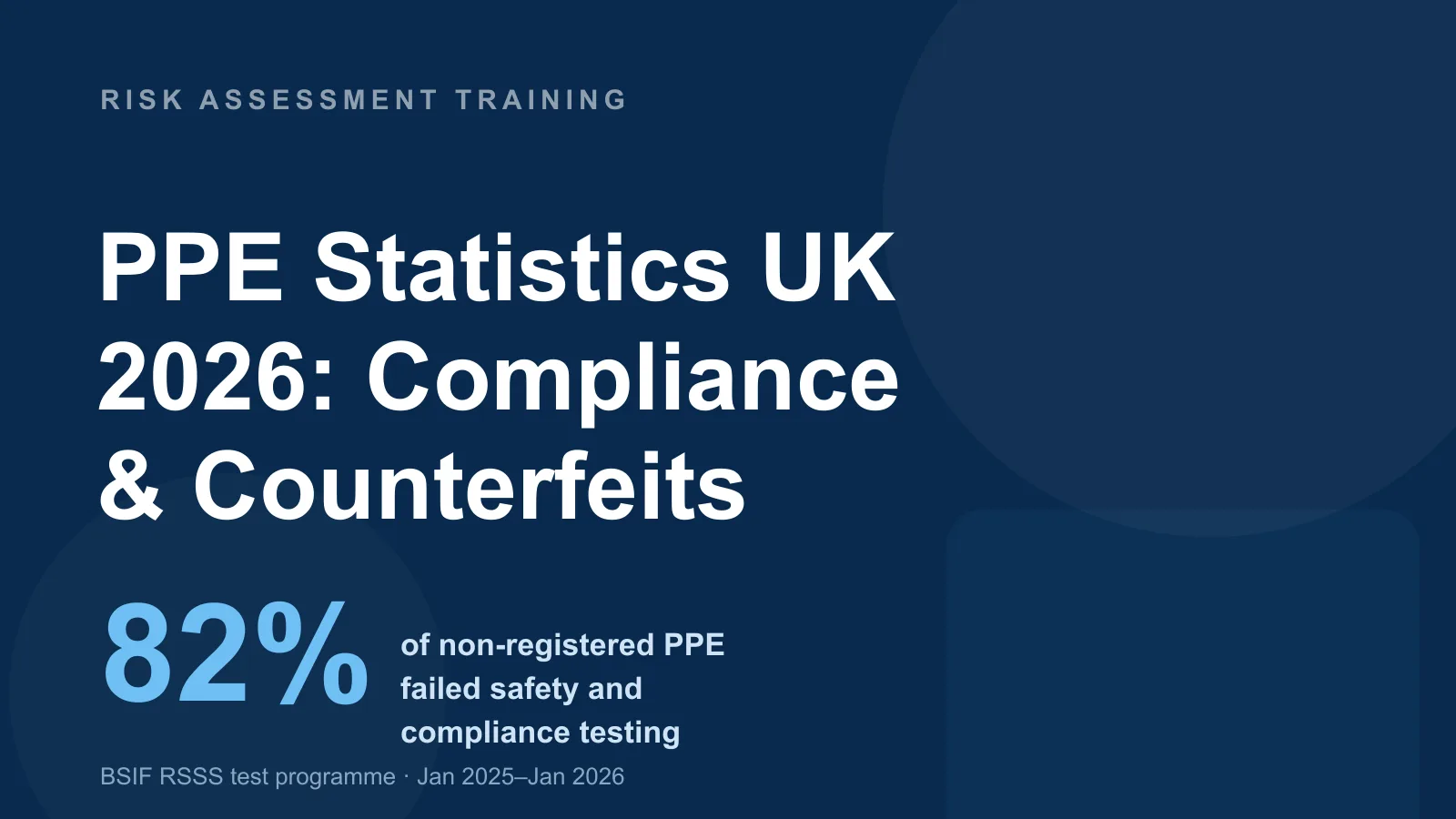
- 82% of PPE sourced from non-registered UK suppliers failed to meet the required safety and compliance standards in BSIF’s 2025 testing.
- 18% — the share of the 88 non-member products tested that met all applicable regulatory requirements (Jan 2025–Jan 2026 cycle).
- 96% compliance rate for PPE from BSIF Registered Safety Suppliers, with issues typically minor documentation matters.
- 100% of hearing protection and 100% of fall-protection products from non-registered suppliers failed testing.
- 84% of respiratory protective equipment tested had ineffective filters — a product-compliance data point, not an exposure figure.
- 4% of women say their PPE fits perfectly; only 26% report comfortable or perfect-fitting PPE, against 60% of men (WES, 2024).
- 61% of pregnant women were not provided with the correct maternity PPE (WES, 2024).
- ~£2.34bn — the UK PPE market in 2025 (~US$2.95bn), forecast to grow at about 5.7% a year to 2033.
All figures are the latest available as of July 2026, and this page is updated when new data lands — principally each February, when BSIF publishes fresh Registered Safety Supplier Scheme test results for the preceding year.
Where does PPE sit in the risk-assessment hierarchy of control?
PPE is the last and lowest-ranked control in the hierarchy — the “last resort” once elimination, substitution, engineering controls and administrative controls have been applied. That ranking is not an opinion; it is written into UK law. Under the Personal Protective Equipment at Work (Amendment) Regulations 2022 — in force since 6 April 2022 and last updated on HSE’s site in January 2026 — employers must provide suitable PPE where a risk cannot be controlled by other means, and the 2022 amendment extended those duties to “limb (b)” workers (many gig and casual workers) as well as employees.
The practical consequence for a risk assessment is simple: PPE is only ever as good as the item itself and the fit on the wearer. If earlier controls have been exhausted and PPE is carrying the residual risk, a defective or ill-fitting item means the risk is effectively uncontrolled. That is why the compliance and fit data below belongs on a risk-assessment site — it measures how reliable the last line of defence actually is. For the wider duty, see our guide to what a risk assessment is under UK law and the five-step method.
What percentage of PPE fails safety and compliance testing in the UK?
82% of PPE bought from non-registered UK suppliers failed to meet the required safety and compliance standards in BSIF’s most recent testing round, covering January 2025 to January 2026 and published in February 2026. Put the other way round, only 18% of the products BSIF assessed from outside its scheme passed everything asked of them. The programme tested 88 products across 116 individual tests — a modest sample, but a consistent annual one, which is what makes the year-on-year trend usable.
The contrast with the scheme’s own members is the headline. PPE supplied by BSIF Registered Safety Suppliers achieved a 96% compliance rate over the same period, and where members did fall short the issues were typically minor documentation matters rather than a product that would fail to protect. In control-hierarchy terms, the registered-supplier route is the difference between a last line of defence that holds and one that is compliant on paper but not in the field.
Because this is the anchor series for the page, it is worth being precise about what “failed” means: BSIF’s tests check products against the relevant standards and the documentation and marking that legally must accompany them. A failure can be a physical shortfall, a missing or invalid certificate, or incorrect CE/UKCA marking — all of which matter when the item is the residual control for a real workplace hazard.
Which PPE categories fail testing most often?
The 100% failure rates are the ones that stop you in your tracks: every hearing-protection product and every fall-protection product BSIF tested from non-registered suppliers failed against the test criteria in the 2025 cycle. Fall protection is a life-safety category — the equipment is all that stands between a worker and the ground — so a complete failure rate in the sample is the starkest illustration of why supplier provenance matters. The table below sets out the category-level picture from the same programme.
| PPE category (non-registered suppliers) | Failed testing | Note |
|---|---|---|
| Hearing protection | 100% | Entire sample failed |
| Fall protection | 100% | Life-safety category — entire sample failed |
| Head protection | 94% | Failed required test criteria |
| Sports & motorcycle protective equipment | 91% | Did not pass testing |
| Respiratory protective equipment (RPE) | 84% | Ineffective filters (product-compliance point) |
| High-visibility jackets | 84% | Failed brightness/visibility requirements |
| Safety footwear | 79% | Failed overall compliance checks |
| All non-member products | 82% | 88 products across 116 tests |
A note on the RPE figure: 84% of respiratory protective equipment tested had ineffective filters. On this page that is purely a product-compliance data point — a measure of whether the equipment met its standard. How respirators are selected against a specific airborne substance, and how they fit into COSHH exposure control, is a different question that sits with our sister site, COSHH Training. Here we are only counting whether the kit passed its test.
Is buying cheap or non-registered PPE online safe?
On the evidence, no — the 82% non-member failure rate is itself the clearest warning against buying PPE from unknown online sellers on price alone. The BSIF data is a standing measure of a market in which a large share of unbranded, non-registered product simply does not do what it claims. When PPE is the residual control on a risk assessment, a bargain that fails testing is not a saving; it is an uncontrolled risk that looks controlled.
The counterfeit problem became briefly visible at national scale during the pandemic. London Trading Standards and the Office for Product Safety and Standards stopped 6.5 million sub-standard face masks and around 8,000 counterfeit hand-sanitiser units at Heathrow, and about 2.25 million of the masks were found not to comply with legal safety standards. Those figures are pandemic-vintage context from 2020–21, not a live enforcement series — they show what happens to supply-chain integrity when demand spikes, rather than telling you the current rate of seizures. The durable, refreshable measure remains the BSIF annual test programme.
The practical takeaway for a dutyholder is to treat supplier registration as part of the control itself. Buying through a BSIF Registered Safety Supplier shifts you from an 18% chance of a fully compliant product to a 96% one — a control decision, not just a procurement one.
How much PPE for women doesn’t fit properly?
Only 4% of women say their PPE fits perfectly, and just 26% report PPE that is comfortable or well fitting — against 60% of men — according to the Women’s Engineering Society PPE survey of around 1,500 respondents, conducted August 2023 to January 2024 and published in 2024. Because PPE is the last line of defence, poor fit is not a comfort issue; a respirator that does not seal, a harness that does not sit correctly or gloves that do not grip mean the residual risk the assessment relied on PPE to control is not actually being controlled.
The knock-on behaviour is the safety-critical part. The WES survey found that 42% of women modify ill-fitting PPE against HSE guidance — for example tucking over-long trousers into boots — which can defeat the protection the item was certified to give. When women raised PPE concerns, more than 50% saw nothing change, against just 9% whose concerns were fully addressed, so the fit gap tends to persist rather than resolve.
The TUC’s work on PPE and women points the same way: only 29% of women were supplied with PPE actually designed for women, and 57% said PPE sometimes or significantly hampered their work. (These TUC figures are cited here via a University of the Built Environment summary, as the TUC materials date to earlier survey work.) A risk assessment that specifies “PPE provided” without confirming it fits the individual is recording a control that may not exist in practice — which is why fit testing and a proper range of sizes belong in the assessment, not the storeroom.
What about maternity and pregnancy PPE?
61% of pregnant women were not provided with the correct maternity PPE, according to the same WES 2024 survey — a striking gap given that pregnancy is one of the situations where UK law requires a specific, individual risk assessment. Standard-issue PPE frequently stops fitting as pregnancy progresses, so the general provision an employer relies on can quietly fail exactly when a tailored assessment is legally expected.
The detail of the pregnancy risk-assessment duty — when it is triggered, what it must cover and how it is reviewed — is its own topic, covered on our pregnancy risk assessment page. For the purposes of PPE statistics, the point is narrow: correct-fitting maternity PPE is part of the control the assessment specifies, and on the survey evidence it is missing more often than not.
How big is the UK PPE market?
The UK PPE market was worth roughly £2.34 billion (about US$2.95bn) in 2025 and is forecast to grow at around 5.7% a year to 2033, according to Grand View Research. It is a large and growing sector — which is precisely why the compliance and provenance data matters. A multi-billion-pound market with an 82% non-member failure rate is a market where a great deal of money buys equipment that does not perform, and where the gap between a registered and a non-registered supplier is a genuine safety variable rather than a branding one.
For a dutyholder, the market size is context rather than a control input: it explains the sheer volume of product in circulation and the commercial pressure that makes cut-price, non-compliant PPE so easy to find. The control response is unchanged — specify the right equipment in the assessment, buy it from a registered supplier, and confirm it fits the wearer.
Frequently asked questions
What percentage of PPE fails safety and compliance testing in the UK?
In BSIF’s Registered Safety Supplier Scheme testing for January 2025 to January 2026, 82% of PPE from non-registered suppliers failed to meet the required standards — only 18% of the 88 products tested passed everything. By contrast, PPE from BSIF Registered Safety Suppliers achieved a 96% compliance rate. BSIF refreshes these figures every February.
How much PPE for women doesn’t fit properly?
Only 4% of women say their PPE fits perfectly and just 26% report comfortable or well-fitting PPE, against 60% of men, in the WES 2024 survey of around 1,500 respondents. The same survey found 42% modify ill-fitting PPE against HSE guidance and 61% of pregnant women were not given correct maternity PPE.
Is buying cheap or non-registered PPE online safe?
The evidence says treat it as high risk: 82% of non-registered PPE failed BSIF testing, versus a 96% pass rate for Registered Safety Suppliers. During the pandemic, London Trading Standards and OPSS also intercepted 6.5 million sub-standard masks (about 2.25 million non-compliant) — pandemic-era context, not a current series. Buying through a BSIF Registered Safety Supplier is the reliable control.
Where does PPE sit in the risk-assessment hierarchy of control?
PPE is the last and lowest control — the “last resort” used only after elimination, substitution, engineering and administrative controls. Under the PPE at Work (Amendment) Regulations 2022, employers must provide suitable PPE where a risk cannot be controlled by other means. Because it carries the residual risk, a defective or ill-fitting item leaves that risk effectively uncontrolled.
How often are these PPE statistics updated?
The core BSIF test figures refresh every February for the preceding year, and the UK market sizing updates annually. The WES and TUC fit surveys are ad hoc and refreshed opportunistically when a new survey lands. This page is reviewed against each release, and all figures here are the latest available as of July 2026.
Related guides
- Risk Assessment Statistics UK: Compliance Facts & Data
- HSE Enforcement Statistics UK: Fines, Prosecutions & Notices
- Work-Related Stress Statistics UK: HSE Facts & Data
- Pregnancy risk assessment: the employer’s duty explained
- The 5 steps to risk assessment: how to do one properly
Sources & references
- BSIF — Testing reveals 82% of non-member PPE failed safety and compliance checks in 2025 (Registered Safety Supplier Scheme, Jan 2025–Jan 2026)
- Process & Control Today — BSIF testing reveals 82% of non-member PPE failed (category-level data, Feb 2026)
- Construction Briefing — The right fit: why PPE needs to be more inclusive (reporting the WES 2024 PPE survey)
- University of the Built Environment — The PPE gender gap in the built environment (summarising the TUC PPE and women survey)
- Health and Safety Executive — Personal Protective Equipment at Work (Amendment) Regulations 2022
- GOV.UK / OPSS — Clamping down on the risk of unsafe PPE (pandemic-era seizure data, 2020–21)
- Grand View Research — UK Personal Protective Equipment market size and outlook (2025 revenue, forecast to 2033)
PPE is the last line of defence — train your team to work up the hierarchy and control risk before it reaches the wearer.
Explore the Risk Assessment Training course →
Mark writes about workplace health & safety, risk assessment and accredited online training for Risk Assessment Training, part of Online CPD Academy.