
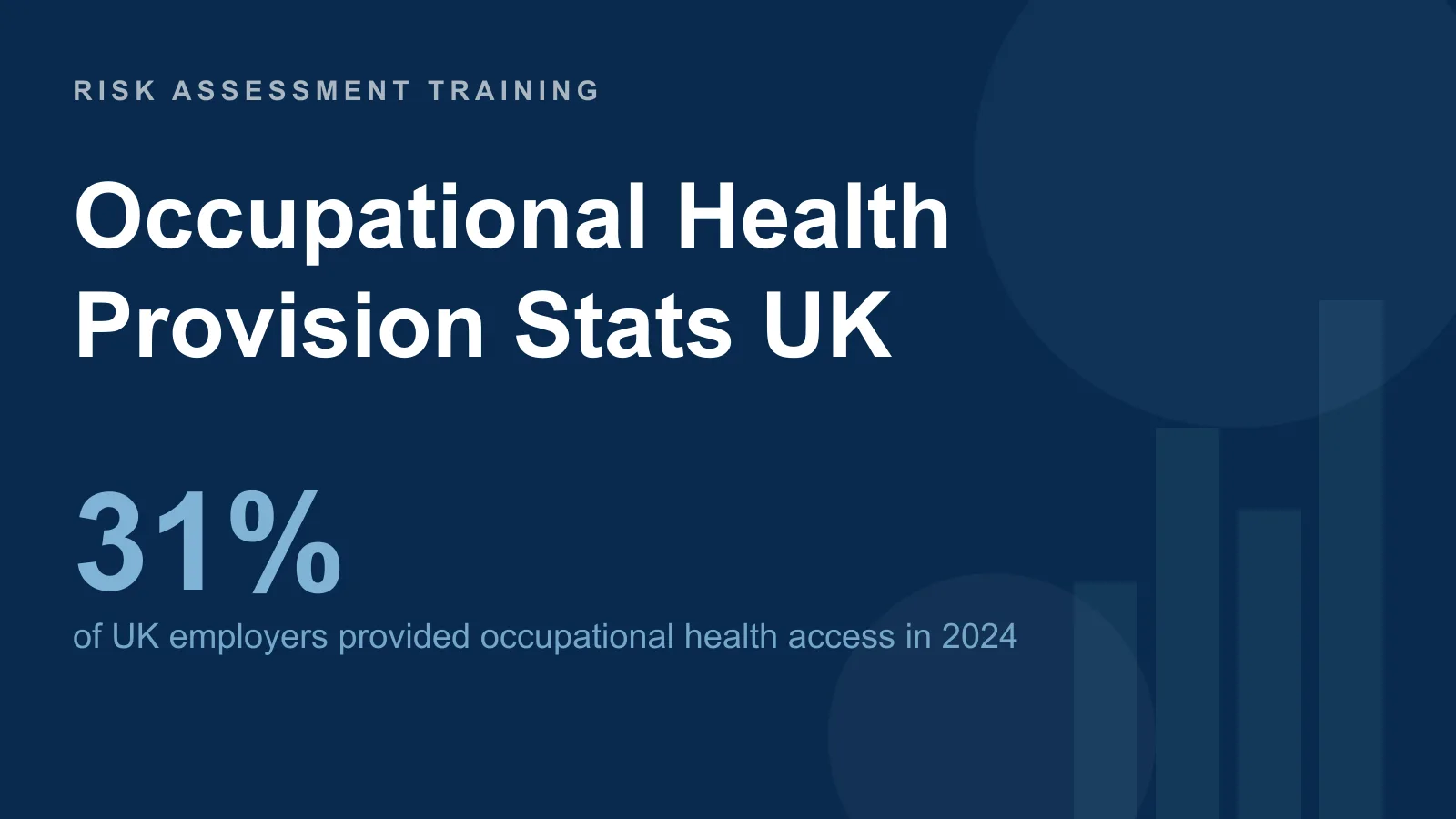
How many UK employers actually give their people access to occupational health (OH) services? The answer sits across a handful of official and near-official sources — the DWP Employer Survey 2024, the joint DWP/DHSC study Understanding Occupational Health Provision 2023-24, the CIPD’s Health and Wellbeing at Work survey, Lancaster University’s Work Foundation, the Society of Occupational Medicine (SOM) and the March 2026 Keep Britain Working review. This page pulls those figures into one citable reference on provision and access: how many employers offer OH, how the gap between large firms and small ones looks, how many workers can actually reach a service, and why the OH clinical workforce is a bottleneck. Every figure carries its source and data period.
Key facts and figures
- 31% of UK employers provided access to occupational health or vocational rehabilitation services in 2024 — 65% did not, and 4% were unsure (DWP Employer Survey 2024).
- 51% of employees reported having access to employer-provided occupational health services (DWP employee sample, 2,013 respondents, cited by SOM).
- 30–34% — the share of the UK workforce estimated to be able to reach specialist occupational health care (SOM commentary on DWP data).
- 86% of large employers (250+ staff) offer some OH provision, versus only around 30% of SMEs (Keep Britain Working final report, March 2026).
- 28%+ of the smallest employers (microbusinesses) offer no workplace health support at all, against 99% of large employers providing some form (Work Foundation, 2026).
- 38% of OH providers had unfilled vacancies — rising to 53% among NHS providers (DWP/DHSC Understanding OH Provision 2023-24).
- 64% of occupational health physicians are over 50, and around half are likely to retire within 10 years (SOM, Future of the OH Workforce).
- 95% — the median capacity use reported by OH providers over 12 months, with 24% at full capacity and a further 20% beyond it (DWP/DHSC, 2023-24).
All figures are the latest available as of July 2026, and this page is updated when new data is released — principally the biennial DWP Employer Survey and CIPD Health and Wellbeing at Work survey, plus any further Keep Britain Working updates following the March 2026 final report.
How many UK employers provide occupational health services?
31% of UK employers provided access to occupational health or vocational rehabilitation services in 2024, according to the DWP Employer Survey 2024 (fieldwork February to April 2024, published 16 May 2025). The remaining employers split into 65% that did not provide any access and 4% that were unsure. On that measure — the most representative national employer survey in this space — occupational health remains a minority offer, reaching under a third of workplaces.
Provision was also broadly flat over time. The DWP survey found OH provision in 2024 was largely unchanged from its 2022 baseline, although the way employers buy it shifted: using an external provider on an “as required” basis rose 5.4 percentage points and in-house support rose 5.6 points between the two waves. In other words, more employers moved toward flexible, pay-as-you-need arrangements rather than expanding fixed provision.
Other surveys report higher headline figures because they ask different employers different questions. The CIPD’s Health and Wellbeing at Work survey (2025 edition, published 9 September 2025) found 69% of organisations offer occupational health services, and the Work Foundation’s 2026 leader survey put employer-reported provision at 39%. The gap is real and instructive: CIPD samples larger, more HR-mature organisations, so its numbers sit well above a representative all-employer base. When comparing “how many employers offer OH” claims, always check who was surveyed.
How do employers actually buy occupational health?
The single most common route in 2024 was using an external provider on an “as required” basis (19% of employers), according to the DWP Employer Survey 2024. Below that came in-house resource (9%), public-sector or NHS provision (8%) and a long-term external contract (6%). Employers can and do use more than one route, which is why the individual shares don’t simply add to the 31% headline.
That distribution matters for anyone trying to read the market. Occupational health in the UK is dominated by ad-hoc, outsourced arrangements rather than embedded, contracted capacity — a pattern that helps explain both the flexibility employers value and the strain on providers when demand spikes. The route breakdown below is drawn from the 2024 wave.
| How OH is provided | Share of employers (2024) |
|---|---|
| Any access to OH / vocational rehabilitation | 31% |
| External provider, “as required” basis | 19% |
| In-house OH resource | 9% |
| Public-sector / NHS provision | 8% |
| Long-term external contract | 6% |
| No access provided | 65% |
| Unsure | 4% |
Source: DWP Employer Survey 2024 (fieldwork Feb–Apr 2024). Employers may use more than one route, so route shares do not sum to the headline provision figure.
What percentage of UK workers have access to occupational health?
51% of employees reported having access to employer-provided occupational health services, according to a DWP employee sample of 2,013 respondents highlighted in the Society of Occupational Medicine’s commentary on the data. That employee-side figure sits far above the 31% employer-side figure for a simple reason: the employers who provide OH tend to be the larger ones, so a minority of workplaces still covers around half of workers.
Access to a service is not the same as access to specialist clinical care, though. SOM’s analysis of the DWP data concludes that only around 30–34% of the UK workforce can actually reach specialist occupational health care — a much tighter figure than the self-reported “have access” number, and the one most often quoted in policy debate about OH coverage. The distinction between “my employer offers something” and “I can see an OH specialist when I need to” is where most of the coverage gap lives.
Are large employers more likely to offer OH than SMEs?
Yes — decisively. The Keep Britain Working final report (published 31 March 2026) found 86% of large employers offer some occupational health provision versus only around 30% of SMEs. The CIPD’s 2025 survey shows the same shape from its own sample: 69% of organisations overall offer OH, rising to 86% at large organisations of 250-plus employees.
The Work Foundation’s 2026 leader survey (1,001 senior business leaders) sharpens the small-employer picture. It found that over 28% of the smallest employers (microbusinesses) offer no workplace health support at all, against 99% of large employers providing some form of support. Firm size is the single strongest predictor of whether a worker has any OH safety net behind them.
Age of workforce is another sharp divide. The same Work Foundation survey found only 21% of employers with an older (55+) workforce offer key workplace health support — 15.4 percentage points below the survey average — even though those are the workforces most likely to need it. This size-and-age gap is exactly the lever the Keep Britain Working review targets, and it is why the phrase “unequal support” recurs across the 2026 evidence.
Is there a shortage of occupational health professionals in the UK?
Yes — supply is constrained on both capacity and headcount. The DWP/DHSC study Understanding Occupational Health Provision 2023-24 (fieldwork August 2023 to January 2024, published 5 August 2025) found that 24% of OH providers were operating at full capacity and a further 20% beyond maximum capacity, with a median capacity use of 95% over the previous 12 months. A market running that hot has little slack to absorb new demand.
Recruitment is the deeper problem. The same study found 38% of OH providers had unfilled vacancies, rising to 53% among NHS providers. On the clinical workforce itself, SOM’s Future of the Occupational Health Workforce paper reports that 64% of occupational health physicians are over 50 and around 50% are likely to retire within 10 years, while 44% of OH providers struggle to fill nurse and doctor vacancies. An ageing, retiring specialist workforce sitting behind a market already at 95% capacity is the structural reason coverage is hard to expand quickly.
| OH supply measure | Figure | Source (period) |
|---|---|---|
| Providers at full capacity | 24% | DWP/DHSC (2023-24) |
| Providers beyond maximum capacity | 20% | DWP/DHSC (2023-24) |
| Median capacity use over 12 months | 95% | DWP/DHSC (2023-24) |
| Providers with unfilled vacancies | 38% | DWP/DHSC (2023-24) |
| NHS providers with unfilled vacancies | 53% | DWP/DHSC (2023-24) |
| OH physicians aged over 50 | 64% | SOM (OH Workforce paper) |
| OH physicians likely to retire within 10 years | ~50% | SOM (OH Workforce paper) |
Why is occupational health access on the policy agenda?
The topicality comes from the Keep Britain Working review led by Sir Charlie Mayfield, whose final report landed on 31 March 2026 with OH access named as a lever for tackling economic inactivity. The macro numbers behind the review are stark — around 2.8 million people are economically inactive because of long-term sickness, and the wider cost of ill health to the economy is estimated in the low hundreds of billions of pounds a year. Those totals are the reason OH provision is being treated as a national issue rather than a private HR benefit; we cite them here only as framing, not as the subject of this page.
The review also underlines that provision does not always translate into felt benefit. It reports that just 22% of disabled employees and 25% of managers said occupational health had helped manage barriers at work (Keep Britain Working, March 2026, citing Business Disability Forum). Coverage, quality and impact are three different measures — and on all three, the UK has room to improve.
Occupational health is distinct from an employer’s core risk-assessment duty, but the two are close cousins: both are about anticipating harm to workers and acting before it lands. For the compliance side — how many employers assess risk, how the duty is enforced and what it costs to get it wrong — see our risk assessment statistics and HSE enforcement statistics pages. Work-related ill-health case counts and sickness-absence totals are covered elsewhere and deliberately kept off this page, which stays on provision and access.
Frequently asked questions
How many UK employers provide occupational health services?
Around 31% of UK employers provided access to occupational health or vocational rehabilitation services in 2024, according to the DWP Employer Survey 2024 — 65% did not and 4% were unsure. Surveys of larger, HR-mature organisations report higher figures (the CIPD found 69%), because they sample a different, larger-employer base rather than a representative cross-section of all workplaces.
What percentage of UK workers have access to occupational health?
About 51% of employees said they had access to employer-provided occupational health services in the DWP employee sample. However, the Society of Occupational Medicine estimates that only around 30–34% of the UK workforce can actually reach specialist occupational health care — so “having access” to something and being able to see an OH specialist are meaningfully different.
Are large employers more likely to offer occupational health than SMEs?
Yes. The Keep Britain Working final report (March 2026) found 86% of large employers offer some OH provision versus only around 30% of SMEs, and the Work Foundation found over 28% of the smallest microbusinesses offer no workplace health support at all, against 99% of large employers. Firm size is the strongest single predictor of whether a worker has OH cover.
Is there a shortage of occupational health professionals in the UK?
Yes. The DWP/DHSC 2023-24 study found 38% of OH providers had unfilled vacancies (53% among NHS providers), with median capacity use at 95% over 12 months. The Society of Occupational Medicine reports that 64% of OH physicians are over 50 and around half are likely to retire within a decade, so the specialist workforce is ageing while the market already runs near full capacity.
How often are these statistics updated?
The DWP Employer Survey and the CIPD Health and Wellbeing at Work survey are both biennial (next expected waves around 2026 and 2027 respectively), the Work Foundation leader survey is roughly annual, and the Keep Britain Working review provides staged updates following its March 2026 final report. This page is reviewed against each release, and the figures here are the latest available as of July 2026.
Related guides
- Risk Assessment Statistics UK: Compliance Facts & Data
- Work-Related Stress Statistics UK: HSE Facts & Data
- HSE Enforcement Statistics UK: Fines, Prosecutions & Notices
- Stress risk assessment: the HSE Management Standards explained
- Who can carry out a risk assessment? The competence question explained
Sources & references
- DWP — Employer Survey 2024 (fieldwork Feb–Apr 2024, published 16 May 2025)
- DWP / DHSC — Understanding Occupational Health Provision 2023-24 (published 5 Aug 2025)
- Society of Occupational Medicine — Challenging data about access to OH services
- Work Foundation, Lancaster University — Unequal Support: employer views on workforce health (2026)
- CIPD — Health and Wellbeing at Work survey (2025 edition, published 9 Sep 2025)
- Keep Britain Working (Mayfield) — Final Report (published 31 March 2026)
- Society of Occupational Medicine — The Future of the Occupational Health Workforce
Occupational health manages harm after it appears — risk assessment prevents it. Train your team to assess workplace risks properly.
Explore the Risk Assessment Training course →
Mark writes about workplace health & safety, risk assessment and accredited online training for Risk Assessment Training, part of Online CPD Academy.