
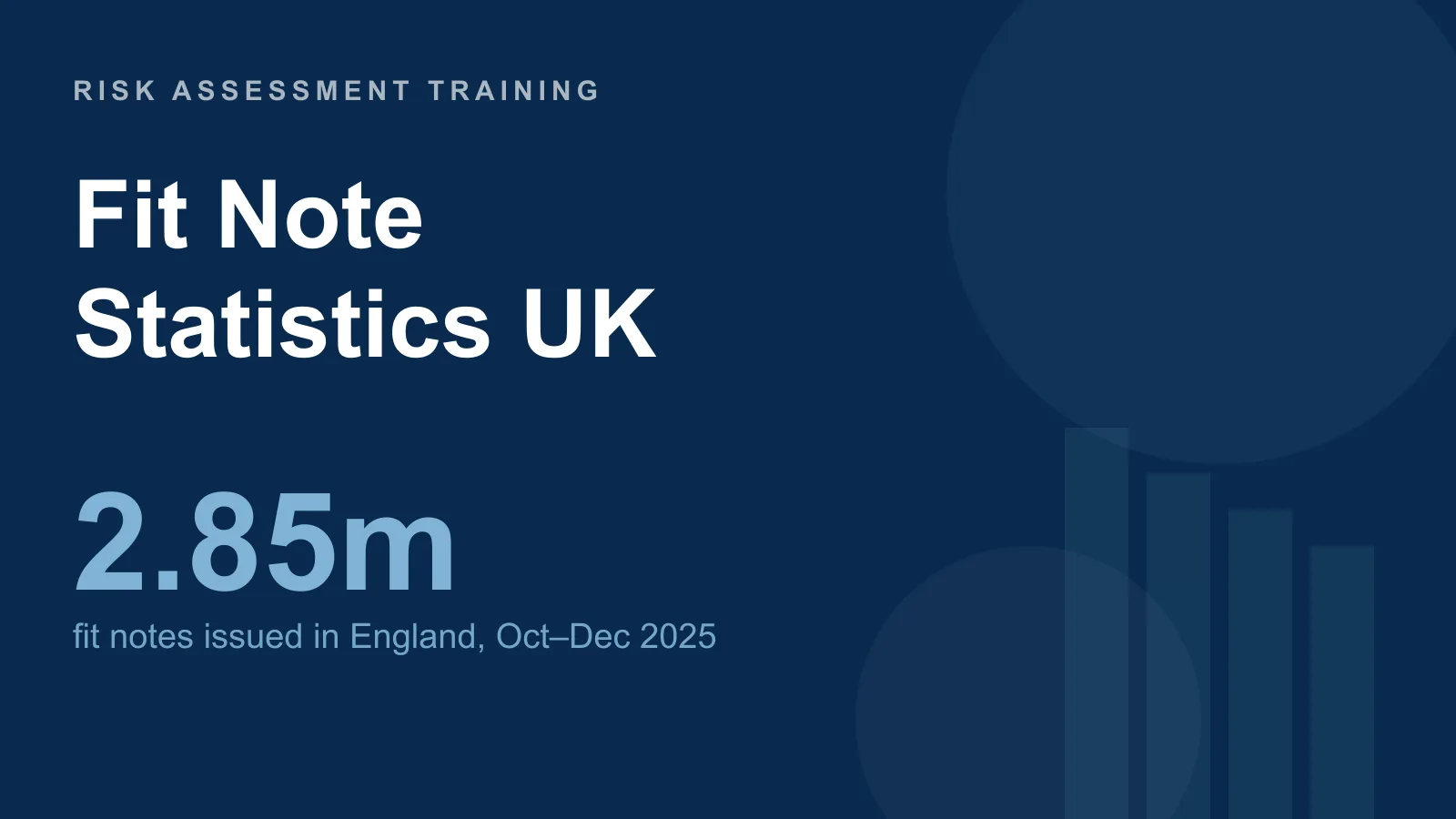
GP practices in England issued 2.85 million fit notes in a single quarter — October to December 2025 alone — and analysis of the wider system suggests around 93% of them simply tell the patient they are “not fit for work”, with no adjustments recommended. This page pulls together the UK’s fit note statistics — how many are issued, how long they run, how the numbers have grown, and what the 2026 reform agenda means for employers — in one fully cited reference.
The figures come primarily from NHS England Digital’s quarterly Fit Notes Issued by GP Practices series, mirrored on GOV.UK, together with the Department for Work and Pensions’ 2026 fit note reform materials and the Policy Exchange appraisal of the system. Every number is linked to its source at the end of the page. Scope note: these are GP-issued fit notes in England only — the NHS Digital series does not cover Scotland or Wales — and this page deliberately sticks to certification behaviour rather than overall sickness-absence rates or work-related ill-health counts, which we cover separately.
Key facts and figures
- 2,853,624 fit notes were issued by GP practices in England in Q3 2025-26 (Oct–Dec 2025), down 0.5% year-on-year.
- 42.3% of those Q3 fit notes ran for 5 weeks or longer — 1,207,801 notes.
- ~93% of fit notes are signed “not fit for work” with no adjustments recommended (Policy Exchange, 2024).
- 71% of fit notes issued between April 2021 and December 2023 contained no diagnosis.
- 5.3m → 11m+ — annual fit note volume roughly doubled from 2015/16 to 2022/23.
- ~40,000 people were signed off on a fit note every working day in 2025 (Centre for Social Justice).
- 3,077 vs 1,832 fit notes per 100,000 patients — the highest (North West) and lowest (London) regional rates in Q3 2025-26.
- £3 million backs the first-year WorkWell fit note reform pilots across 4 sites (DWP, 2026).
These are the latest figures available as of July 2026. NHS England Digital refreshes the fit note volume, the 5-weeks-or-longer share and the regional rates every quarter (published January, April, July and October), and this page is updated when a new release lands or the reform figures move.
How many fit notes are issued in the UK each year?
2,853,624 fit notes were issued by GP practices in England in the quarter from October to December 2025 (Q3 of 2025-26), according to NHS England Digital’s December 2025 release. That was down by 14,935 notes, or 0.5%, on the same quarter a year earlier — a rare year-on-year dip in a series that has trended firmly upwards for a decade.
Those notes came from 1,172,470 fit note episodes in the quarter (a run of notes for one continuing spell of ill health), which was actually up 19,148, or 1.7%, year-on-year. In other words, roughly the same number of people were being certified across slightly more episodes, with each episode averaging a little over two notes. The immediately preceding quarter, July to September 2025 (Q2 2025-26), saw 2,708,049 fit notes, itself down 0.6% year-on-year.
Scaled up, the annual picture is stark. The Centre for Social Justice’s 2025 analysis put the yearly total at around 11 million fit notes, equivalent to about 40,000 people being signed off every working day. That headline is what has driven the “sick note culture” debate — and it is the growth curve, more than any single quarter, that has put the fit note on the political agenda.
What percentage of fit notes say “not fit for work”?
Around 93% of fit notes are signed “not fit for work” with no workplace adjustments recommended, according to Policy Exchange’s 2024 appraisal of the system, Not Fit for Purpose. That figure is the crux of the reform argument. The fit note was introduced in 2010 precisely so that a GP could tick “may be fit for work” and suggest adjustments — a phased return, altered duties, amended hours, workplace adaptations — instead of the old binary sign-off. In practice, the “may be fit” option is used on only a small minority of notes.
The picture on diagnosis is just as striking: 71% of all fit notes issued between April 2021 and December 2023 contained no recorded diagnosis at all. Where a diagnosis was recorded, mental and behavioural disorders were the single largest category at 37% (we cover the workplace-stress side of that story on our work-related stress statistics page). The combination — a note that names no condition and recommends no adjustment — is what critics mean when they say the current fit note functions as a “permission slip” to be absent rather than a plan to get back to work.
For employers, that has a direct practical consequence. A note that simply certifies “not fit for work” gives an HR team or line manager almost nothing to act on. It is one reason absence-management best practice leans so heavily on the employer’s own return-to-work conversations, occupational-health referrals and a documented stress risk assessment where the cause is work-related — because the fit note itself rarely supplies the detail.
How long can a fit note last, and how many run for 5 weeks or more?
1,207,801 fit notes (42.3%) issued in Q3 2025-26 ran for 5 weeks or longer, according to NHS England Digital’s December 2025 release — down very slightly from 42.7% in the same quarter of 2024-25. The share had been higher still in the previous quarter: 44.2% of Q2 2025-26 fit notes (1,196,189 notes) were for 5 weeks or more, up from 44.0% a year earlier.
There is no statutory maximum length for a fit note. A GP can certify any period they consider clinically appropriate, though for the first six months of a condition a note cannot cover more than three months at a time. The 5-weeks-or-longer band matters because it captures the longer spells — the ones most likely to tip into long-term absence, and the ones where an employer’s duty to consider reasonable adjustments and manage the case actively is at its sharpest. Policy Exchange found that of people given a long (5-week-plus) fit note, roughly 20% did not return to work at all.
The table below sets out the headline volumes from the two most recent NHS Digital quarters.
| Measure | Q3 2025-26 (Oct–Dec 2025) | Q2 2025-26 (Jul–Sep 2025) |
|---|---|---|
| Fit notes issued | 2,853,624 | 2,708,049 |
| Year-on-year change | −14,935 (−0.5%) | −14,989 (−0.6%) |
| Fit note episodes | 1,172,470 | — |
| Notes for 5 weeks or longer | 1,207,801 (42.3%) | 1,196,189 (44.2%) |
| 5-week share, prior year | 42.7% | 44.0% |
How has fit note volume changed over time?
Annual fit note volume roughly doubled in seven years — from about 5.3 million in 2015/16 to more than 11 million in 2022/23, on Policy Exchange’s figures. That doubling, rather than any single quarter’s total, is what turned the fit note from an administrative footnote into a headline. The two most recent NHS Digital quarters both edging down year-on-year hints that the curve may finally be flattening, but a couple of quarters is not yet a trend, and the annual total remains at historically high levels.
Two cautions apply when reading the long series. First, the way the data has been collected and coded has changed over the years, so very long-run comparisons should be treated as indicative rather than exact. Second, a rising count of fit notes is not, on its own, evidence of rising fraud or malingering — it reflects an older workforce, longer NHS waiting lists keeping people in limbo, and the fact that a fit note is currently the only formal route back to work. That is exactly the ambiguity the 2026 reform programme is trying to resolve.
Which regions issue the most fit notes?
The North West had the highest regional rate in Q3 2025-26, at 3,077 fit notes per 100,000 registered patients, while London had the lowest at 1,832 — a gap of roughly 1.7 times between the top and bottom regions. Expressing the data as a rate per 100,000 patients (rather than a raw count) strips out the effect of population size, so the spread reflects genuine differences in health, demographics and local labour markets rather than simply where more people live.
For a national employer, the regional variation is a reminder that absence patterns are not uniform across a workforce. A distribution centre in the North West and a head office in London can sit within the same company and the same policies, yet face materially different rates of certified absence — which is one argument for measuring and managing absence locally rather than assuming a single company-wide baseline.
Is the fit note system being reformed in 2026?
Yes — a fit note reform programme was set out in 2026, and it is the reason these statistics matter beyond the NHS. On 20 May 2026 the Department for Work and Pensions announced that the “broken” fit note system would be overhauled, backing a first wave of WorkWell pilots with £3 million in their first year across four sites, covering up to 100,000 appointments, within a wider WorkWell programme aiming to reach 250,000 people. The central idea is to shift the conversation away from a GP’s “not fit for work” sign-off and towards specialist support that focuses on what someone can do.
The professional appetite for change is clear in the DWP’s May 2026 Fit Note Reform: Call for Evidence results. Only 29% of primary-care clinicians agreed that issuing fit notes is a good use of GP time, against 61% of clinicians in secondary care. Employers were unconvinced by the current process too: about 66% of surveyed employers found it ineffective — yet 82% of patients found it effective, a split that captures the whole tension in the debate. What is efficient for the person receiving the note is not necessarily useful to the employer who has to manage the absence.
The table below summarises the reform-sentiment and scale figures.
| Reform measure | Figure | Source / period |
|---|---|---|
| Primary-care clinicians who back fit notes as a good use of GP time | 29% | DWP Call for Evidence, 2026 |
| Secondary-care clinicians who agree | 61% | DWP Call for Evidence, 2026 |
| Employers finding the process ineffective | ~66% | DWP Call for Evidence, 2026 |
| Patients finding the process effective | 82% | DWP Call for Evidence, 2026 |
| WorkWell pilot funding (year one) | £3m across 4 sites | DWP, May 2026 |
| Appointments covered by pilots | Up to 100,000 | DWP, May 2026 |
| Wider WorkWell programme reach | 250,000 people | DWP, May 2026 |
None of this changes an employer’s current legal position: a fit note is still the recognised medical evidence for statutory sick pay purposes after seven days, and the duty to consider reasonable adjustments and to risk-assess work-related hazards is unchanged. But the direction of travel is towards notes that say more about capability and less about incapacity — which, for the first time, would give employers something concrete to act on.
What does this mean for employers and absence management?
The single most useful takeaway is that the fit note, as it stands, is a poor source of the information an employer actually needs. With around 93% of notes offering no adjustments and 71% recording no diagnosis, the burden of understanding an absence — and of planning a safe, supported return — sits with the employer, not the certificate. Good absence management fills that gap with structured return-to-work interviews, occupational-health input where appropriate, and clear internal records.
It also reinforces why prevention matters. Where the underlying cause of absence is a workplace hazard — from manual handling to work-related stress — a competent, up-to-date risk assessment is both a legal duty and the most direct lever an employer has on the numbers above. You cannot control how a GP writes a fit note, but you can control whether the risks that generate long-term absence were identified and managed in the first place.
Frequently asked questions
How many fit notes are issued in the UK each year?
GP practices in England issued 2,853,624 fit notes in a single quarter (October to December 2025), and the Centre for Social Justice estimated around 11 million fit notes were issued across 2025 — roughly 40,000 people signed off every working day. The NHS Digital series covers England only; Scotland and Wales are not included.
What percentage of fit notes say “not fit for work”?
Around 93% of fit notes are signed “not fit for work” with no adjustments recommended, according to Policy Exchange’s 2024 analysis. The alternative “may be fit for work” option — which lets a GP suggest a phased return or altered duties — is used on only a small minority of notes.
How long can a fit note last, and how many run for 5 weeks or more?
There is no fixed maximum, though for the first six months of a condition a single note cannot exceed three months. In Q3 2025-26, 42.3% of fit notes (1,207,801) ran for 5 weeks or longer; the figure was 44.2% in the preceding quarter. Policy Exchange found roughly 20% of people given a long fit note did not return to work.
Is the fit note system being reformed or scrapped in 2026?
It is being reformed, not scrapped. In May 2026 the DWP announced an overhaul, backing WorkWell pilots with £3 million in year one across four sites (up to 100,000 appointments) as part of a programme targeting 250,000 people. The aim is to move away from a simple “not fit for work” sign-off towards support focused on what a person can do.
Do fit note statistics cover the whole UK?
No. NHS England Digital’s Fit Notes Issued by GP Practices series covers England only, and reflects notes issued by GP practices using the electronic system. Scotland and Wales are not part of this series, and it does not capture fit notes issued in hospitals or by other clinicians.
Related guides
- Work-Related Stress Statistics UK: HSE Facts & Data
- Risk Assessment Statistics UK: Compliance Facts & Data
- HSE Enforcement Statistics UK: Fines, Prosecutions & Notices
- How to carry out a stress risk assessment
- What is a risk assessment? A guide to UK workplace law
Sources & references
- NHS England Digital — Fit Notes Issued by GP Practices (quarterly statistical series)
- NHS England Digital — Fit Notes Issued by GP Practices, December 2025 (Q3 2025-26)
- GOV.UK — Fit Notes Issued by GP Practices, England, December 2025 (statistics release)
- GOV.UK / DWP — Broken fit note system to be overhauled (news release, May 2026)
- GOV.UK / DWP — Fit Note Reform: Call for Evidence, Results (May 2026)
- Policy Exchange — Not Fit for Purpose: an appraisal of the fit note system (2024)
- Pulse Today — Calls to end GP-issued fit notes after 40,000 per day issued in 2025 (Centre for Social Justice analysis)
Fit notes tell you someone is off — a good risk assessment stops the absence starting. Train your team to spot and control the workplace hazards behind long-term sickness.
Explore the Risk Assessment Training course →
Mark writes about workplace health & safety, risk assessment and accredited online training for Risk Assessment Training, part of Online CPD Academy.